The following is a translated and edited version of an article by Bálint Barna, originally published in Hungarian in Parókia. Translated by Ildikó Antal-Ferencz.
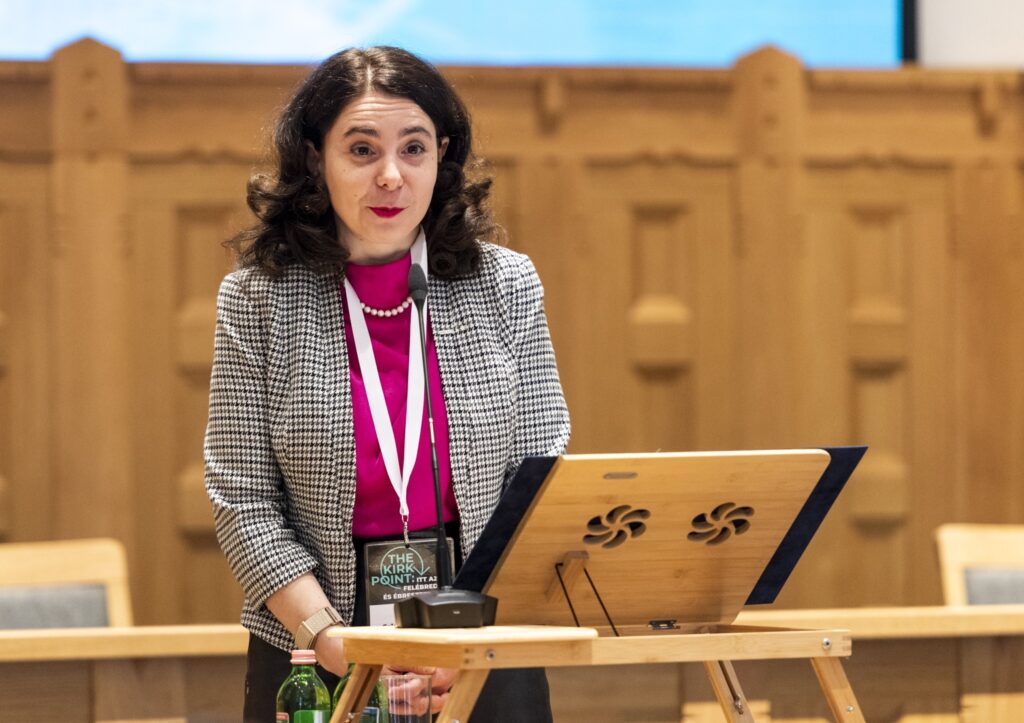
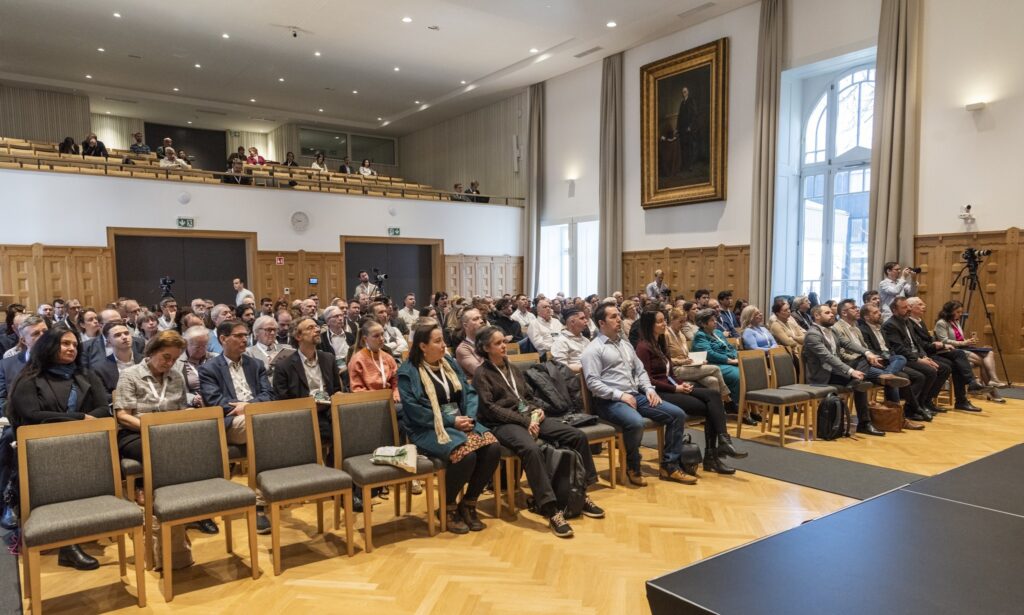
The first NEXT conference of the Mission Academy took place on 28 February 2026 at Ráday House in Budapest. It was co-organized by the Reformed Church District of Dunamellék, and its aim was to highlight that global Christianity has reached a turning point in history, and that it matters greatly how it responds to the new era. In her opening remarks, Flóra Szkordilisz, an elder of the Őrmező congregation and one of the founding members of the Mission Academy, explained that their organization, established in December 2024, seeks to address both Christian brothers and sisters and the wider world by drawing on the cultural strength of the Reformed tradition, bearing witness to the Redeemer in both word and deed.
Recognizing Grace Through Light
At the opening devotion, Bishop of the Reformed Church District of Dunamellék Zoltán Balog preached on the basis of John 12:34–36. According to the passage, confusion arose among the Jews about how Jesus could say that the Son of Man must be lifted up if, according to the Scripture, Christ remains forever. ‘While you have the light, believe in the light, that you may become children of light!’ Jesus replied to them. The bishop explained that the Scripture does not immediately resolve the crowd’s confusion. Moreover, the ‘lifting up’ can simultaneously refer both to a man hanging on a tree and to glorification, which makes understanding even more difficult.
‘How can these two belong together? Those who discover this duality may recognize in it the grace of God. For this we need the light, so that we may understand the Scripture, and afterwards be able to read the world around us through it as well,’ said Zoltán Balog. ‘The eternal appears within finite history, in a single person. The concentrated essence of God’s will radiates out into the world through the Cross. Jesus brings an end to impersonal religion, and we must allow this to happen within ourselves as well. From this, a new order of life may be born after liberation.’ He added that from the children of light, a community of contrast emerges in relation to the darkness of the world.
Reaching a Turning Point
Reformed minister and President of the Mission Academy Miklós Pocsaji described the murder of Christian activist Charlie Kirk as a turning point and made three assertions:
- A radical cultural transformation is taking place.
- This transformation affects Christian Western civilization.
- The other six civilizations are undergoing renewal and religious revivals.
In his view, this means we must move beyond the denial of reality, because only on the ground of reality can we move forward. He spoke about the relationship between the Church and culture, explaining that at present the Church exists within culture and the boundaries are blurred, as they can permeate one another. However, he added that in the deeper layers of culture, there always lies the question of what we believe about humanity and about God—something Christianity addresses on theological foundations.
‘The age in which we live is no longer indifferent to Christianity but hostile’
Referring to the Apostle Paul, the speaker explained that throughout the history of the Church there has always been a kind of spiritual struggle, and today as well we must tear down ‘arguments that conceal God’. ‘The age in which we live is no longer indifferent to Christianity but hostile. The dividing line within the Church lies in the fact that some have already understood this, while others still believe that we live in an indifferent world,’ he said. Among the necessary responses he listed awareness, rebellion, resistance, and offence. In his view, we must simultaneously remain relevant and penetrate culture while also building a counter-culture, even if the two appear contradictory. According to Miklós Pocsaji, they are not opposites but rather a paradox that may become a driving force.
The Importance of Remembering and Awakening
In Western civilization, we have forgotten who and what we are and what our problem is, and we are seeking answers in the wrong place: within ourselves, stated evangelical theologian and blogger Ádám Szabados in his lecture.
Quoting Abraham Kuyper, the speaker explained that in the struggle between Calvinism and modernism, the churches have become exhausted and fallen asleep, forgetting their responsibilities towards humanity. In his view, in order to understand what has infected the churches, we must first identify the diseases present in culture, and only the correct diagnosis can lead to effective remembrance, for we must remember. Ádám Szabados also sees a difficulty in the fact that when culture changes, some Christians still respond to those changes from an earlier stage, in which they remain stuck.
Regarding the diagnosis, he explained that the first root problem is that humanity has replaced God as the starting point, and the second is that, as a result, humanity’s problems have shifted from vertical to horizontal. ‘Horizontal thinking deprives us of the possibility of God’s glory and removes us from beneath God’s wrath, whereas the problem of sin is vertical, for which the death and resurrection of Christ on the cross provide the solution,’ he said.
‘When culture changes, some Christians still respond to those changes from an earlier stage, in which they remain stuck’
‘Revival must begin within the Church. Not within particular denominations, but among God’s people. For this, above all, we need the Holy Spirit of God. But afterwards, we must reflect on the symptoms of the disease and on the assumptions behind them, also carrying out the necessary intellectual work. We must return to complete obedience to the Word. Only that Christianity will prevail which takes up the cross.’
Strengthening Ourselves in Communities
Columnist Rod Dreher, author of The Benedict Option, stated that in his lecture, he wished to outline the present situation and the strategic steps that follow from it. He emphasized that we should not seek meaning in politics but rather in our denominations, schools, and families. ‘Some critics of my book believe that in The Benedict Option, I advise Christians to withdraw from public life. That is not true. I merely draw attention to the fact that we must see the world around us clearly, and to do this, we must be deeply rooted in Christian teaching. Nothing we struggle for matters if, in the meantime, we lose our faith.’ In his view, our churches, schools, and families must be strengthened in Christ so that we do not follow the path of some Western denominations.
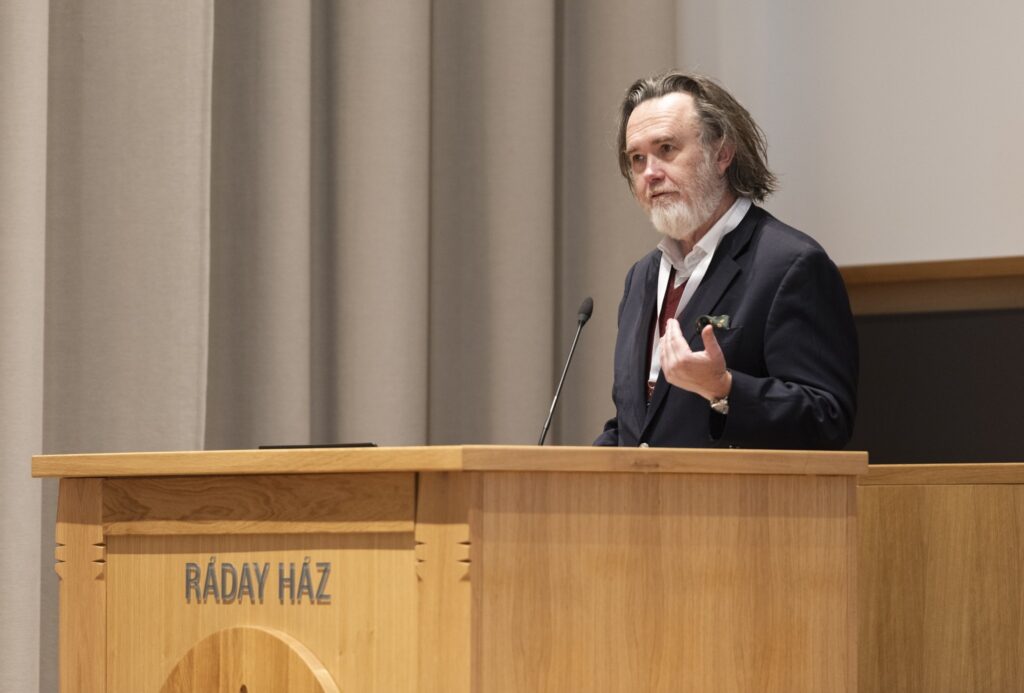
Most of our children are growing up in a digital reality, the speaker pointed out, adding that what we pay attention to shapes our perception of reality. The way digital media shapes our thinking is far more important than the information it conveys: it fragments attention, makes concentration more difficult, weakens traditional communities, and adapts reality to desires.
‘We must strengthen the communities in which we meet each other personally and face to face. We must place great emphasis on prayer in order to remain in a relationship with God. Let us not allow politics to become more important than our faith. It is important to speak with those with whom we disagree. We must prepare ourselves to suffer for our faith. Let us be disciples, not merely admirers of Jesus!’ Rod Dreher listed the necessary steps.
Debates and Reflections
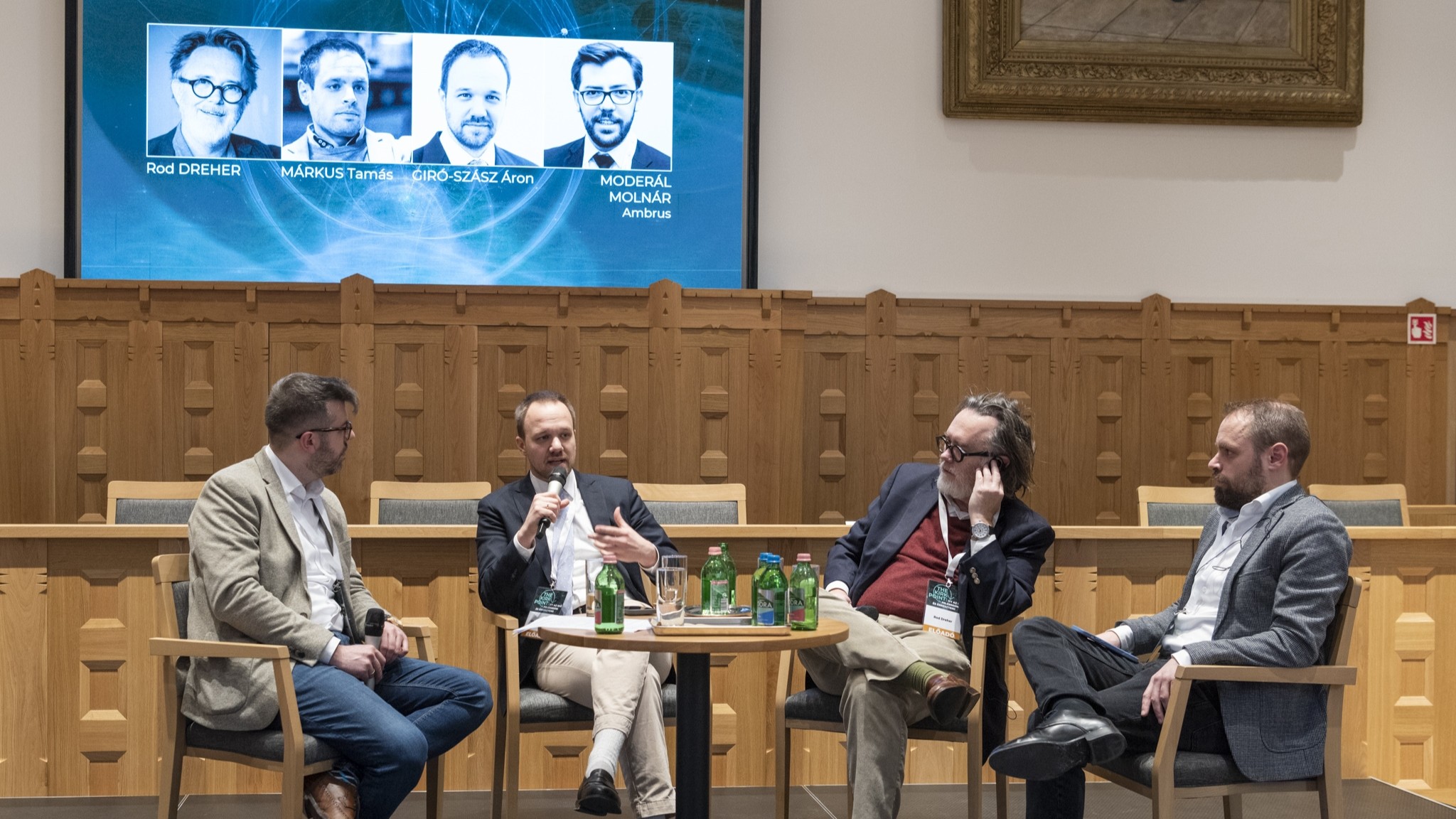
After the lectures, the three speakers took part in a discussion moderated by Ambrus Molnár, minister responsible for the education of pastors in the Reformed Church District of Dunamellék. Regarding the Hungarian context, it was noted that we are simultaneously part of Western culture and also something of an island that is not isolated from its influences. Miklós Pocsaji explained that only a small proportion of Hungarian society regularly attends church and that the average Hungarian is rather individualistic, so there is plenty of work to be done. Responding to the issue of authenticity, Ádám Szabados emphasized that we must ask what our Lord has sent us to do and then fulfil that calling. Rod Dreher pointed out that in a disintegrating world, many young people seeking stability are moving towards more traditional denominations and congregations, which presents an opportunity.
In the second discussion, the participants spoke about freedom of speech, important issues for congregations, and liberation from self-censorship. The moderator was again Ambrus Molnár; his discussion partners were Rod Dreher, lawyer and founding president of the Axióma Centre Áron Giró-Szász, and minister and president of the Evangelical Group Tamás András Márkus.
‘We must make others understand that the meaning of life is not the maximization of our happiness,’ said Áron Giró-Szász, who sees it as a problem that we do not have biblical and free reflection on everything and that there are taboo subjects. ‘We must find a civilizational framework for speaking out, but these cannot be limited by another person’s sense of comfort.’
Freedom of speech is under serious threat in several European countries, even though it still remains one of the most important fundamental freedoms, Rod Dreher argued. He added that Charlie Kirk had the courage to say what he truly believed. That makes a huge difference. In his experience, pastors and priests generally do not dare to speak about sex or transgender issues, even though there are believers who would expect guidance in these matters. Regarding authenticity, he explained that when others see the integrity with which we live our lives, it has a far greater impact than our words. ‘We fear God alone,’ he said.
‘The restriction of freedom of speech begins when elites establish a mainstream, and this may create an inner pressure within us towards self-censorship. In this respect, Charlie Kirk’s courage was liberating,’ added Tamás András Márkus. Concerning taboo topics, he said there are differences between denominations and congregations in how these are taught, which is why he sees the need for an official position so that the same teaching can be presented about them. ‘It is important to note that Christians are not fetishists of suffering; we too are seekers of happiness, but ultimate happiness is found in Christ,’ he emphasized.
Related articles:
At a time when public debate is increasingly polarized and superficial, Hungarian Conservative remains committed to depth, intellectual honesty, and independent conservative thought.
Producing high-quality journalism requires resources. Your contribution helps us expand our coverage, reach new audiences, and keep our content accessible.

Please consider supporting our mission.