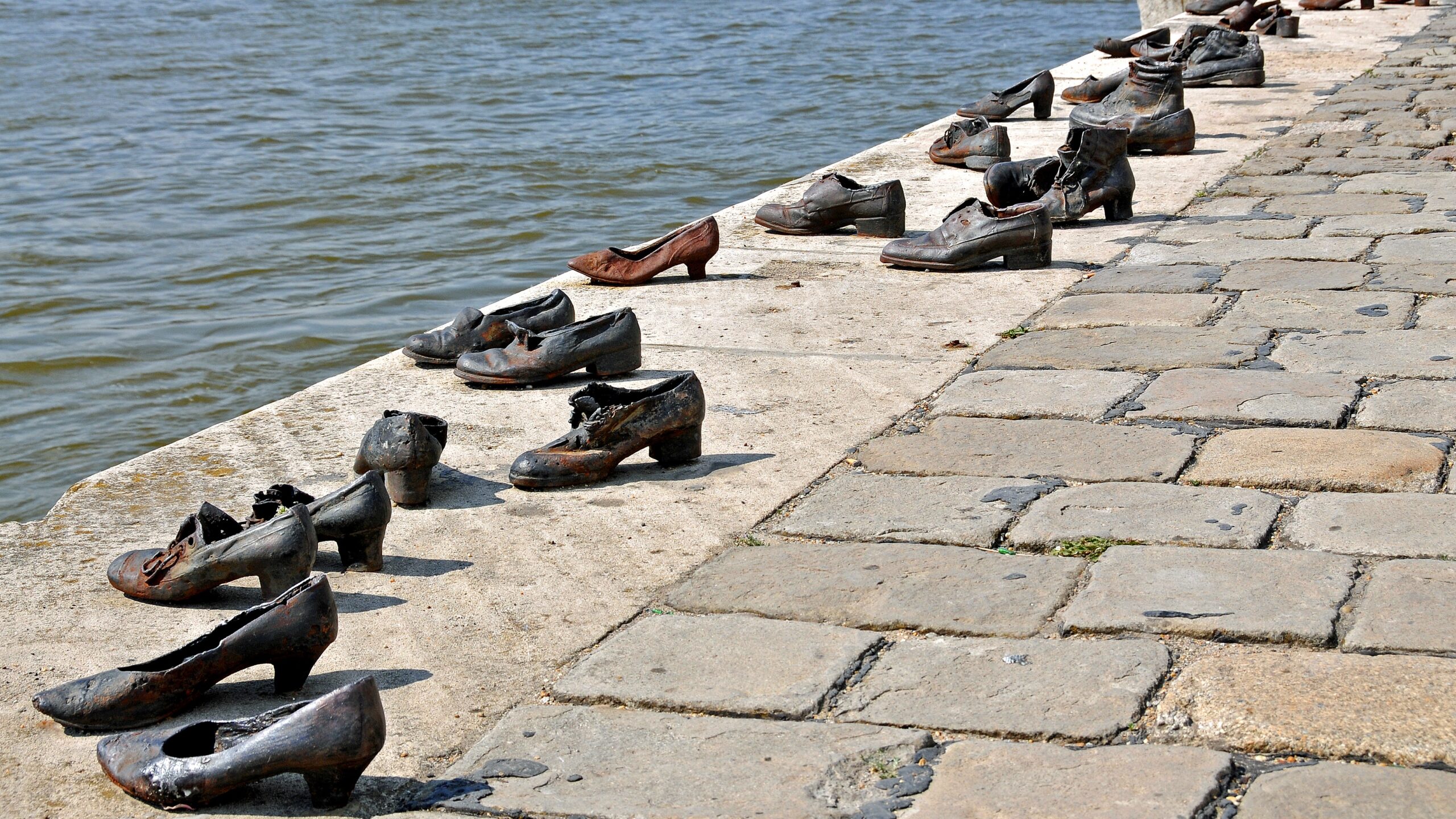
Created in 2005 by film director Can Togay and sculptor Gyula Pauer, the memorial recalls the Arrow Cross terror of 1944–45, when Jews were forced to remove their shoes before being shot into the Danube. The shoes, once valuable wartime possessions, were taken and often reused or sold by the perpetrators.
The memorial stands today as one of Budapest’s most visited Holocaust sites, where candles, stones, and flowers are regularly placed in remembrance.
Childhood Memories
In his recollection, Can Togay evokes in a personal and deeply moving way the experience that later led to the creation of the ‘Shoes on the Danube Bank’ memorial. Among his childhood memories, particularly, are the stories of people murdered on the banks of the Danube, a feeling which he is still able to recall to this day.
This personal experience and historical memory became the foundation of a shared idea, which he realized together with sculptor Gyula Pauer. The aim of the work is not only remembrance, but also the act of bringing a suppressed, painful fragment of urban and national memory out of obscurity.
In Can Togay’s words, the memorial is an important testimony of Budapest’s collective memory: proof that the city does not surrender to forgetting, and is capable of confronting even the most difficult chapters of its past.
‘Uncle Instalment’
Gyula Pauer’s recollection adds a particularly strong personal dimension to the intellectual background of the ‘Shoes on the Danube Bank’. The artist experienced the end of the Second World War as a four-year-old child, together with his parents, in an air-raid shelter in Budapest. As he writes, he understood very little of the events outside at the time, from news reports he only formed an impression that the retreating Germans were being pursued by Soviet forces, while the city was under bombardment and the Arrow Cross were shooting people into the Danube.
‘The city does not surrender to forgetting, and is capable of confronting even the most difficult chapters of its past’
The return home after the war did not bring immediate understanding either. His father asked him to keep silent about a man hiding with them, called ‘Uncle Részlet’ (részlet meaning ‘instalment’, a reference to the fact that they had bought furniture from him on instalments). The story only gradually acquired its true meaning later, when the family met the man again, who gratefully thanked them for the shelter.
In his recollection, Pauer emphasizes that the tragedy of the Holocaust and the persecution of Jews only slowly became a personally processable experience for him, later becoming one of the central themes of his artistic work. The creation of the ‘Shoes on the Danube Bank’ was the result of a longer inner process, in which a conversation with an old friend and a suggestion from Can Togay also played a decisive role. In the artist’s words, the final form of the memorial is the result of a kind of personal and collective work of memory.
Holocaust Remembrance Day in Hungary
Hungary has officially observed the Holocaust Remembrance Day since 2001 on 16 April, marking the beginning of the ghettoization of Hungarian Jews in 1944. The initiative, introduced by then-education minister Zoltán Pokorni, was intended to ensure that schools and public institutions regularly confront this chapter of national history.
From the spring of 1944, following the German occupation and with the cooperation of Hungarian authorities, approximately 437,000 to 450,000 Jewish people were deported from Hungary, the vast majority of them to the Auschwitz-Birkenau concentration and extermination camp. The deportations took place at an extremely rapid pace: the Jewish communities of rural Hungary were almost entirely destroyed within just a few months.
In total, the number of Hungarian victims of the Holocaust is estimated at around 550,000 to 600,000 people, including not only those deported, but also those who died in forced labour service, in ghettos, during the Arrow Cross terror in Budapest, and on death marches.
This tragedy represents one of the greatest human losses in Hungarian history, profoundly shaping not only a community but also the nation’s historical and moral memory.
Related articles:
At a time when public debate is increasingly polarized and superficial, Hungarian Conservative remains committed to depth, intellectual honesty, and independent conservative thought.
Producing high-quality journalism requires resources. Your contribution helps us expand our coverage, reach new audiences, and keep our content accessible.

Please consider supporting our mission.