The following is an adapted version of an article written by Bettina Felde-Tóth, a research fellow at the Europe Strategy Institute of the University of Public Service, originally published on the Five Minutes Europe blog of Ludovika.hu.
Green roofs and green walls were previously experimental urban design elements with undeniable aesthetic qualities. Today, however, they have been proven to be scalable nature-based solutions for urban climate adaptation, biodiversity protection, energy efficiency, and population well-being.
A recent study by the European Commission’s Joint Research Centre (JRC) examined how green roofs and green walls contribute to urban climate resilience and energy efficiency, as well as serving as an aesthetic element in the urban landscape. The study also highlights how greening the built environment directly supports the EU’s nature restoration and biodiversity goals.
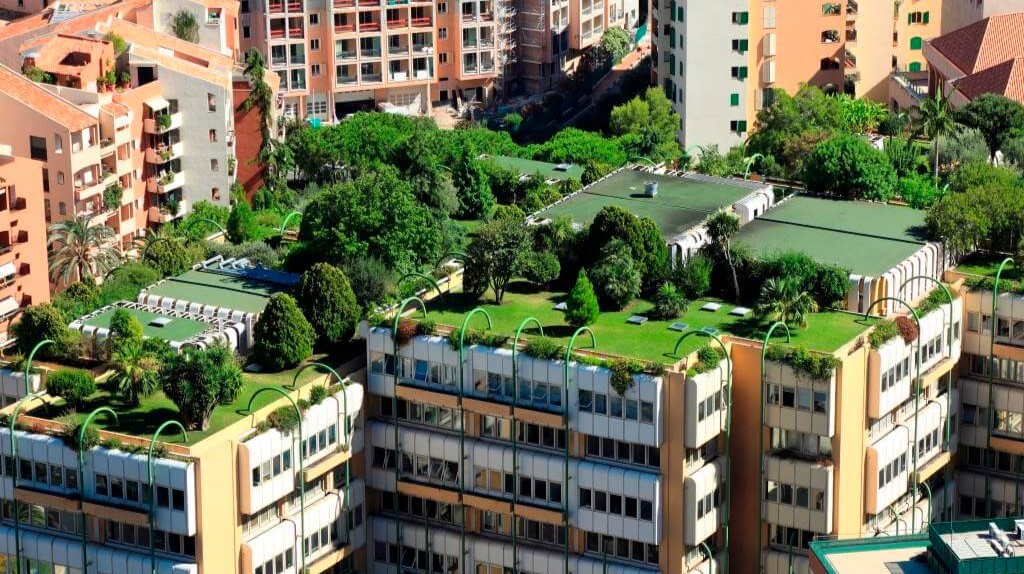
The essence of green roofs and green walls is to transform unused roof and façade surfaces into urban green infrastructure. This is especially important in densely built-up neighbourhoods, where there is little space available for creating new parks. According to the report, extensive green roofs are the most common because they require less maintenance and are cheaper to install. In contrast, intensive roofs and green walls can create greater biodiversity, microclimatic, and social value when associated with appropriate planning and maintenance.
One of the most important health benefits of green roofs and green walls is the reduction of heat stress. Urban heat islands pose a particular risk to the elderly, the chronically ill, children, and people living in uninsulated or poorly insulated apartments. Green areas reduce environmental heat load by evaporation and shading, which can indirectly reduce the risk of heat-related illnesses and deaths. Installations can also improve air quality, reduce dust and some air pollutants, and have noise-reducing and psychological well-being effects.
‘The essence of green roofs and green walls is to transform unused roof and façade surfaces into urban green infrastructure’
But they can have a positive impact not only on society. According to the report, green roofs make a measurable contribution to stormwater retention, the mitigation of temperature extremes, energy efficiency, and the expansion of urban species habitats. Roofs and façades can also act as ecological corridors, connecting fragmented urban habitats, especially for pollinators and birds. The greatest environmental added value, of course, occurs when green roofs are not isolated investments, but are integrated into the urban green network.
Despite their many positive features, these installations remain very few in Europe’s major cities, which may be due to high investment costs, structural suitability tests, and uncertainty about maintenance. The report therefore recommends hybrid governance models: the public sector can encourage investment through regulation, the private sector can participate in financing, and the public sector or specific civil society communities can contribute to the spread of green roofs and walls through maintenance.
However, the high initial costs can be mitigated if considering the indirect returns. Green roofs can extend the life of roof insulation, reduce cooling energy requirements, relieve the sewerage network, and increase property values.
These interventions can also support the implementation of the EU’s nature restoration and biodiversity strategies. In the case of the former, the goal is to maintain urban green space and canopy cover by 2030 and achieve an increasing trend thereafter. Green roofs contribute to this by creating new green space where there is no more room for expansion at ground level. They support the biodiversity strategy by creating new urban habitats, increasing the number of green spaces, and potentially increasing pollinator numbers. However, the greatest impact can be achieved when green roofs are not seen as decoration, but as a mandatory and supported element of urban green infrastructure.
Related articles:
Click here to read the original article.
At a time when public debate is increasingly polarized and superficial, Hungarian Conservative remains committed to depth, intellectual honesty, and independent conservative thought.
Producing high-quality journalism requires resources. Your contribution helps us expand our coverage, reach new audiences, and keep our content accessible.

Please consider supporting our mission.