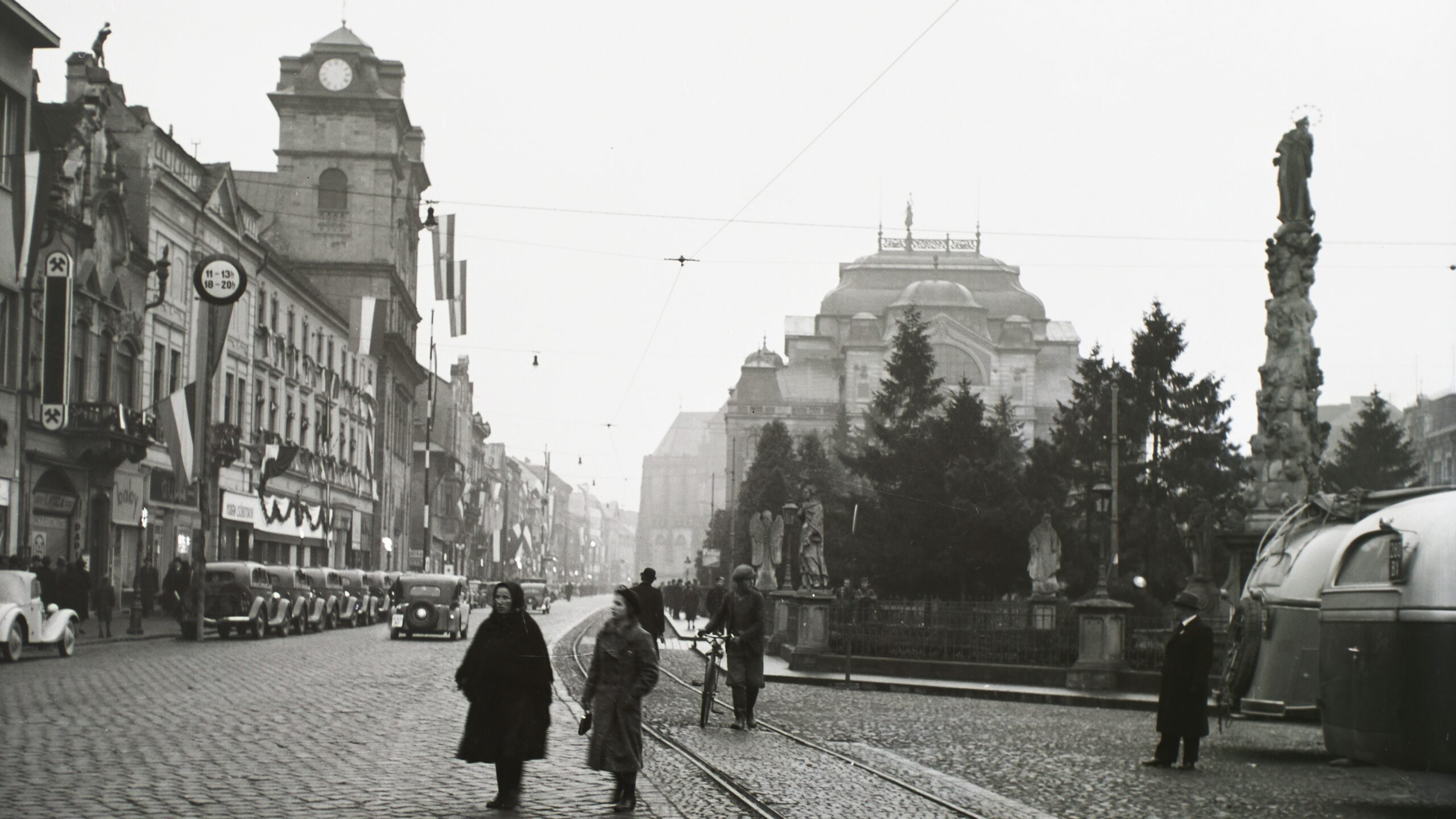
In the midst of the Arrow Cross dictatorship, in January 1945, the few remaining Hungarian newspapers that had been ‘brought into line’ began announcing in articles an upcoming great event: the approaching 48th birthday of Hungary’s ‘Leader of the Nation’ (Nemzetvezető), Ferenc Szálasi. Szálasi had been born on 6 January 1897, in Kassa—a city that was liberated by Soviet forces on 19 January 1945.
The newspaper Kőszegi Hírek wrote about the ‘great day’ as follows:
‘Wherever free Hungarians live, souls celebrate on this day of Epiphany. The birthday of our Leader of the Nation, Ferenc Szálasi, is a special celebration for those who have remained faithful to the ancient traditions, to our historical past, and to the ancestral land of our fathers won and preserved with blood. The celebration had no outward pomp. The difficult historical times did not allow for manifestation in external forms, but all the more for that warm, inner celebration which, throughout the country, turned with heartfelt prayer to the Lord of the Heavens, asking His blessing for the life of the first Hungarian, Ferenc Szálasi.’[1]
On the occasion of the birthday, the Arrow Cross poet Géza Alföldi also published a poem titled The Leader:
‘For the leader must be adored,
[…] without thinking
you set out after him, and if he leads headfirst
into the abyss […]
you do not ask what he wants or why.’[2]
A particularly large event was planned in Kassa. The National Theatre was decorated with Hungarian flags and the emblems of the ‘Arrow Cross Party–Hungarist Movement’, while the lord lieutenant’s (főispán) box was adorned with an Árpád-striped flag. Present were Gábor Gyarmathy, the county lord lieutenant; Major General Béla Tanító, district commander of the Royal Hungarian Army; and József Fazekas, the acting mayor.
At the event, József Oláh, a teacher and the county propaganda chief, delivered a speech in which he said that ‘we do not even wish to celebrate, but merely to devote a few minutes to that Hungarian man who today leads our nation with rock-solid faith and determined, powerful will. We, the people of Kassa, have a special claim to do so. Our Leader of the Nation, our Brother, first saw God’s radiant daylight here in Kassa.’ During the ceremony, the national anthem and the Hungarist March were played from a record; then local actors and actresses performed more Arrow Cross songs and poems.[3]
‘Our Leader of the Nation, our Brother, first saw God’s radiant daylight here in Kassa’
It is an ironic fact that before the birthday commemoration, Gyarmathy and Fazekas attended another event: the funeral of the former mayor of Kassa, László Tost, who was buried earlier that afternoon. Tost was known for his anti-Nazi and anti-Arrow Cross views; he had been shot by Arrow Cross thugs on 2 January and died a few days later. This only compounded the family tragedies, as earlier his son, Lieutenant Colonel Gyula Tost—who had played a major role in the failed attempt of former governor Miklós Horthy to switch sides on 15 October—had committed suicide in the Castle on the 16th. The ‘deceased’ mayor had died ‘under tragic circumstances’, and during his lifetime he had enjoyed the ‘respect’ of the city’s inhabitants, wrote the Arrow Cross press. Gyarmathy also placed a wreath on the grave.[4]
By that time, the Arrow Cross had already held the city under terror for 83 days. After Tost’s death, they murdered Sándor Koczka, a private office employee. The local Arrow Cross press blamed the mysterious deaths on ‘partisans’. Readers could meanwhile reassure themselves that the authorities had recently hanged several partisans on the city’s Main Street.[5]
Several documents concerning these executions have survived in the records of the Arrow Cross Ministry of Justice. Gábor Gyarmathy, the lord lieutenant, wrote a report on the case: according to him, those executed were partisans and deserters. As he wrote: ‘in accordance with the Leader of the Nation’s firm verbal order…I sentenced them to death by hanging as a deterrent example.’
The lord lieutenant also listed the victims by name. First, under the heading of ‘partisan activity’, four Jewish men who had been sent to perform unarmed forced labour (munkaszolgálat): they were Sándor Hatsch, László Hercz, Ábrahám Grün, and Mózes Kohán. Then two Catholic farmers (Mihály Gulyás, András Bruszky) appeared, followed by six military deserters (József Suha, Sándor Fábián, Béla Szerényi, András Stücs [probably Szücs?], Ferenc Cseh, and János Dulinyi). In Suha’s case, Gyarmathy considered it important to note that he was Roma, while in Dulinyi’s case, it was recorded that the victim did not know his own date of birth. The hangings took place on the afternoon of 5 January; the bodies were cut down from the trees lining Main Street only on the 8th.[6]
Interestingly, in connection with the case, the police chief of Kassa, György Horváth, questioned Gyarmathy. Horváth himself had been heavily implicated in the deportations from Kassa; moreover—since the Germans took over the deported Jews only there—virtually all the Jews deported from Hungary passed through his jurisdiction. (Horváth was first sentenced to death by the People’s Court, then his sentence was commuted to life forced labour; he died in 1949.) Before Horváth, Gyarmathy calmly declared that ‘he had passed the sentence, he had carried it out, and he assumed full responsibility for it’, but he also added that Szálasi had told him verbally: ‘Carry out the reprisals first, and the investigation can come afterwards.’[7]
Further details emerged during the questioning. The men had been captured by the Germans and handed over to them. ‘The executions were carried out by two soldiers in civilian clothes requested from and provided by the German SD [Sicherheitsdienst] in Kassa, in such a way that the condemned men, with the noose already placed around their necks, were made to stand on a truck; when the rope had been fastened, the truck drove off and the condemned man remained hanging from the tree. The hanging took place in the presence of passers-by on the street, as well as some members of the F.N.Sz. [Armed National Service, an Arrow Cross paramilitary body] and the Party Service.’
‘Carry out the reprisals first, and the investigation can come afterwards’
Although police officers were present, they merely kept order and simply watched the ‘execution’. The truck used belonged to the Arrow Cross Party Service, and the prisoners had also been guarded by the same organization. Horváth recorded the information and then merely ‘requested’ ‘the Government Commissioner and Lord Lieutenant to refrain from similar procedures until further instructions were received’, which Gyarmathy promised to do.
The report reached the Royal Hungarian Chief Prosecutor’s Office, then based in Győr, which interpreted the hangings without trial as ordinary murder and connected them with the violent deaths occurring daily in Kassa; it therefore initiated criminal proceedings. The story was ultimately closed by the following communication sent to the Ministry of Justice from the Ministry of Defence on 2 March 1945: ‘The Leader of the Nation…by his act of clemency has ordered that in connection with the executions that occurred in Kassa no criminal proceedings may be initiated against either military or civilian persons, and any such criminal proceedings already under way must be discontinued.’[8] In a sense, the decision was unnecessary, since Kassa was already in Soviet hands by that time; Hungarian authorities would not have been able to conduct the investigation.
Only weeks after the birthday celebrations held in his honour, the regime of Ferenc Szálasi collapsed along with the Arrow Cross terror that had claimed so many lives in cities like Kassa. The victims hanging from the trees of Main Street were soon forgotten by the regime that ordered their deaths, but their fate remains one of the starkest reminders of the lawless brutality of Hungary’s final wartime dictatorship.
[1] Kőszegi Hírek, 13 Jan 1945, p. 3.
[2] Felvidéki Ujság, 5 Jan 1945, p. 3.
[3] Felvidéki Ujság, 9 Jan 1945, p. 3.
[4] Felvidéki Ujság, 9 Jan 1945, p. 3.
[5] Felvidéki Ujság, 8 Jan 1945 and 12 Jan 3 and 8 Jan 2.
[6] Magyar Nemzeti Levéltár Országos Levéltára (Hungarian National Archives, MNL OL), K800, box 3., record group 1., p. 102.
[7] Ibid, p. 103.
[8] Ibid, p. 99.
Related articles:
At a time when public debate is increasingly polarized and superficial, Hungarian Conservative remains committed to depth, intellectual honesty, and independent conservative thought.
Producing high-quality journalism requires resources. Your contribution helps us expand our coverage, reach new audiences, and keep our content accessible.

Please consider supporting our mission.