This is a translated and edited version of the original article.
Beautiful natural surroundings, lakesides, wooden cabins, evening campfires, and camp traditions dating back nearly 150 years. From a European perspective, the four-to-eight-week residential summer camps that were initially popular mainly among Jewish communities in the north-eastern United States, but have since become an integral part of American culture, may seem somewhat unusual. Yet they exist in every state across the USA and are extremely popular—and they are not entirely unfamiliar to Europe either.
Not only because several organizations such as the scouts provide a similarly nature-oriented and community-building experience (although their camps typically last only seven–ten days), but also because traditionally many children spent several weeks with their grandparents in the countryside across Europe, where they could spend time with their cousins and local children while also helping their grandparents. However, nowadays, due to social changes, fewer and fewer parents are able to arrange such family-oriented summer holidays for their children. Of course, staying with relatives is not the same as attending a summer camp, but closeness to nature, spending an extended period away from one’s parents, and developing independence are also integral parts of the experience.
Nowadays, however, the focus shifts to the deliberate development of social skills and, alongside organized activities, to the complete freedom from the internet and digital devices. These considerations have recently become the principal motivation for parents who choose these camps. And there are serious financial considerations as well: these camps cost between $8,000 and $16,000 per child. Unsurprisingly, the overwhelming majority of children attending full-summer camps still come from affluent, upper-middle-class, predominantly white families. Most American parents living on average wages have little choice but to enroll their children in day camps organized by their local municipality or organizations such as the local YMCA. These are by no means inexpensive either, but they are considerably more affordable.
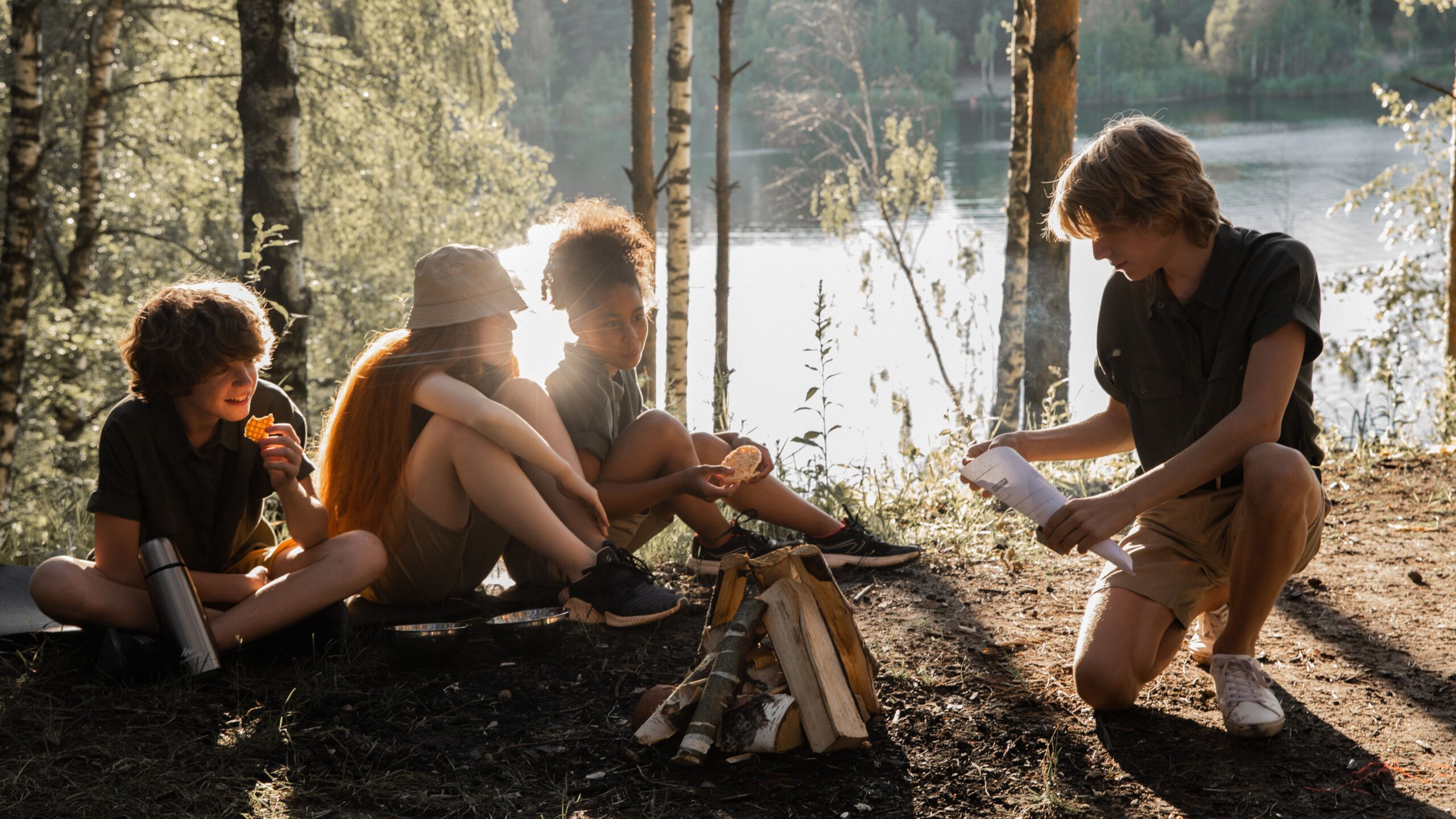
According to the website of one of the major camp operators, more than 21 million campers attend over 20,000 summer camps across North America each year. The vast majority of these camps are still located within relative proximity to the major cities on the East Coast, particularly in the states of New York, Pennsylvania, Connecticut, Massachusetts, Georgia, and the Carolinas. However, camps operate, albeit more sparsely, in every state across the USA. Typically situated in beautiful woodland settings, often on the shores of lakes, these camps host children aged six–17, and employ an international staff made up predominantly of university-aged young adults. Most staff members come from the English-speaking world, although many also arrive from South Africa, Poland, and the Czech Republic, while Spanish, Scottish, Irish, Canadian, German, and French staff members are also common.
‘Camps operate, albeit more sparsely, in every state across the USA’
The aim of these three-to-eight-week (most commonly seven-week) summer camps is to provide children with programs that develop not only their physical abilities, but also their social skills—all while they are away from their parents and in a gadget-free environment. For many children, this is the first time they spend such an extended period away from home. Campers may write letters every day using traditional post, but they are only allowed to speak to their parents by telephone once every two or three weeks, and they meet in person only once during the camp, typically on a weekend halfway through the program. In return, they gain lifelong memories and friendships, which is why so many return year after year. Many children try to practice particular sports for the first time at the camp, while those who grow up in cities often see a clear, star-filled night sky for the very first time there, too.
Traditional residential summer camps offer an exceptionally wide variety of activities. Campers may choose from dozens of different programs, including individual and team sports (often water sports), arts and crafts, theater, music, archery, horse riding, dance, gymnastics, acrobatics, and many more. Some camps operate exclusively for boys or girls, often located next to one another but run independently. So-called rustic camps provide an even more adventurous and nature-oriented experience: accommodation is usually in tents, and some camps have electricity only in designated areas of the campsite.
Denominational Jewish camps are found primarily on the East Coast, where the tradition of organized summer camping began nearly 150 years ago, although numerous Christian organizations also operate camps these days. Even in non-religious camps, the teaching and practice of core human values—such as love, kindness, helpfulness, and acceptance—are an integral part of camp life. The extent to which religion is practiced varies from camp to camp, and belonging to a particular denomination is generally not a requirement either for attending or for working there. Openness and mutual respect, however, are always expected.
Specialized summer camps focusing on sport, the creative arts, or the performing arts enable children to develop their talents in specific fields. Most of these camps are privately owned, and in many cases the camp director is also the owner. Running a summer camp is often a family tradition as well. Many long-established camps are still managed by the families of their founders. Organization-owned camps also encompass a wide variety. Those serving children with disabilities or children with disadvantaged backgrounds are typically operated by non-profit organizations.
‘Specialized summer camps focusing on sport, the creative arts, or the performing arts enable children to develop their talents in specific fields’
Based on my own personal experience, many New Jersey families also send their children to traditional residential camps, usually from the age of seven to nine. In some families, one of the parents attended the same camp as a child; others received invitations to camps organized by families they knew. Some first heard about them from friends who also had children of a similar age, while in other cases the children themselves wanted to join, because their friends were already attending. Reasons may differ, but parents overwhelmingly share the same primary motivation: complete freedom from digital devices. This is something that no other type of camp or childcare arrangement can provide continuously for several weeks—or even for an entire summer. If parents were motivated only by having too little annual leave, the unavailability of grandparents, or the need to keep their children occupied throughout the holidays, then nearby day camps or even an au pair in their own homes would serve the purpose just as well.
For Brian Savage, these camps are particularly attractive because they provide children with a healthy summer experience. He and his wife therefore send their daughter—and later, they hope, their sons as well—to camp knowing that she will not only enjoy herself, but will also benefit both physically and emotionally. Camp offers an excellent opportunity for their daughter to meet new people and try new activities, something she has thoroughly enjoyed over the past three years. Because they know the family who runs the camp personally, they feel reassured that they are entrusting her to people they know and trust, and who will look after her well. Their daughter loves performing, something she is able to do in camp talent shows and theatrical productions. She also thoroughly enjoys the independence that camp provides. Although the camp is extremely well organized and supervision is continuous, it still offers a degree of freedom that she finds especially appealing.
For Susan Feldman, too, the absence of digital devices is the primary reason for choosing these camps. As she explained, children spend the entire summer engaged in activities during which they are free to ‘just be children’. She added that the camp attended by her daughters embraces a culture that promotes inclusion, respect, friendship, tolerance, and kindness. Each year, the camp adopts a theme designed to instill pride in both campers and staff for being members of the community. Previous themes have included bullying prevention, kindness, and the importance of family bonds. Every member of staff receives a themed T-shirt, which is then presented to a camper who has best embodied that particular core value. Weekly ribbon ceremonies are also held, during which campers receive colored ribbons symbolizing different character traits such as cooperation, sportsmanship, and friendship. Awards are also presented each week, including recognition of the Camper of the Week.
For Robyn Sachnoff, the motivation—apart from the fact that her husband and several relatives attended the very same camp in their youth—is to provide her children with the opportunity to play in a safe environment and to explore the world away from home. She also loves the fact that mobile phones must be left behind. Initially, she found reassurance in knowing that her young sons’ older cousins were also attending the camp, as well as in receiving several hundred photographs each day from the camp photographer. In addition, parents may send messages at any time through a dedicated app for an additional fee. However, this is a one-way communication channel only, much like the option offered at other camps to send occasional urgent emails through the camp administration. Her sons particularly enjoy the camp because of the lifelong friendships they have formed, the freedom to spend time as they choose when not participating in organized activities, and the competitions held between camps in the region.
Maria Hunter, who grew up in Europe, regularly attended state-run residential camps as a child, operated by her parents’ employers, where the camp staff consisted primarily of teachers. As the costs of these camps were merely symbolic, they were accessible to everyone. She therefore finds the very high fees charged by American camps regrettable, as they place such experiences beyond reach for many families. This year, she and her husband sent their daughter to camp for the first time, because she wanted to be with her friends and was especially attracted by the strong sense of ‘sisterhood’ that develops there. The parents’ own motivation, however—and the reason they are happy to send her back next year despite the considerable cost—was that the experience clearly benefited her. Spending time in nature, rather than with digital devices, proved to be a genuinely positive experience for her.
Related articles:
Read the original articles here.
At a time when public debate is increasingly polarized and superficial, Hungarian Conservative remains committed to depth, intellectual honesty, and independent conservative thought.
Producing high-quality journalism requires resources. Your contribution helps us expand our coverage, reach new audiences, and keep our content accessible.

Please consider supporting our mission.