The following is an adapted version of an article written by Mátyás Bíró, originally published in Hungarian in Magyar Krónika.
Our first written record of traditional Hungarian cuisine dates back to a 16th-century cookbook written by a chef who cooked for several Transylvanian princes, possibly including István Báthory himself. The book reveals the astonishing variety of dishes served at the tables of princes and nobles. It was published in 1893 by Béla Radvánszky as part of a series entitled Old Hungarian Cookbooks.
We know of a book published in Késmárk in 1601 entitled Cooking of Hungarian Dishes by ‘Lord Sebestyén Thököly’s chef’, that is, Mihály Szent Benedeki. The third Hungarian cookbook of the time, like the first, was written in Transylvania and was the work of Mihály Apafi’s head chef. The first printed cookbook in Hungarian is entitled Booklet of Chef Craft, published in 1698 by Miklós Kis of Misztótfalu in Kolozsvár (today’s Cluj-Napoca, Romania), and it is possible that it was written by one of the Franciscan cooks of Csíksomlyó. It has recently been republished.
We have ample information about the varied cuisine of the royal court from the time of King Matthias, but not from a single cookbook, rather from various historical sources. Ling and pike, rabbit, partridge, pheasant, lamb, game, and peacock, prepared with long or short sauces, saffron, pepper, ginger, and cinnamon—these were the dishes that graced the tables of the rulers. And of course, there was also room for good sourdough breads and cheeses, onions—which the king loved very much—as well as the pastries introduced by Queen Beatrix.
‘We have ample information about the varied cuisine of the royal court from the time of King Matthias’
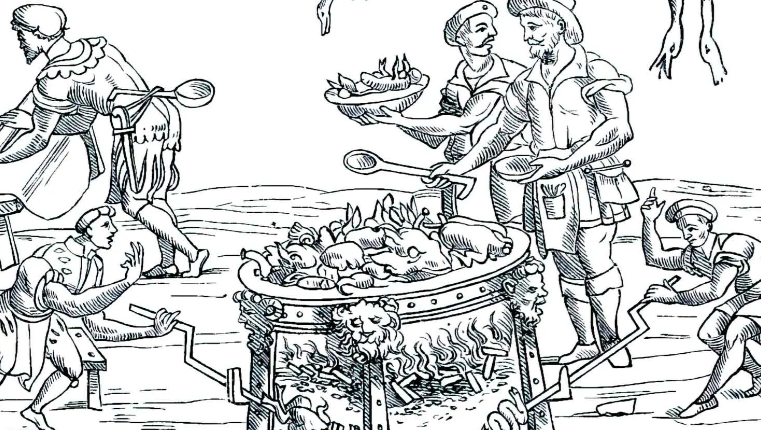
In the 1460s György Veres of Nagyszakács was the master of the royal kitchen, but unfortunately, he only wielded a wooden spoon, not a pen, so no cookbook has survived from him either. However, one of the codices in the Royal Library in Munich contains four recipes from the time of Matthias: two fish dishes, a fried capon cooked in ginger marinade, and a sauce suitable for game, which was made with meat and bread rolls, strained through a sieve, seasoned with vinegar, water, honey, saffron, cloves, and cinnamon.
Looking at the details of the first Hungarian cookbook known today, the manuscript found is a copy from the early 17th century; the front page is missing, and neither the author nor the year of publication is known. The author was probably a chef who worked in the courts of foreign princes and learned to cook in Hungarian kitchens before becoming the head chef of several Transylvanian nobles and princes. The first and main part of the book is ‘The Science of Cooking’, while the second part contains a doctor’s instructions on what foods to prepare for the ill. The book contains nearly 700 recipes, plus 100 dietetic foods, giving us a fairly accurate picture of the eating habits of the Hungarian nobility of the time, their favourite dishes, and almost every important cooking method.
Although potatoes began to become known in Hungary at the end of the 16th century thanks to Boldizsár Batthyány, they only became widely available in the 18th century. Tomatoes appeared even later, in the 1880s, so these two vegetables could not have been included among the ingredients in the recipes of the first Hungarian cookbook.
There are several cooking terms in the text that are no longer used today, such as an archaic expression for small meatballs, plucking the poultry, etc. There is also a figure of speech that is no longer used in kitchens today, which is why its appearance in recipes sounds very strange to us: ‘manure’ the food, that is, sprinkle the meat with a mixture of raisins, almonds, and figs.
This article is based on Károly Ballai’s book The History of the Hungarian Catering Industry.
Related articles:
Click here to read the original article.
At a time when public debate is increasingly polarized and superficial, Hungarian Conservative remains committed to depth, intellectual honesty, and independent conservative thought.
Producing high-quality journalism requires resources. Your contribution helps us expand our coverage, reach new audiences, and keep our content accessible.

Please consider supporting our mission.