We have previously written about the inhumane system of unarmed labour service (munkaszolgálat) during WWII-era Hungary, and how two great Hungarian Jewish writers, Jenő Rejtő and Antal Szerb, perished during their time on forced labour. Another well-known Jewish forced labourer who was drafted from the Castle District (Attila Street 65—today the address of the Office of the Buda Castle Municipality) was the famous Olympic athlete Attila Petschauer.
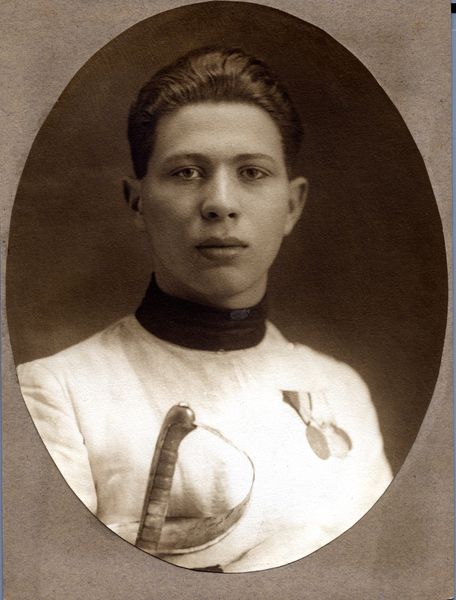
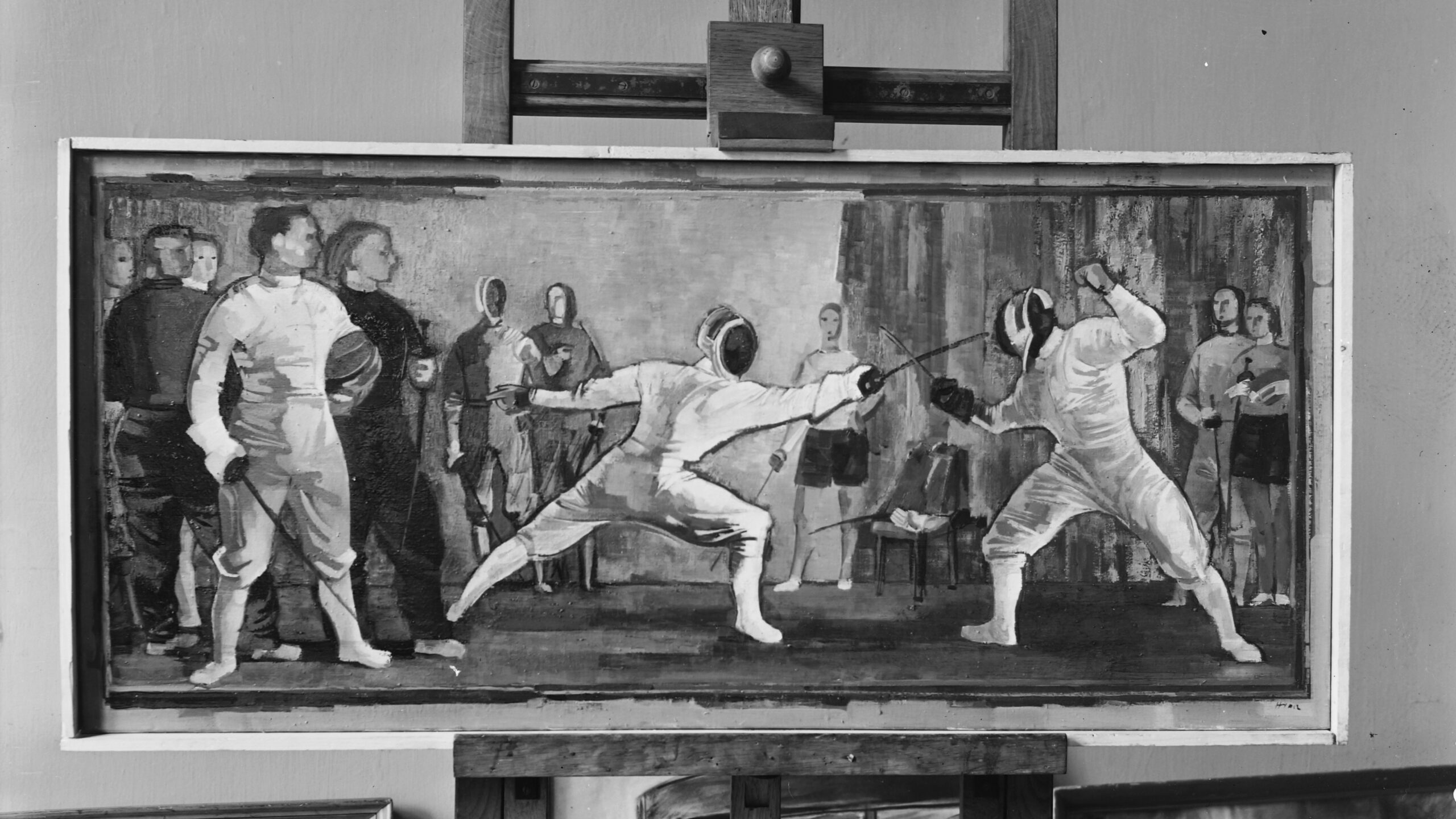
Petschauer was born in Budapest in 1904 and was a talented fencer. He was working towards his law degree when he became a member of the Hungarian Olympic team in 1928 and won a gold medal in team sabre, and then another gold medal in 1932 in Los Angeles, also in team sabre. In 1928, he also won a silver medal in individual sabre. In short, he was at one point one of the world’s top fencers.
A film about him was also made in 1999, Sunshine (A napfény íze). Although István Szabó’s 1999 film does not claim to follow Petschauer’s biography precisely through the character of Ádám Sors, it is still worth clarifying a few points about him. Not only is the story that he was tortured to death as a forced labourer untrue (although he obviously died indirectly as a result of the abuse and hardships he suffered during forced labour service), but it is also a fact that he did not have to convert to Christianity in order to become a member of the Olympic team.
After his sporting successes, he gave several interviews to the liberal Jewish newspaper Egyenlőség, and on such occasions, he always made it clear that he continued to follow the ‘Jewish faith‘. ‘I have always resolutely and devotedly stood up for my Jewish faith!’ he told the paper in 1926, and he reaffirmed this again in 1928 following his Olympic victory.[1]
In the latter interview, we also learn several details about Petschauer. According to the article, ‘as we look around the dark-brown dining room, the shining rows of silver and gold cups almost brighten the furniture that seems dizzy in the summer gloom. All triumphant memories, the rewards of the victories of a magnificent arm and nervous constitution. Attila Petschauer himself also looks tenderly over his trophies, and from here, from the summit of a career that runs to the Olympic competition, looking back over the past, he says: “I began fencing at the age of six. I was a very weak child and was often ill. My parents enrolled me in the Fodor school, where the late Károly Fodor, who was like a second father to me, taught me. He discovered my talent, and somehow, I also felt my calling and took the sport very seriously, but I would never have believed that I would go this far.”’
Here, Petschauer referred to the National Fencing Club led by Károly Fodor (born Mózes Freyberger) as the ‘Fodor school’, where in 1923 he won a national competition among 110 participants. From the words quoted above, a picture emerges of a modest champion, yet Petschauer was truly a man of many talents. As a high school student, he painted, and later, ‘talented’ landscape paintings of his hung in his dining room; in his youth, he also played music. He was proud that whenever he travelled abroad, he visited museums as well: after the Olympics in the Netherlands, he went to an exhibition in The Hague. In 1926, it is certain that he still supported himself with a civilian occupation, as he worked as a bookkeeper in his uncle’s fur shop in Budapest.
He also spoke to Egyenlőség about the situation of Hungarian Jewry:
‘I would like to tell Hungarian Jewry not to believe that there is real antisemitism in Hungary. The leading circles will sooner or later realize that the Jewish Hungarian is just as valuable a member of the nation as the Christian Hungarian. Between us, there has been harmony and friendly understanding. I ask my Jewish brothers not to fall for irresponsible agitation, but to trust in a better future. I believe that Hungary will become great again if we unite and work together for an integral Hungary.’
However, this statement should not be taken as a sign that the fencer had never experienced antisemitism, since Petschauer had earlier become involved in a fistfight at the Keleti railway station with an antisemitic nationalist journalist who had attacked him personally, and he was later subjected to disciplinary proceedings within his sports federation because of it. Nevertheless, there can be no doubt that Petschauer was, unfortunately, wrong, and antisemitism at the time was indeed ‘real’.
‘I ask my Jewish brothers not to fall for irresponsible agitation, but to trust in a better future’
As for his death, historical scholarship has now reassuringly clarified that he was not tortured to death as a labour serviceman but died in a Soviet military hospital on 30 January 1943. Yet additional legends continue to circulate about his death. During the People’s Court trial of one Lieutenant Colonel Lipót Muray, the commander of the labour service centre at Nagykáta, Petschauer’s figure was mentioned several times.[2] Although it was not part of the indictment, it was repeatedly alleged during the trial that Muray had torn Petschauer’s Olympic decorations from his chest, and that this was how Petschauer ended up being sent to the front, where he later died (Olympic champions were generally exempt from antisemitic laws).
Another defendant in the trial was one officer Tibor Molnár, who had previously been a proven member of the so-called Hungarian National Socialist party. At the March 1945 hearing, Molnár denied that he himself had torn off Petschauer’s decorations, claiming that Muray had done so:
‘I did not tear off Petschauer’s decorations; Lieutenant Colonel Muray did. 33 men arrived from Budapest, among them Petschauer. It was still on the way, they could be recognized. Petschauer’s decorations were clearly visible. Muray ordered Petschauer to remove them. Petschauer did not comply, whereupon Muray tore them off with his own hands.’
Others, however, disputed this. According to Imre Dénes, a former forced labourer who testified as a witness, ‘Muray also passed before the 35 men, but I did not see him tear off Petschauer’s decorations.’
Muray himself naturally denied it:
‘One evening, 32 men reported to me who were on their way to Russia. Among them was Petschauer. It was an order that these forced labourers had to go…I did not tear off his decorations…’
Even more interesting were the testimonies of the forced labourers György Nemes and Károly Bálint. Of the two, Nemes later became the better known: the writer and journalist served as editor-in-chief of the famous weekly Élet és Irodalom from 1963. According to Nemes, ‘I witnessed the moment when Petschauer arrived with 34 doctors. It was still during the day. Molnár took their valuables, and that is how they were put into the wagon, as they were, without equipment.’ According to Bálint, ‘Petschauer’s drafting together with his 34 companions happened as follows: their train arrived after lunch, and they were lined up. Muray told Petschauer that it would be better if he put away his decorations, because he might still need them later.’
According to these witnesses, therefore, it was Molnár who took Petschauer’s decorations, while Muray actually encouraged the former Olympian to put them away because they might prove useful later. The warning was in fact entirely justified, since, as a former Olympian, Petschauer should in principle have been exempt from the anti-Jewish laws, and it is therefore not entirely clear why he was performing forced labour in the first place. Despite this, the April 1945 judgment of the National Council of People’s Tribunals stated as part of the established facts that ‘Tibor Molnár…was an eyewitness when the first defendant [Muray] tore off Attila Petschauer’s decorations.’ In the end, Tibor Molnár escaped the death penalty, while Muray was hanged. In light of the sources examined above, it does not appear entirely clear who tore off Petschauer’s decorations, although it seems more likely that it was Molnár. The question undoubtedly requires further research.
Attila Petschauer’s fate illustrates how real historical events often become intertwined with legends that emerge afterwards. For this reason, it is especially important to examine the surviving sources critically in order to bring his story closer to historical reality. At the same time, his life and death also reflect the broader historical tragedy of Hungarian Jewry, whose loyal and accomplished members could still become victims of persecution and destruction.
[1] See my previous Hungarian article on Petschauer: https://www.szombat.org/politika/dicsoseget-hoztam-hazamra-es-felekezetemre-magyar-zsidok-az-olimpian
[2] BFL XXV.1.a.1.1945.99. p. 106, p. 139, p. 141, p. 151, p. 173–174, p. 182, p. 188.
Related articles:
At a time when public debate is increasingly polarized and superficial, Hungarian Conservative remains committed to depth, intellectual honesty, and independent conservative thought.
Producing high-quality journalism requires resources. Your contribution helps us expand our coverage, reach new audiences, and keep our content accessible.

Please consider supporting our mission.