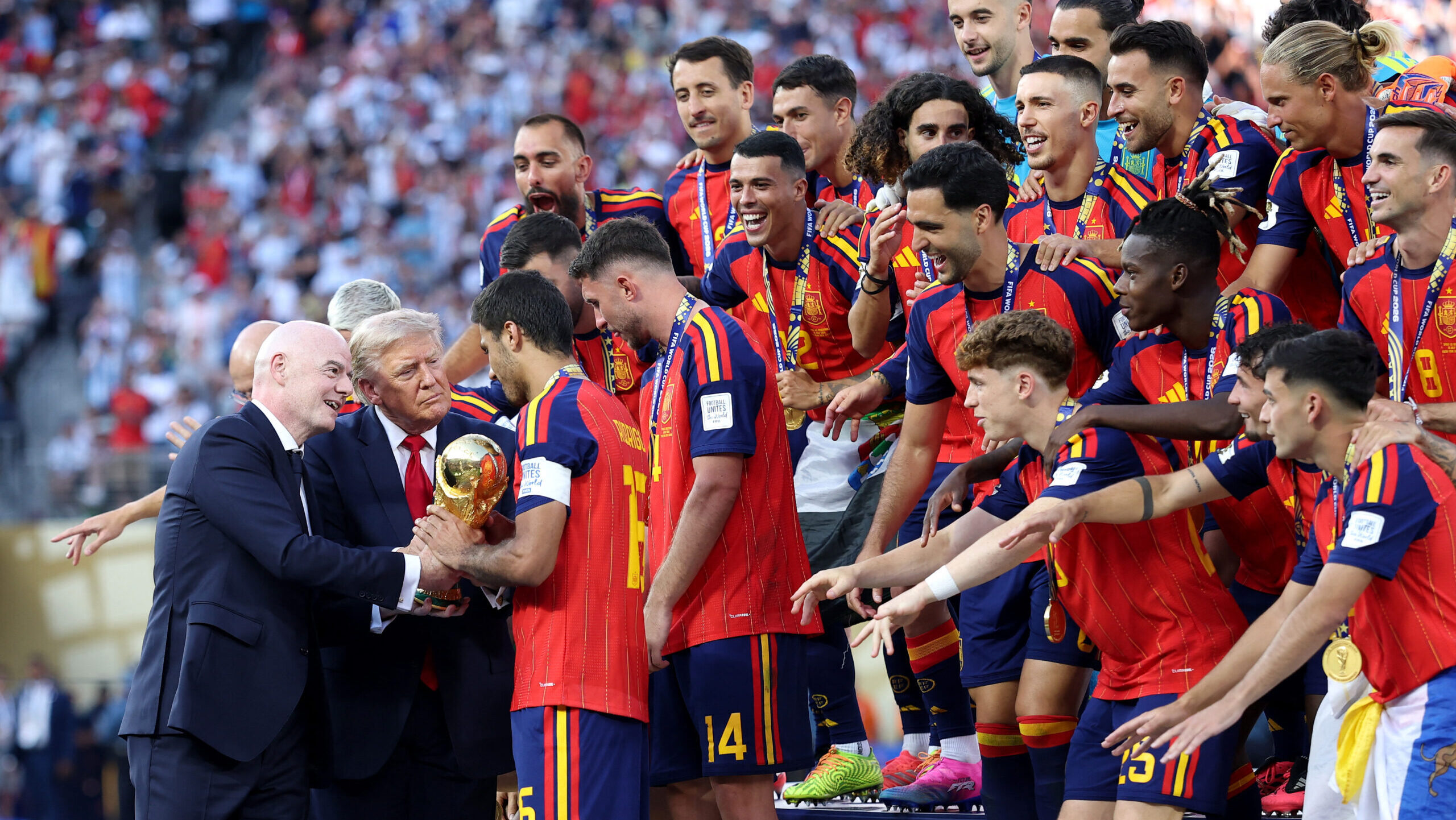
Spanish captain Rodri lifted the World Cup trophy on Sunday night in New York, marking only the second time the European football nation has won the most prestigious title in the beautiful game. That marked the end not only of an incredibly disgraceful and one-sided final against Argentina’s anti-football, but also of a tournament that resembled nothing football fans had witnessed in the decades-long history of the game.
With Ferran Torres’s strike in the 106th minute, Spain did more than win the trophy: it stopped football’s most aggressively ‘Americanized’ World Cup from ending with spectacle, engagement, and commercial interests completely overwhelming the sport itself.
Money Above Everything: Massive Commercial Success
What ‘Americanization’ stands for in the current context is equally important. It is not an insult to US supporters, of course, nor a claim that the United States invented commercialization. It instead describes a design philosophy familiar from American sports leagues, such as the NFL and NBA: predictable stoppages, advertising inside the action, coaching interventions, celebrity presentation, forensic replay, executive access, and entertainment as competition’s equal partner.
While these are common and traditional characteristics of almost every sport popular across the Atlantic, they are almost entirely alien to European sports culture—not to reject the fact that European football is itself already more commercialized than it was decades ago, although in different ways from American sport.
‘The 2026 FIFA World Cup was already unique and a historic first’
The 2026 FIFA World Cup was already unique and a historic first. Co-hosted by the United States, Canada, and Mexico, the first 48-team, 104-match World Cup crossed a continent and drew 6,810,966 spectators—about 65,490 per match. After the round of 16, FIFA reported 99.7 per cent occupancy, 7.7 million fan-festival visits, 607,350 hospitality packages, and 20 billion views across its platforms. It also logged more than 500 million ticket requests in 33 days.
From a commercial perspective, the World Cup was a massive success. FIFA’s attendance releases and final reports describe it well. The association’s 2023–26 budget was expected to reach about $15 billion, with around $10 billion generated in 2026 alone, much of it during the tournament. A FIFA–WTO study projected $80.1 billion in global output and $40.9 billion in GDP related to the World Cup alone.
Much of this revenue came from advertising, which leads us to the first, and arguably most controversial, attempt to alter European football according to American characteristics: the hydration breaks.
Hydration Breaks, Extended VAR Usage, Half-Time Show
FIFA announced at the end of 2025 that the World Cup would feature mandatory three-minute hydration breaks around the 22nd minute of each half, regardless of weather or stadium conditions. While there was a legitimate medical case behind the breaks, as weather conditions at some venues—especially in Mexico—made hydration and cooling essential, the universal application turned them into a major controversy, resulting in 10 hours and 24 minutes of interruption during regulation time. According to a June analysis, US broadcaster Fox would make at least $250 million, perhaps as much as $500–600 million, because of the new regulation.
FIFA President Gianni Infantino denied that the breaks were introduced for commercial reasons and stated that FIFA earned nothing extra under existing deals. Yet football fans did not receive the changes well, to put it mildly.
In a YouGov survey of British fans, 66 per cent viewed the breaks negatively and 21 per cent positively. Traditional European football consists of two flowing halves that coaches cannot keep stopping and resetting. Continuity is part of its culture, and part of its strategy. Implementing mandatory hydration breaks therefore fundamentally changed the dynamics of a football match, breaking it into four quarters rather than two halves, as highlighted by England manager Thomas Tuchel.
Recent analysis underscores how the breaks changed entire games. Across 72 group-stage matches, The Times reported that momentum shifted above average after 32 per cent of first breaks and 26 per cent of second breaks. Momentum fell by 17 per cent on average, while the previously dominant side suffered a 38 per cent larger decline. During the Netherlands–Sweden match, a 4–1 Dutch shot advantage before the break became 8–1 in Sweden’s favour after a tactical adjustment. Switzerland’s match against Bosnia and Herzegovina provides another clear example of the hydration breaks’ deeper impact.
To ‘crown’ all of this, Sunday’s final saw FIFA’s first-ever World Cup half-time show, an 11-minute production featuring global stars such as Madonna, Shakira, BTS, Justin Bieber, and others. The half-time interval lasted 27 minutes, with seven minutes each required to erect and remove the stage. The pre-match show—yes, there was an additional show before the game as well—had already delayed kick-off by five minutes. All of this went against the International Football Association Board (IFAB) regulations, which state that half-time must not exceed 15 minutes.
‘During the final, the players’ rhythm became subordinate to production and commercial interests’
Half-time shows are traditional features of the Super Bowl, the NFL’s championship game, blending competition with concerts and advertising. World Cups have long featured opening ceremonies, but half-time itself had remained protected. During the final, the players’ rhythm became subordinate to production and commercial interests, carrying a significant risk of injury, according to studies pointing to reduced muscle temperature and performance.
The 2026 World Cup also saw expanded powers and greater use of the video assistant referee (VAR), already among football’s most controversial modern innovations. During the tournament, however, it was applied more frequently, more decisively, and with broader powers to overturn the original referee’s decisions. It increasingly resembled the American replay-booth model. It also produced some of the most debated decisions of recent tournaments, with finalists Argentina benefiting from a 5–0 balance in decision-changing VAR rulings (of the five match-defining and disputed VAR interventions involving Argentina, all five favoured Lionel Messi’s side).
The scandal involving American striker Folarin Balogun also stemmed from a VAR decision and further strengthened the Americanization argument. The Monaco forward was sent off after a VAR review of a dangerous, yet clearly unintentional, foul against Bosnia and Herzegovina, resulting in a one-match ban. US President Donald Trump publicly criticized the decision and called on Infantino to request a review. FIFA’s disciplinary committee upheld the offence and imposed the suspension, but suspended its implementation for a year and fined Balogun $40,000.
The decision sparked outrage, with UEFA, fans, and even the European Commission condemning what they described as political interference in the tournament. Both Trump and FIFA maintained that the president had requested only reconsideration, not a predetermined outcome. Nevertheless, the entire episode created the appearance of the host nation’s political leadership intervening to secure an advantage for its national team against Belgium. The United States, with Balogun back in the starting line-up, ultimately lost 4–1 to Belgium and was eliminated from the tournament.
A Victory of ‘Real’ Football
Spain’s triumph therefore carried symbolism beyond an ordinary World Cup victory. Playing a classic possession-based system built on positional intelligence, discipline, and technical superiority against Argentina’s aggressive, disruptive, and dirty approach—coupled with several highly controversial VAR decisions in the final itself, including Mac Allister’s avoided red card for his challenge on Dani Olmo, Paredes escaping a second yellow card, and two Spain goals being disallowed—Luis de la Fuente’s side delivered not only victory, but also a defence of the European concept of football against a commercially driven push towards Americanization. It defended the soul of football, more accurately.
The 2026 World Cup proved that North America can stage football on an unprecedented scale. Its crowds were enormous, its logistics formidable, and its revenues historic. But commercial success does not settle who owns the game’s identity. Spain supplied the ending FIFA could not manufacture by doing what Europeans have always done best: playing football.
Related articles:
At a time when public debate is increasingly polarized and superficial, Hungarian Conservative remains committed to depth, intellectual honesty, and independent conservative thought.
Producing high-quality journalism requires resources. Your contribution helps us expand our coverage, reach new audiences, and keep our content accessible.

Please consider supporting our mission.