The 22nd quadrennial FIFA World Cup is just three months away, with hosts Mexico kicking off against South Africa (the repeat of the 2010 World Cup opener) at the Estadio Azteca in Mexico City, Mexico on 11 June. Given that the big sporting event is fast approaching, let’s take a look at the story behind the inaugural FIFA World Cup in 1930.
Back in the 1920s, the international footballing federation FIFA was headed by Frenchman Jules Rimet. He presided over 41 member associations in 1926, the year the FIFA Congress decided to host the inaugural FIFA World Cup. Prior to that, the men’s football event at the Summer Olympics was the most prestigious international football competition.
There was plenty of enthusiasm for the new initiative among the FIFA nations. However, once the European associations (which made up the vast majority, 25 out of the 41 members) learnt that the inaugural FIFA World Cup would not be hosted on the Old Continent, that enthusiasm shattered.
Rimet awarded the hosting rights to the small South American nation of Uruguay for two reasons. One, they were the back-to-back winners of the 1924 and 1928 Olympics, and thus he felt that they had earned that distinction on the pitch. And two, he feared that by hosting the event in Europe, football would become too Eurocentric of a sport, given that already the vast majority of FIFA members were from the continent.
With his move, however, he made the first-ever FIFA World Cup a very American affair.
Initially, no European nation was willing to take on the three-week boat trip to Uruguay. However, FIFA President Rimet used his influence in his home country to get France to join the competition, while FIFA Vice President Rodolphe Seeldrayers did the same for his home country of Belgium.
In the case of Romania, the newly crowned and avid football fan monarch, Carol II stepped in. By royal decree, he ordered all employers to give the national team members paid leave for the duration of the World Cup, and provided the funds for the team’s travel. He used his diplomatic influence to convince Yugoslavia to send a squad to Uruguay as well, bringing the number of nations in Europe taking part in the first-ever World Cup to four.
The countries in the Americas were a lot more eager to join, given the proximity of the venue and the possibility of land travel. Hosts Uruguay were a given, who were followed by Brazil (the only nation to play in all 22 World Cups), Argentina, Paraguay, Chile, Peru, and Bolivia from the South American continent. From North and Central America, the United States and Mexico joined the line-up. The one African FIFA member, Egypt was also supposed to be included. However, a heavy storm on the Mediterranean Sea made them miss their boat connection in Marseille, France.
Thus, if you count them up, the inaugural 1930 FIFA World Cup kicked off on 13 July 1930 with a total of 13 nations participating. Please note that, unlike in any of the following World Cups, this tournament did not have a qualification process. Rather, FIFA actively tried to recruit national teams that were willing to participate.
The 13 teams were divided into four groups, one of four teams and three of three teams. All games were played in the capital city of Montevideo.
Argentina topped Group 1, winning all three of their games against Chile, France, and Mexico. In Group 2, Yugoslavia finished first ahead of Brazil and Bolivia. Hosts Uruguay in Group 3 beat both Romania and Peru, getting them the top spot; while in Group 4, the United States bested Paraguay and Belgium for the #1 spot. Interestingly, none of the group stage games resulted in a draw. The four group winners then advanced to the semi-final.
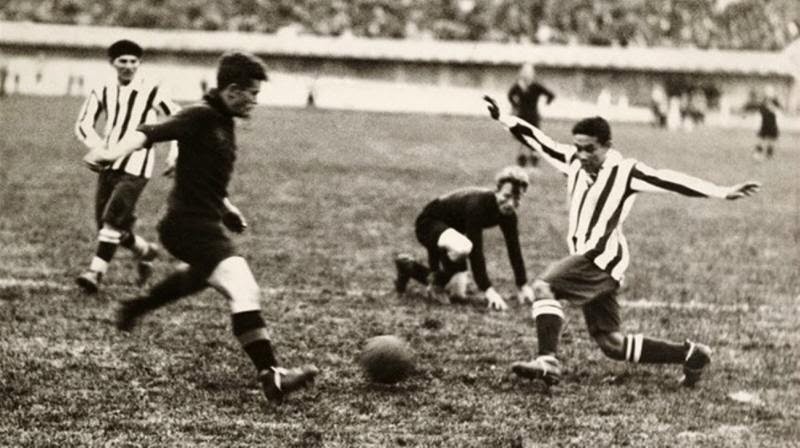
There, Uruguay trashed Yugoslavia 6–1. Argentina beat the USA by the exact same scoreline. Since there was no third-place play-off, the United States were awarded the bronze medal for their better group stage performance over Yugoslavia.
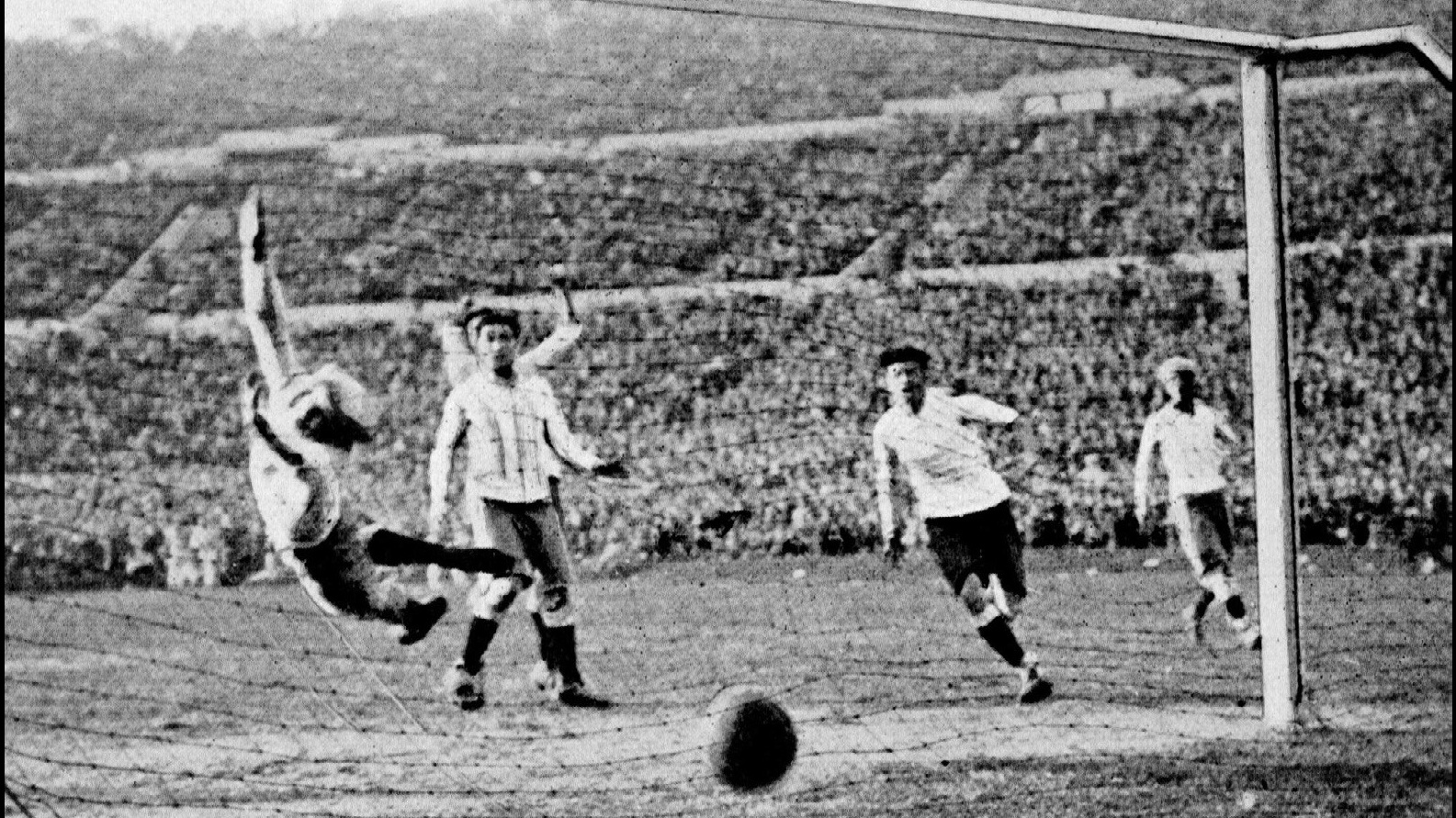
While one game, Romania vs Peru in Group 3, only had 300 spectators on the stands for a negative World Cup record, low interest was not a concern for the final between Uruguay and Argentina. 68,000 people gathered at the Estadio Centenario in Montevideo on 30 July 1930 to see the two South American nations battle it out for the first FIFA World Cup title.
The Uruguayans were captained by right-back José Nasazzi of the local club Bella Vista. En route to the final, inner-left Pedro Cea of Club Nacional scored a hat-trick against Yugoslavia in the semi-final, and found the net against Romania in the group stage as well, thus he had contributed the most to his team’s goal total, four. Centre-forward Héctor ‘El Manco’ Castro is also often noted from the Uruguayan side, distinguished by his missing right forearm, which he lost in a sawing accident at age 13.
The Argentina side was led by captain Manuel Ferreira of Estudiantes de La Plata, who played in the inside-left position. Meanwhile, centre-forward Guillermo Stábile of Club Atlético Huracán had emerged as the tournament’s standout goalscorer. By the time of the final, he had already scored an impressive seven goals in just three matches. Stábile began with a hat-trick against Mexico, followed by a brace against Chile in the group stage, before adding two more goals to his tally against the United States in the semi-final.
Dorado took the lead for the hosts in the 12th minute. However, to the surprise of the home crowd, Argentina were ahead by halftime with Peucelle scoring in 20th, then Stábile scoring his eighth goal in the tournament in the 37th minute.
Cea levelled the score in the 57th minute in the second half. Then, eleven minutes later, Iriarte fired a long-range shot into the Argentine net, giving the Urus back their lead. The one-armed Castro headed home another goal in the 89th minute, setting the final, 4–2 scoreline.
Hosts Uruguay became the first-ever FIFA World Champions! Due to the success of the first tournament, so many countries wanted to play at the next Mundial in 1934 in Italy that, for the first time, qualification matches had to be held to decide the participating teams.
Related articles:
At a time when public debate is increasingly polarized and superficial, Hungarian Conservative remains committed to depth, intellectual honesty, and independent conservative thought.
Producing high-quality journalism requires resources. Your contribution helps us expand our coverage, reach new audiences, and keep our content accessible.

Please consider supporting our mission.