Austria has publicly rejected Prime Minister Péter Magyar’s claim that Vienna filed a complaint against Hungary in Brussels over the emergency riverbed sill built to keep the Paks nuclear power plant operating, contradicting an accusation the Hungarian premier repeated on Wednesday, 9 September, while attacking Austria over its handling of a separate dispute between the two neighbours.
Austria’s Federal Ministry for Innovation, Mobility and Infrastructure told APA that Vienna had filed no complaint with the European Commission over the project.
The denial is particularly awkward because Magyar had first raised the allegation at his 3 September government press conference, saying that, ‘to my knowledge, Austria has turned to the Union’ over the construction. The Austrian denial was reported on 7 September. Nevertheless, Magyar returned to the issue on Wednesday, this time stating more categorically on Facebook that ‘Austria has complained about our country in Brussels’, before adding that it would be good if the Austrians were ‘this active’ over the asbestos case.
An Already Controversial Project
The sill was part of an emergency operation prompted by the severe heatwave and drought that hit Hungary at the end of July and in August. On 30 July, MVM warned that record-low Danube levels could force the entire roughly 2,000 MW Paks plant, which provides around half of the country’s electricity, to stop generating within 24–72 hours.
The problem was not an absolute shortage of cooling water, but that the river had fallen below the effective operating range of the plant’s existing intake pumps. After output subsequently fell to a fraction of normal capacity, the government decided on 12 August to construct a rock sill between Paks and Dunaszentbenedek and deploy two 80-metre barges to raise the upstream water level. The original plan envisaged roughly 145,000 cubic metres of stone at an estimated gross cost of HUF 6.1 billion, around €16.8 million.
The project itself has already become controversial in Hungary. As previously reported by Hungarian Conservative, construction caused severe local scour, with the riverbed reportedly deepening by 8–13 metres at the site, while a restricted emergency procurement awarded part of the works to A-Híd Építő Zrt as the sole bidder at more than HUF 2 billion net, around €5.5 million, around 30 per cent above the financial coverage initially reported for that tender.
The government nevertheless completed the first functional stage in 17 days, with the two sides of the sill meeting on 29 August after around 43,000 cubic metres of stone had been placed.
The Austrian government’s denial, however, does not mean that there are no international concerns regarding the sill. The Budapest-based Danube Commission and the European Commission are in direct contact with the Hungarian authorities, while Danube states have prepared a joint position under the EU Strategy for the Danube Region and sent it to Transport Minister Dávid Vitézy and Magyar.
Crucially, the Danube Commission says it does not question Hungary’s objective of securing cooling water for Paks. Its objections concern extending the sill across the full width of the river and its planned height, which could obstruct navigation on a core section of the Trans-European Transport Network. It has demanded continuous navigability and called a closure of the fairway until the end of November unacceptable because of the potential economic damage to shipping and industry.
Pro Danube International, representing inland-navigation and logistics interests, has separately written to the European Commission and Danube authorities demanding predictable navigation conditions during and after construction. The organization likewise acknowledges both the exceptional low-water situation and the need to protect critical infrastructure.
A Difficult New Beginning
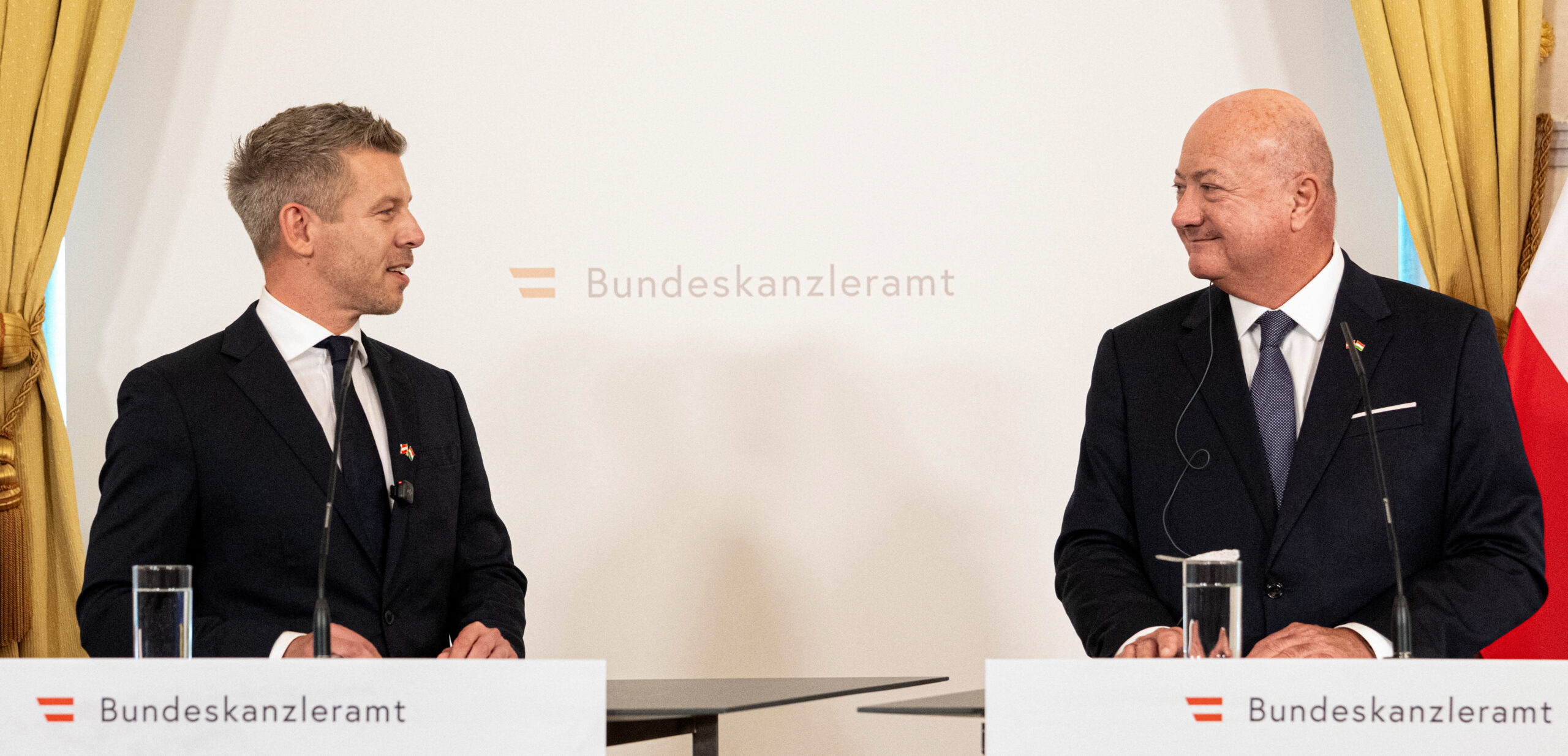
The dispute comes only months after Magyar and Austrian Chancellor Christian Stocker proclaimed a ‘new chapter’ in bilateral relations during the Hungarian prime minister’s 21 May visit to Vienna. The two leaders pledged closer Central European cooperation and announced plans for a joint government meeting in the autumn.
Magyar’s asbestos reference concerns a separate environmental dispute over allegedly contaminated crushed stone exported from Burgenland to western Hungary. Four Austrian quarries were closed in January after asbestos findings, while Hungary and Austria established a bilateral working group during Magyar’s May visit to Vienna.
Budapest has since set up a HUF 3 billion, or around €8.2 million, remediation fund and demanded that Austria contribute to the clean-up under the ‘polluter pays’ principle. In Szombathely alone, around 84,000 tonnes of contaminated gravel are expected to be removed. Chancellor Stocker has said Vienna is awaiting a legal assessment by the Finanzprokuratur before determining liability.
Related articles:
At a time when public debate is increasingly polarized and superficial, Hungarian Conservative remains committed to depth, intellectual honesty, and independent conservative thought.
Producing high-quality journalism requires resources. Your contribution helps us expand our coverage, reach new audiences, and keep our content accessible.

Please consider supporting our mission.