The Persian/Arab Gulf region is among the most water-scarce areas in the world, with national supply systems relying almost exclusively on seawater desalination. According to the latest data, the six Gulf states—Bahrain, Kuwait, Oman, Qatar, Saudi Arabia, and the United Arab Emirates—account for approximately 40 per cent of global desalinated water production.
However, the ongoing conflict with Iran has highlighted the vulnerability of the region’s water infrastructure. Over the past two months, several drones have struck desalination facilities, underscoring how water supply systems may face serious disruptions during military conflicts.
A Water-Scarce Region
Countries in the region rely on groundwater resources and desalinated seawater to supply rapidly growing cities, industrial zones, and agricultural areas. The severity of the situation is underscored by the United Nations benchmark of 500 cubic metres per person per year as the threshold for ‘absolute water scarcity’, while Gulf Arab states average only about 120 cubic metres per capita annually. This figure is barely a quarter of the critical threshold, making desalination effectively unavoidable.
The problem is exacerbated by rapid population growth and accelerating urbanization. For instance, population growth rates in GCC member states are nearly three times the global average. As a result, water demand continues to rise while natural replenishment remains extremely limited.
A significant portion of groundwater resources is non-renewable ‘fossil water’, whose extraction causes long-term depletion. In addition, climate change impacts—such as reduced precipitation and rising temperatures—further worsen the water balance. According to the Gulf Research Center, average temperatures in the GCC region are expected to increase by an additional 1–2°C by 2050, making water supply increasingly dependent on technological solutions. This dependence creates vulnerabilities not only economically but also politically and in terms of security.
The Role of Wadis
A defining natural feature of Gulf Arab states is the absence of permanent rivers in their desert environment. Seasonal watercourses—known as wadis (from Arabic, meaning ‘valley’ or ‘ravine’)—do exist, but they carry water only during rare rainfall events and therefore cannot serve as a reliable foundation for water supply.
Historically, these watercourses played a crucial role in settlement patterns: many early communities and oases developed along them because water and more fertile soil were more readily available there. They were also important for agriculture, as sudden floods deposited nutrient-rich sediments. Caravan routes frequently followed their courses as they formed natural pathways through the desert. Wadis also served as meeting points, often becoming centres for markets, tribal relations, and community life. As such, they came to symbolize livelihood and survival.
‘Wadis also served as meeting points, often becoming centres for markets, tribal relations, and community life’
Today, they remain important water sources in arid regions and influence the locations of settlements and agricultural activities. During periods of flow, much of the water quickly infiltrates the soil, contributing to groundwater recharge. Flash floods are common after sudden rainfall, transporting large volumes of water and sediment in a short time. One of the best-known examples is Wadi Rum in Jordan, which attracts millions of visitors each year. Numerous wadis can also be found in Saudi Arabia, Oman, and the United Arab Emirates.
Despite their historical and local importance, the volume and reliability of water provided from wadis fall far short of modern social and economic demands, so they cannot serve as a viable alternative to desalination and instead play only a supplementary role in the region’s water management.
The Role and Volume of Desalination
According to a 2023 report by the GCC Statistical Center, the six Gulf states produced 7.2 billion cubic metres of freshwater through desalination. This equates to approximately 122 cubic metres per capita per year (about 334 litres per day). Saudi Arabia—the region’s largest and most populous country at 35 million people—is also one of the world’s leading producers of desalinated water.
An analysis published by Al Jazeera highlights that the role of desalinated water varies significantly by country, depending on the availability of alternative water sources. Qatar is the most dependent, with 61 per cent of its total water supply coming from desalination. In Bahrain, desalination provides 59 per cent of the water supply and accounts for 90 per cent of drinking water. In Kuwait, nearly 50 per cent of annual water consumption is derived from desalination, while in the United Arab Emirates the figure is 41 per cent. In Oman, desalination accounts for 23 per cent of annual water demand, and in Saudi Arabia, for only 18 per cent, largely because of its substantial groundwater reserves.
Security and Environmental Risks
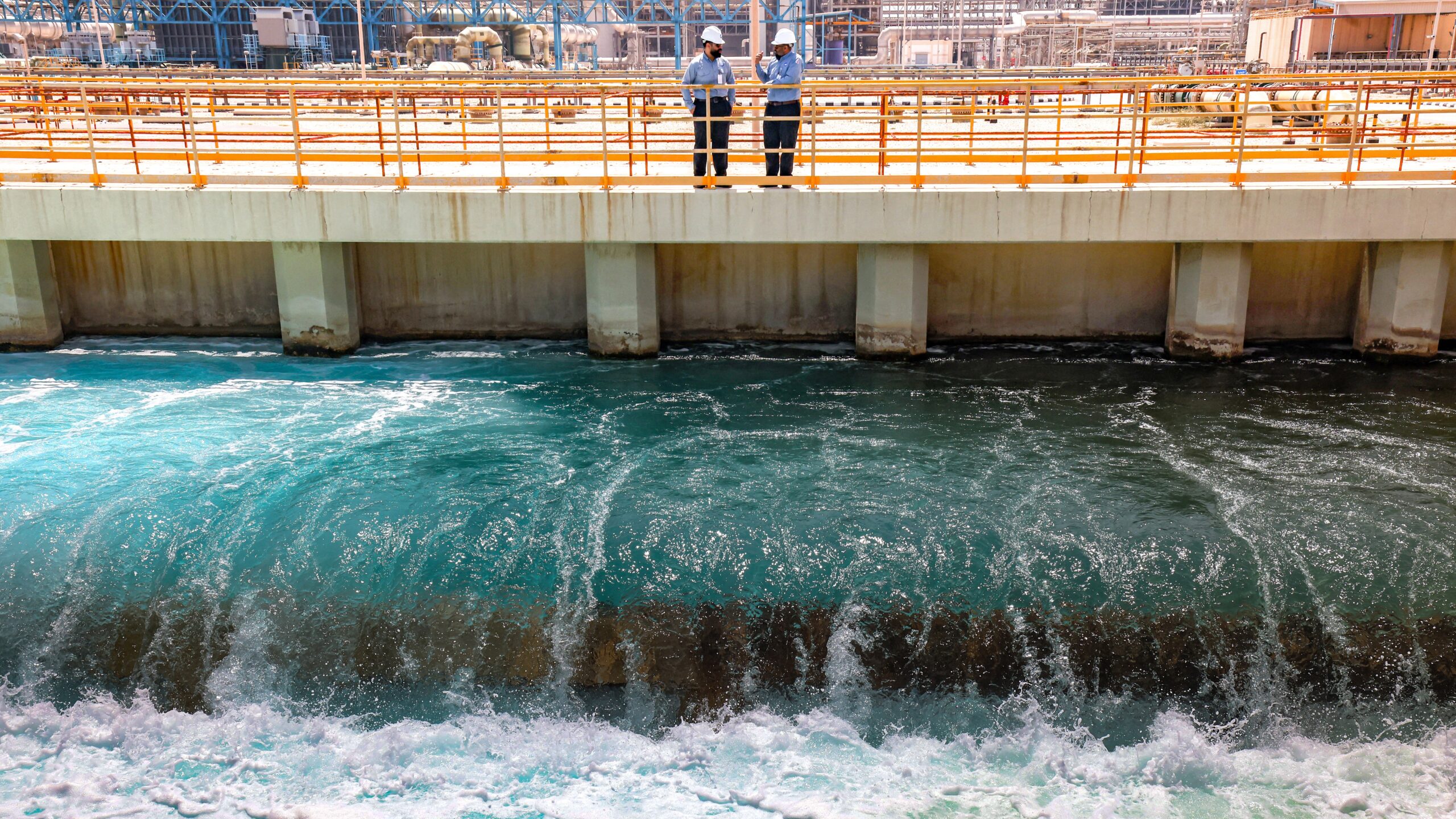
The current conflict with Iran has shown that desalination plants are strategic infrastructure. The failure of a single facility can jeopardize the water supply of hundreds of thousands of people. Attacks on Gulf Arab states illustrate that water infrastructure can become a key target in conflicts. Because most desalination plants are located along coastlines, they are geographically concentrated and easily identifiable targets.
This vulnerability is compounded by the fact that many countries rely heavily on a small number of large-capacity facilities—such as the Ras Al-Khair Power and Desalination Plant in Saudi Arabia—resulting in limited system redundancy. Consequently, the loss of a single facility can trigger cascading supply disruptions. Additionally, the growing risks of cyberattacks and infrastructure sabotage further underscore the strategic importance of water security.
‘Desalination is highly energy-intensive and contributes to greenhouse gas emissions and air pollution’
Beyond its geopolitical and security dimensions, desalination is also an environmental challenge. According to an analysis by the Middle East Institute, the Persian/Arab Gulf is ‘already experiencing the impact of increased salinity from brine discharge, which harms marine ecosystems.’ Moreover, desalination is highly energy-intensive and contributes to greenhouse gas emissions and air pollution. As a result, the environmental impacts are significant, raising questions about the long-term sustainability of the process.
Closing Words
Water security in the Persian/Arab Gulf region fundamentally depends on seawater desalination. Countries in the region account for nearly half of global desalinated water production, with more than 400 plants operating across their territories.
Without this technology, it would be impossible to meet the drinking-water and economic needs of the region’s rapidly growing population of 62 million. At the same time, current geopolitical tensions have highlighted that desalination plants are critical yet vulnerable infrastructure.
As a result, greater emphasis is likely to be placed on protecting water infrastructure, developing decentralized water-production systems, and advancing more energy-efficient and secure desalination technologies. Water security is increasingly treated as an integrated strategic priority, one that demands both technological innovation and stronger regional cooperation.
Related articles:
At a time when public debate is increasingly polarized and superficial, Hungarian Conservative remains committed to depth, intellectual honesty, and independent conservative thought.
Producing high-quality journalism requires resources. Your contribution helps us expand our coverage, reach new audiences, and keep our content accessible.

Please consider supporting our mission.