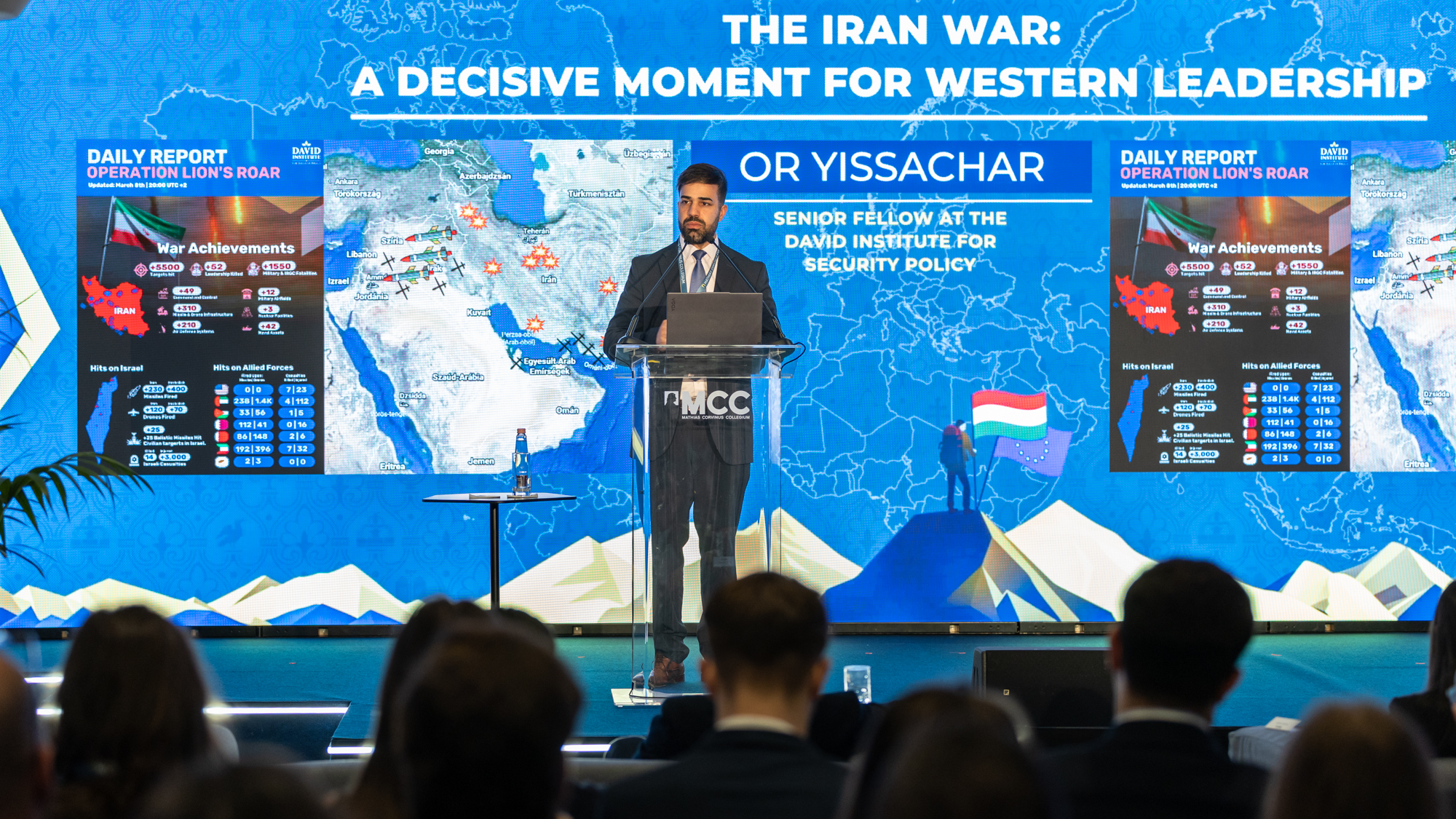
Mathias Corvinus Collegium’s (MCC) high-level summit titled Reclaiming the West kicked off on Tuesday, 10 March, with an unexpected and unplanned debate between two keynote speakers, Or Yissachar, Senior Researcher at the David Institute for Security Policy, and Michael von der Schulenburg, former United Nations Assistant Secretary General and currently a Member of the European Parliament, over the war in Iran.
Speaking about the US–Israeli joint military operation against the Persian country, launched on 28 February and resulting in the elimination of a large part of the Iranian leadership, including Supreme Leader Ali Khamenei, Yissachar stressed that for Israel—a country historically surrounded by hostile actors—freedom must always be defended.
According to him, the formal policy of successive Israeli governments over the past three decades had been to avoid large-scale wars and instead rely on limited tactical operations aimed at deterring adversaries. However, he argued that this strategy ultimately proved to be a ‘complete disaster’ following the Hamas attacks of 7 October, which fundamentally changed Israel’s strategic calculations.
Yissachar described the current operation as a response to unprecedented Iranian aggression. In his view, the Iranian regime operates as a ‘terrorist syndicate’, as seen in Tehran’s retaliatory strikes targeting energy infrastructure, civilian sites, and terror attacks across Europe. The objective of the current military campaign, he explained, is not to launch a ‘forever war’, but to eliminate a threat that has persisted for more than half a century.
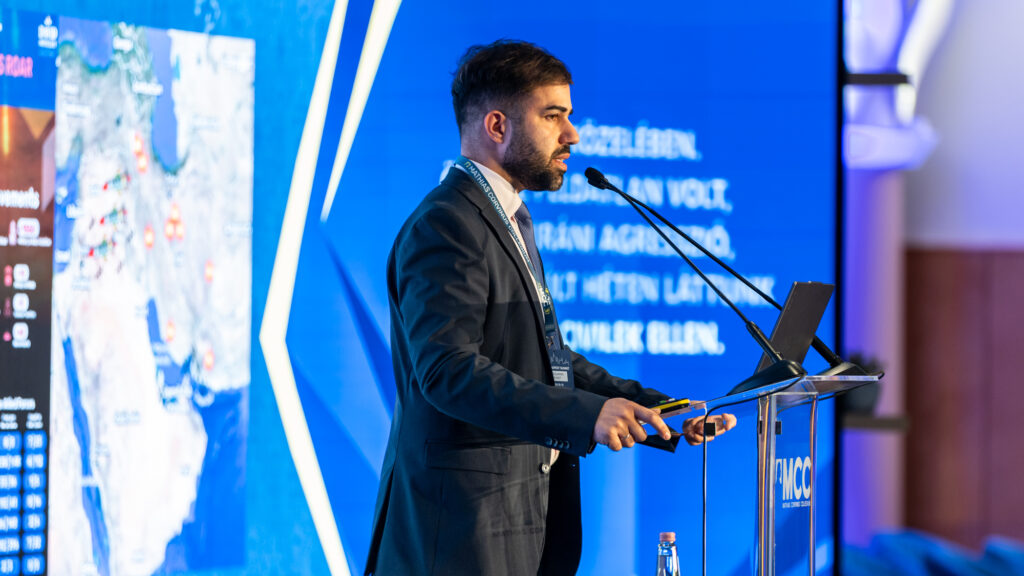
‘The end goal is to collapse the Iranian regime,’ he stated, arguing that decisive action now could pave the way for a different, more cooperative Iran in the future. Yissachar also suggested that the removal of the current leadership in Tehran could ultimately open the door to closer cooperation between Israel and Arab countries—many of which are already fighting in the war on Israel’s side—strengthening regional trade, economic corridors, and broader geopolitical stability.
Yissachar also praised Hungary for what he described as its ‘unique’ and ‘common sense’ position within Europe. He highlighted Hungary’s consistent support for Israel, its migrant-free policy achieved through what he called concrete political decisions, and Budapest’s willingness to defend its values, including recent moves such as leaving the International Criminal Court and blocking EU sanctions against Israel. According to him, Hungary understands ‘the price of freedom’ and serves as ‘a beacon of light in Europe’.
The Israeli analyst also criticized what he described as Western Europe’s ‘strategic passivity’ during the early days of the conflict, warning that civilizations that fail to defend themselves risk gradual erosion. ‘Civilization is like currency—if you are not using it, it erodes; if you are not defending it, nobody else will,’ he said. Quoting Israeli Prime Minister Benjamin Netanyahu, he argued that free societies must be prepared to act decisively when confronted by existential threats.
‘Free societies must be prepared to act decisively when confronted by existential threats’
Michael von der Schulenburg then took the stage. He had originally been scheduled to speak about how the European Union shifted from its fundamental goal of peace in Europe toward a war project. Instead, the former UN official delivered an improvised speech responding to Yissachar’s remarks, offering a sharply different perspective, highlighting how the conflict in the Middle East divides Western intellectual circles.
Schulenburg, who has been involved in numerous peace negotiations and settlements, drew on a ‘butterfly analogy’ of conflicts. According to this concept, every war is driven by competing narratives from the parties involved. Successful peace negotiations therefore require identifying the underlying causes of the conflict—the ‘head of the butterfly’—which are often absent from the narratives of the warring sides, represented by the two wings of the butterfly.
Schulenburg warned that the US–Israeli strikes risk undermining the foundations of international law. Referring to the United Nations Charter and its principle of non-interference, he argued that the targeted killing of a country’s leader while negotiations were still ongoing constitutes a serious violation of international norms.
He also questioned the effectiveness of the military operation regarding its stated objective of regime change in Iran. Citing data on US military interventions, he claimed that Washington has carried out more than 250 interventions under the banner of promoting freedom and democracy, yet these efforts rarely resulted in either. Instead, he argued, such operations frequently left countries in chaos, anarchy, and prolonged humanitarian crises.
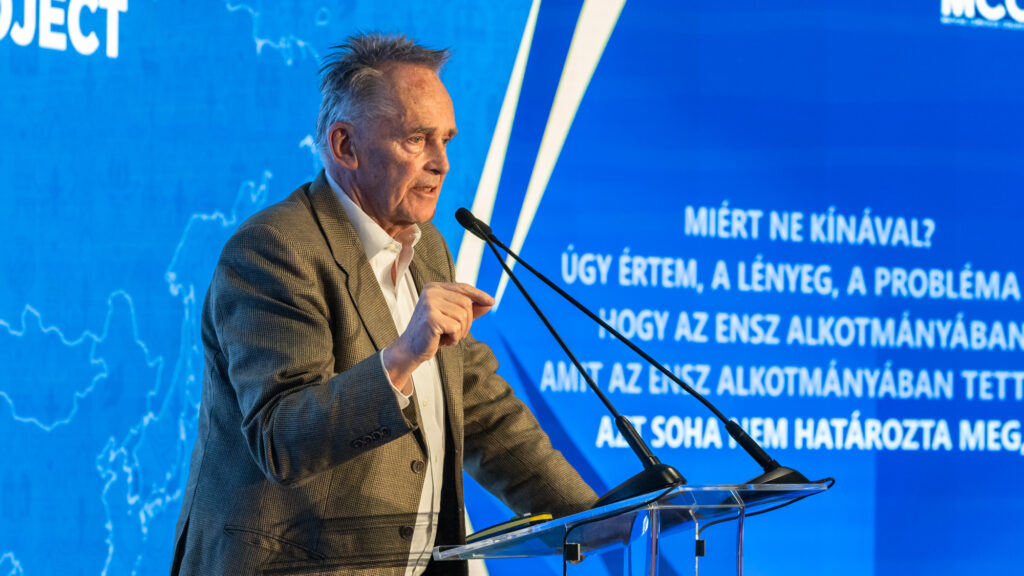
Schulenburg further asserted that intelligence assessments from both US agencies and the United Nations had long suggested that Iran had not attempted to develop a nuclear weapon, one of the main justifications cited for the US–Israeli strikes. In his view, the current war could actually accelerate nuclear proliferation, as other countries might seek atomic weapons as a deterrent.
According to Schulenburg, time may ultimately favour Iran, as the decisive factors in the conflict will not be military operations alone but the reactions of both the Iranian and American public. With US midterm elections approaching, he suggested that the conflict could also pose a political risk for President Donald Trump, who had previously vowed not to launch new wars or pursue regime change policies.
He warned that abandoning international law could ultimately weaken the West itself. ‘If we throw international law aside and allow the rule of the strongest to prevail, what happens if we are no longer the strongest?’ he asked, urging policymakers not to abandon the UN Charter and instead pursue negotiations—even if they take a long time.
According to the programme, the summit was supposed to continue with a Q&A session with Schulenburg moderated by MCC Director Zoltán Szalai. However, the organizers decided to give Yissachar the opportunity to respond, given the exceptional nature of the exchange.
The Israeli analyst defended his position by arguing that international rules cannot constrain states facing existential threats, as Israel perceives Iran to be. ‘What if a country does not play by the UN Charter?’ he asked, insisting that some problems ultimately require military solutions. ‘Sometimes you have to act,’ he pointed out. ‘We are not going to let Iran drop a nuclear bomb on us,’ Yissachar concluded.
Related articles:
At a time when public debate is increasingly polarized and superficial, Hungarian Conservative remains committed to depth, intellectual honesty, and independent conservative thought.
Producing high-quality journalism requires resources. Your contribution helps us expand our coverage, reach new audiences, and keep our content accessible.

Please consider supporting our mission.