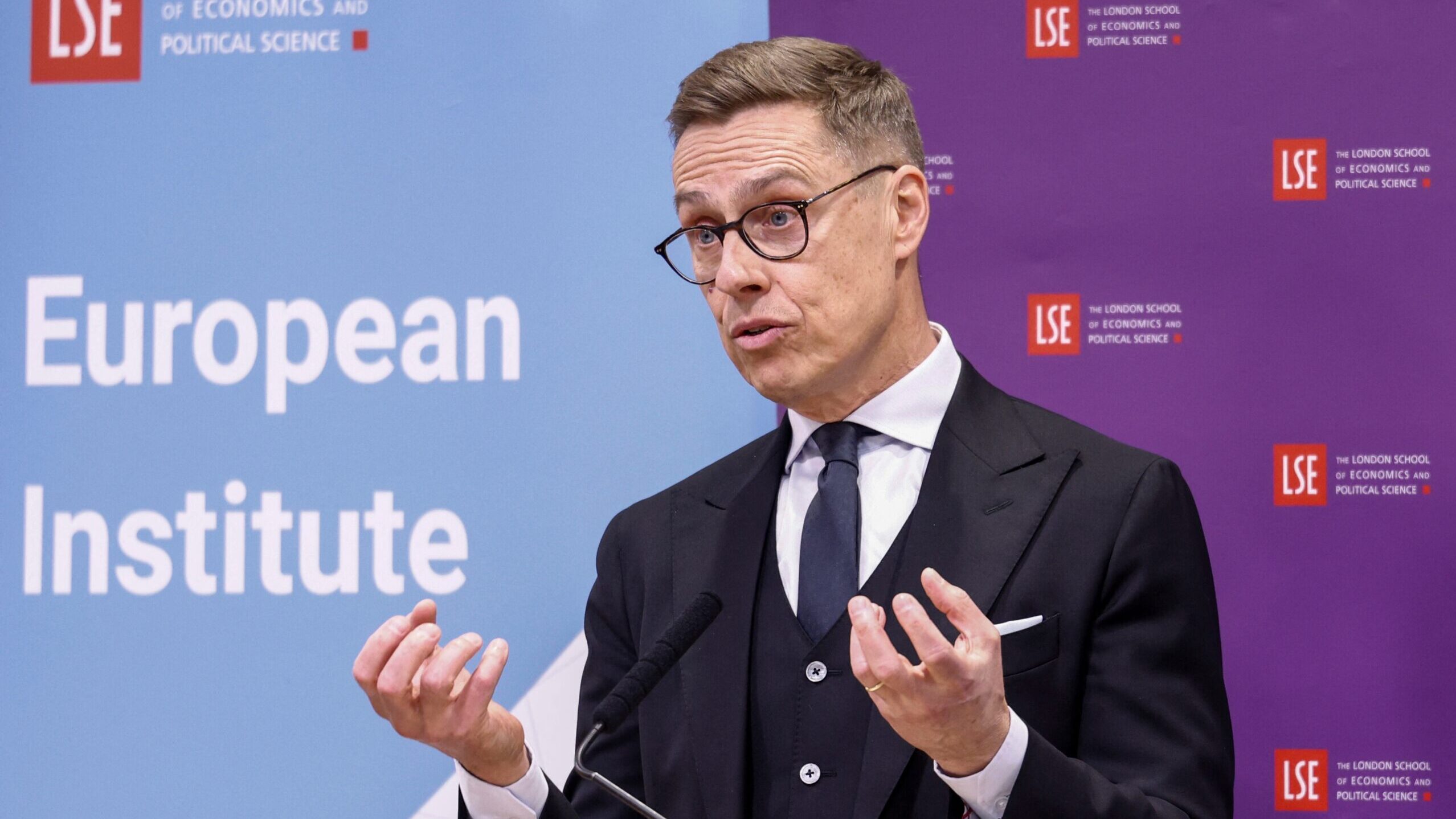
Finnish President Alexander Stubb has become the latest EU leader to speak about restoring dialogue and engaging in negotiations with Russia in order to end the war in Ukraine. Speaking at Chatham House on 17 March, Stubb stated that the moment for the resumption of direct dialogue between the European Union and Russia is approaching.
‘I believe that we are approaching the moment when the channels for political dialogue with Russia will need to be opened,’ he stressed, adding that such dialogue should be conducted on behalf of the entire EU, rather than through a specific member state.
President Stubb’s remarks came after similar statements by Belgian Prime Minister Bart De Wever in an interview with Belgian newspaper L’Echo, published over the weekend. De Wever also added that a negotiated settlement was necessary to restore access to cheap Russian energy, which had formed the foundation of European economic and industrial power in past decades. ‘We must end the conflict in the interest of Europe,’ he declared, adding that this must be done ‘without being naive towards Putin’.
The Belgian prime minister’s remarks caused shock among EU politicians and Western media, as they run directly counter to the mainstream position on the war in Ukraine within the European Union. For a long time, the only leader openly and consistently advocating such an approach was Hungarian Prime Minister Viktor Orbán, later joined by Slovak Prime Minister Robert Fico and—following his recent electoral victory—Czech Prime Minister Andrej Babiš. French President Emmanuel Macron and Italian Prime Minister Giorgia Meloni have also signalled similar positions regarding dialogue with Russia, although not as explicitly as Orbán or De Wever.
EU foreign policy chief Kaja Kallas immediately pushed back against De Wever’s statement, stressing that if Europe goes back to ‘business as usual’ with Russia, more wars will follow on the continent, suggesting that Moscow is determined to target further European countries, particularly the Baltic states. ‘We have to be very vigilant and not actually give Russia what they want because their appetite will only grow,’ the former Estonian prime minister added.
‘A shift in sentiment within the EU regarding reopening dialogue with Russia is already becoming visible’
Facing backlash, De Wever has since walked back his statements, stressing that such normalization should only take place after a peace agreement between Ukraine and Russia.
However, a shift in sentiment within the EU regarding reopening dialogue with Russia is already becoming visible, as the continent grapples with the severe consequences of the conflict in the Middle East and disruptions to energy supplies following the closure of the Strait of Hormuz. The current crisis is the first since the bloc moved to cut off Russian pipeline gas and is now phasing out Russian oil, increasing member states’ dependence on LNG imports. As of 18 March, benchmark Dutch TTF gas prices are fluctuating broadly in the €50–65 per megawatt-hour range, while wholesale electricity prices across major EU economies range between €80–120/MWh. Brent crude oil stands at $100–103 per barrel, representing roughly a 50 per cent increase since late February.
Washington recently decided to temporarily lift sanctions on Russian oil already stranded at sea as of 12 March, allowing countries to deliver, sell, or offload Russian crude oil and petroleum products, thereby easing pressure on the global energy market disrupted by the war in Iran.
While Hungary welcomed the decision and called on the EU to act accordingly, the European Commission has remained firm in its position, stating that the bloc must continue to ‘exert maximum pressure on Russia’.
Related articles:
At a time when public debate is increasingly polarized and superficial, Hungarian Conservative remains committed to depth, intellectual honesty, and independent conservative thought.
Producing high-quality journalism requires resources. Your contribution helps us expand our coverage, reach new audiences, and keep our content accessible.

Please consider supporting our mission.