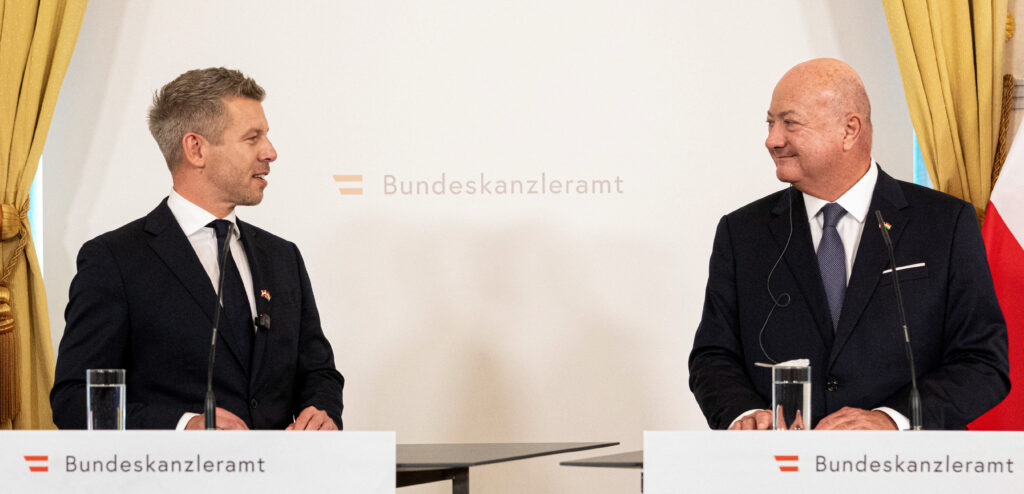

Outgoing Hungarian prime minister Viktor Orbán criticized the European Court of Justice (CJEU) ruling ordering Hungary to roll back its child protection law banning the promotion of homosexuality and gender transition in media accessible to children.
‘The Brusselian steamroller is already in motion,’ Orbán wrote on X in reaction to the landmark ruling. ‘Our patriotic government protected Hungarian children from aggressive LGBTQ propaganda,’ he continued, adding that the ‘Brusselian empire’ now ‘strikes back’. ‘We will not give up the fight for the soul of Europe!’ Orbán concluded.
The Brusselian steamroller is already in motion. Our patriotic government protected Hungarian children from aggressive LGBTQ propaganda. Now the Brusselian empire strikes back. We will not give up the fight for the soul of Europe! https://t.co/y6S4W6psPD
— Orbán Viktor (@PM_ViktorOrban) April 21, 2026
The highest court of the European Union ruled on Tuesday, 21 April, that Hungary’s 2021 child protection law violates EU law by ‘stigmatizing and marginalizing LGBTQ individuals’, breaching core principles such as human dignity and freedom of expression. It also stated that the legislation infringes the internal market and data protection rules. The Court further found that the law is incompatible with ‘a society in which pluralism prevails’ and cannot be justified by reference to national identity.
The judgment is widely considered a landmark because, for the first time, the Court based its decision directly on Article 2 of the Treaty on European Union—its fundamental values clause—as a standalone legal ground, establishing that systemic violations of minority rights can trigger direct judicial enforcement at the EU level.
The legislation in question is a set of amendments aimed at strengthening penalties against paedophilia and protecting minors, and it introduced wide-ranging restrictions on how LGBTQ and gender-related topics can be presented to minors. In practice, this means, for example, that LGBTQ-related material is restricted in schools.
At the time of its adoption in 2021, Orbán said the legislation ensures that parents retain exclusive authority over children’s sexual education, while protecting Hungary’s sovereignty from liberal Western norms and gender ideology. The law has been praised by leading figures of the global right-wing movement, who frame it as an example of pro-family governance and resistance to liberal cultural policies.
European Commission President Ursula von der Leyen described the law as a ‘shame’ in 2021, vowing to use ‘all the powers of the Commission to ensure that the rights of all EU citizens are guaranteed, whoever you are and wherever you live’. Brussels ultimately referred the case to the EUCJ, backed by 15 member states and the European Parliament.
While Western mainstream media and politicians welcomed the ruling, many right-wing activists and political commentators criticized the Court’s decision. American conservative commentator David J Freeman described the ruling as ‘sickening’, adding that ‘protecting children is now unlawful in Europe’.
Similarly, Irish journalist Chay Bowes criticized the ruling, pointing to what he described as a ‘Soros funded cabal in Brussels’.
Telegram founder Pavel Durov highlighted what he described as a contradiction: while the EU seeks to ‘ban teens from social media’, it also advocates exposing them to LGBTQ+ content. ‘What a nuanced way to “protect children” online,’ he wrote in a post on X, which was reposted by Elon Musk.
So the EU wants to ban teens from social media — except for LGBTQ+ content? What a nuanced way to “protect children” online. https://t.co/5eYtAhqgSz
— Pavel Durov (@durov) April 21, 2026
The future of the child protection law remains unclear. After losing the 12 April election, Viktor Orbán is set to move into opposition after 16 consecutive years in power, while Péter Magyar’s Tisza Party will form a government with a constitutional supermajority.
During the campaign, Magyar largely avoided LGBTQ issues in order not to provide grounds for attacks from Fidesz. However, during his first international press conference as prime minister-elect on 13 April, he said that ‘according to Tisza and the many million Hungarian people supporting it, everyone can live with whoever they love as long as they do not violate laws and are not harmful to others’.
One of Tisza’s main campaign promises was to unblock billions of euros in EU funding currently frozen by the European Commission under the rule-of-law conditionality mechanism. Some of the conditions for unlocking these funds are related to LGBTQ rights, meaning the law might be amended regardless of the ruling.
The Commission may now take further action and seek financial penalties if Hungary fails to comply with the judgment. ‘We welcome today’s landmark ruling...This is the first time that the court finds such a violation of a key treaty provision on EU values,’ Commission spokesperson Eva Hrnčířová said on Tuesday. ‘Now the ball is on the Hungarian side of the court; it is now for the Hungarian government to implement the decision.’
Related articles:
At a time when public debate is increasingly polarized and superficial, Hungarian Conservative remains committed to depth, intellectual honesty, and independent conservative thought.
Producing high-quality journalism requires resources. Your contribution helps us expand our coverage, reach new audiences, and keep our content accessible.

Please consider supporting our mission.