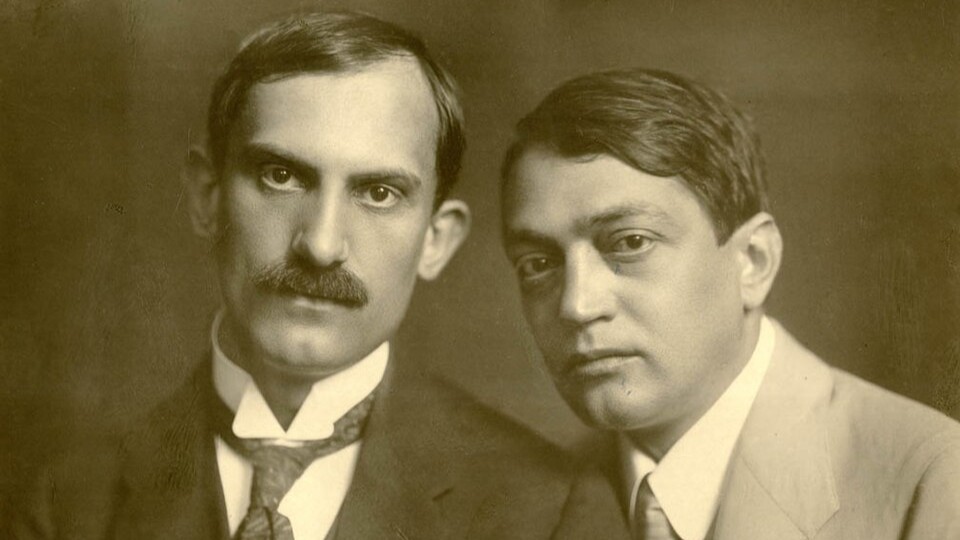
The memory of Endre Ady divided Hungary in the interwar period. As we have written before in the Hungarian Conservative, Ady was in many ways indigestible to a deeply polarized public: his Transylvanian noble origins and Freemasonry; his left-leaning views, reminiscent of socialism, with poems praying for a ‘red revolution’; his self-flagellating nationalism; his Calvinist religious poetry alongside his self-destructive lifestyle—all this created a kaleidoscope from which everyone could extract an ‘Ady’ that justified their own views. Socialists, bourgeois democrats, and racialist nationalists of the era all attempted this, among the latter especially figures like Endre (Bajcsy-)Zsilinszky and István Lendvai.
Interestingly, after Ady’s death in January 1919, for years it did not even occur to anyone that a public space in Hungary might be named after him. The first mention comes from a 1927 newspaper report: the Debrecen Museum, tasked by the city with renaming two hundred streets, named one after Endre Ady.
In 1929 at a meeting of Budapest’s City Council (then called Public Works Council), Béla Fábián—a well-known representative with a classical liberal outlook—urged that a street in the capital be named after the recently deceased former Minister of Justice Vilmos Vázsonyi, as well as after Ady. He emphasized that ‘Ady’s poetic greatness also deserves a street name.’
‘A great dispute arose over the Endre Ady Street issue’
In October of that year, it was reportedly decided that Ida Street (then in District VII, today District XIV) would become Endre Ady Street, but in reality, the matter only reached the stage of debate. According to the journal Esti Kurir:
‘A great dispute arose over the Endre Ady Street issue. The presiding deputy mayor did not want to put the question to a vote. The Social Democrats reacted with loud protest, and after the session declared they would take the matter to the general assembly.’
Minutes of the debate also survive. Conservative Deputy Mayor János Buzáth argued against it on technical grounds—saying that another committee should handle the matter—while the Social Democrat József Büchler brought up political arguments, saying: ‘Surely this is not a political question? He was not a socialist.’
Thus, in Budapest, the creation of an Endre Ady Street initially failed. Elsewhere, however, there already was one—for example, in Békéscsaba, in the ‘Bakucz settlement’ (telep). Although no report announced the decision, from 1929 onward, newspaper advertisements by one György Szudár for house sales listed this address. The capital’s opposition did not give up: in 1929, the newspaper Magyarság reported in a short piece titled ‘There will be no Endre Ady Street’ that the City Council had decided on renaming thirty streets—but Ady’s name was again absent. The vote was secret, and proposals such as naming a square after Miklós Horthy or renaming Villányi Road as Prince Saint Emeric Road passed.
The Council apparently justified its stance by referring to the passage of ‘historical time’—ten years after a person’s death—which by then had already elapsed. Some opposition representatives also rejected the proposal, arguing that Ida Street was too obscure and remote, and that a more worthy public space should bear Ady’s name. One paper commented ironically:
‘My God, so there will be no Endre Ady Street in Pest–Buda. So be it. No one ever became a greater poet for having a street named after them, and if they don’t have one, not a single laurel leaf falls from their head. We do not honour Sándor Petőfi by walking down his street three times a day.’
The then liberal Magyar Hírlap wrote of the dispute:
‘He was ours, wholly and entirely ours—this is what the right side of City Hall could have said. But instead, the message to the left was: let him be yours, keep him, do with him what you will.’
Ironically, in neighbouring countries, several streets were named after Ady. In 1921 in Oradea (Romania), in 1930 in Levice (Czechoslovakia), and later that same year in Timișoara (Romania). By 1932 Balatonalmádi joined Debrecen and Békéscsaba—though we learn this only from advertisements of a certain ‘Kálmán Hotel’. Even in the countryside, renaming sparked debates. In Hódmezővásárhely in January 1944 it was proposed—then rejected—that the still-existing Hódi Pál Street be renamed Endre Ady Street. ‘There can be no question of renaming Hódy Pál Street,’ thundered a local paper (while misspelling the name of the former chief magistrate).
Meanwhile, in Budapest, the proposal somehow did go through—if we believe a school bulletin of the Royal Hungarian State Bólyai Secondary School in District V, which lists a student’s address that year as 1 Endre Ady Street, District II. This may refer to the renaming of Bimbó Street (there were two such streets; one on Rózsadomb later disappeared from records). The breakthrough may have been helped by the famous minister for education, Kuno Klebelsberg, who shortly before his death declared: ‘We can be proud of Endre Ady.’
Interestingly, admiration for Ady was not limited to Social Democrats, liberals, or some more cultured nationalists: the Arrow Cross dictator Ferenc Szálasi also respected him, and people still found the time and energy for a new phase of the ‘Ady debate’ even in the final period of World War II.
Ferenc Fiala, head of the Prime Minister’s press department during the Arrow Cross era, claimed in his people’s tribunal trial that when Szálasi saw Ady’s works on his bookshelf, he said Ady must be expelled from Hungarian literature. This, however, cannot be true, since on the back of a 1942 pamphlet titled ‘Speech by Party Leader Brother Szálasi at the Workers’ Grand Council’, one finds a quotation from Ady. The ‘Arrow Cross press’ also praised and cited Ady in several places.
‘We can be proud of Endre Ady’
The publication Vármegye encouraged administrative employees who had recently come under Soviet occupation to trust in ‘the dawn’ and recall Ady’s prophetic poetry about ‘blooming Hungarian trees’. It is unclear how such employees were supposed to read this article, seeing how they were already under Soviet control.
Lajos Kutasi-Kovács, a notorious Arrow Cross journalist (and later a communist informant), quoted the poet in a November 1944 issue of the Arrow Cross daily Összetartás. Kornél Mattyasovszky, editor-in-chief of the pro-Nazi Magyarország after the Arrow Cross takeover, mentioned him as an example of ‘Hungarian miracle-awaiting’ poetry. The Kassa-based Felvidéki Újság even devoted a full page to ideology: in its December 1944 issue, a Greek Catholic priest discussed reconciling ‘Hungarism’ (the ideology of the Arrow Cross) with papal encyclicals, while at the bottom appeared Ady’s poem I Wish You a Fortunate Year (Szerencsés esztendőt kívánok).
All this is worth recalling because on 27 January 1945, the Arrow Cross paper Zalai Összetartás reported that the local Színház Square would become Hitler Square, Mária Terézia Boulevard would become Mussolini Boulevard, and Miklós Horthy Square would be renamed Endre Ady Square (alongside other renamings). ‘In the new street names, the spiritual revolution brought by Hungarism in the field of historical perspective is clearly expressed,’ the paper wrote.
The decision may have required explanation, because three days later, the paper published an article defending Ady. It recalled that the great poet had been buried 26 years earlier, and while he had lived to see the leftist revolutions of 1918–19, these he did not consider his ‘own’—even though he was otherwise far-left.
‘Now, after 26 years, his immortal figure stands clearly before us, with a childlike purity even in his failings, and his concern for this much-suffering, often debased, yet still great people that produces heroes and poets: the Hungarians.’
‘In our great sorrow, as Soviet tanks encircle the Kerepesi Cemetery, we think of you, Endre Ady, and many of us now understand your scourging of the Hungarian people—we deserved it. We stand now at the grave of the ragged, deaf, and humiliated Hungary. But from the edge of this grave we send you the message, great Endre Ady, that a truer, purer Hungary is being born.’
Something was certainly being born—a Communist occupation that emerged from the horrors of the Arrow Cross dictatorship. Yet, through all these sufferings and changes of systems, one thing remained constant: our reverence for the great poet Endre Ady.
Related articles:
At a time when public debate is increasingly polarized and superficial, Hungarian Conservative remains committed to depth, intellectual honesty, and independent conservative thought.
Producing high-quality journalism requires resources. Your contribution helps us expand our coverage, reach new audiences, and keep our content accessible.

Please consider supporting our mission.