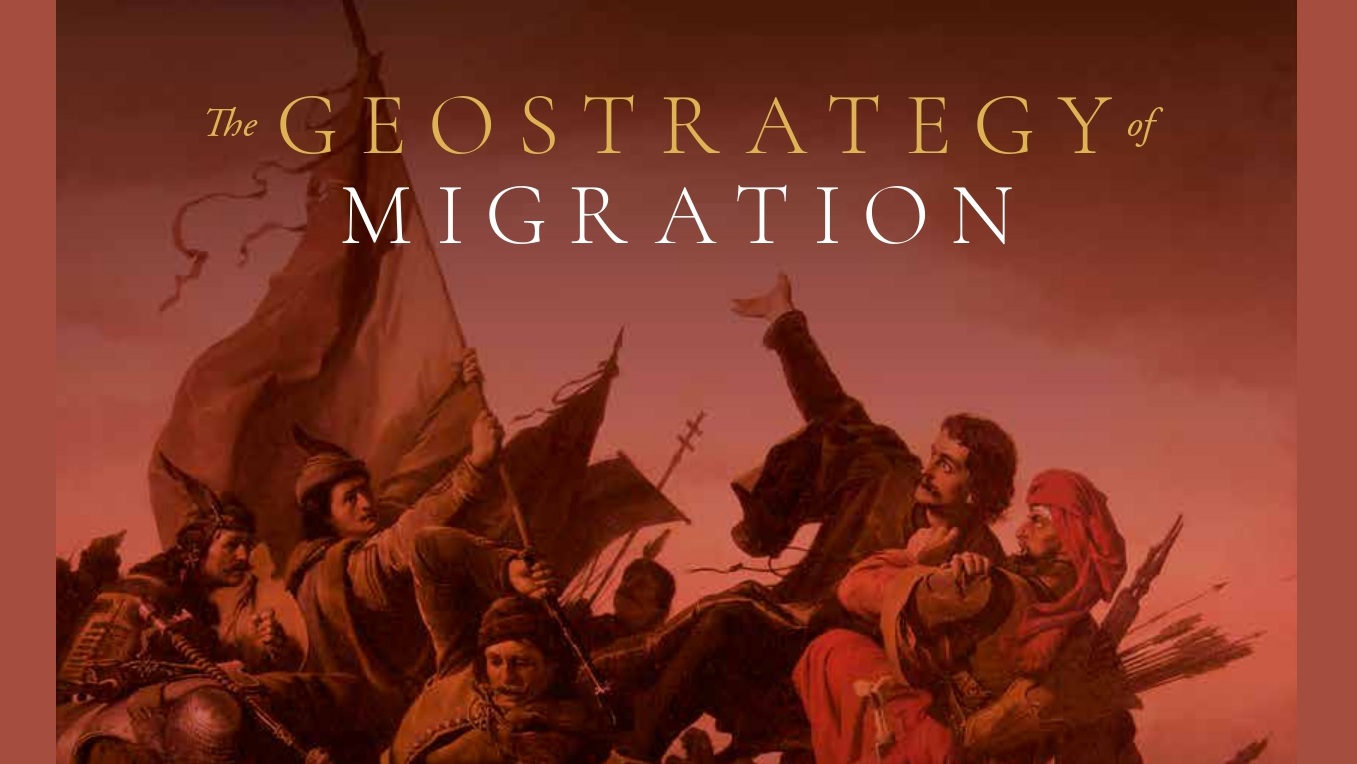
Migration continues to be a dominant topic in European politics, as it has been for over a decade. Historian Dr Tamás Dezső examines the geostrategic dimension of the migration crisis in Europe, in a special print edition of Hungarian Conservative.
In the beginning part of The Geostrategy of Migration, author Dezső makes an eloquent distinction between geopolitics and geostrategy. ‘Geopolitics is an art; geostrategy is a profession based on coldheaded, cold-blooded calculation,’ he writes, setting up the framework of his upcoming analysis.
One of the main pillars of that analysis is demography.
The Muslim-majority parts of Africa and Asia have seen a rapid expansion in population since the end of World War II. The Muslim populations of North Africa, the Middle East, Central Asia, and South Asia have increased five- to sixfold since 1950. Meanwhile, the Muslim population in Sub-Saharan Africa has increased more than sevenfold in the same time period, by more than four times the current population size of the European Union.
By contrast, the number of EU inhabitants has only increased by 140 per cent since 1950. This sharp difference in population growth between Europe and the Muslim-majority parts of the world is only projected to exacerbate in the coming decades.
The five Muslim-majority regions denoted in the analysis (North Africa, the Middle East, and Central Asia, South Asia, and Sub-Saharan Africa) are characterized as ‘a geographically and geostrategically closed system’ by the author. ‘This closed system could be compared to a pressurized steam boiler in which the pressure increases by 1 bar every year. The additional +392 million people appearing in the Muslim world and the additional +818 million people appearing in the Sub-Saharan African world will stretch apart the geographical boundaries of these zones and will move, in waves of migration, toward the path of least resistance,’ he goes on to write.
Of the geographically viable paths, all but one have insurmountable political obstacles for the wave of migrants looking to escape the ‘pressurized steam boiler’.
The right-wing populist and nationalist governments of Russia and India will not allow masses of Muslim immigrants to come into their respective nations, for fear of fuelling separatist sentiments. Both countries already have sizable Islamist minorities, so that is already a real concern for their leaderships. Also, both President Vladimir Putin of Russia and Prime Minister Narendra Modi of India have strong grips on their domestic political systems, with no meaningful change of government in sight for the foreseeable future.
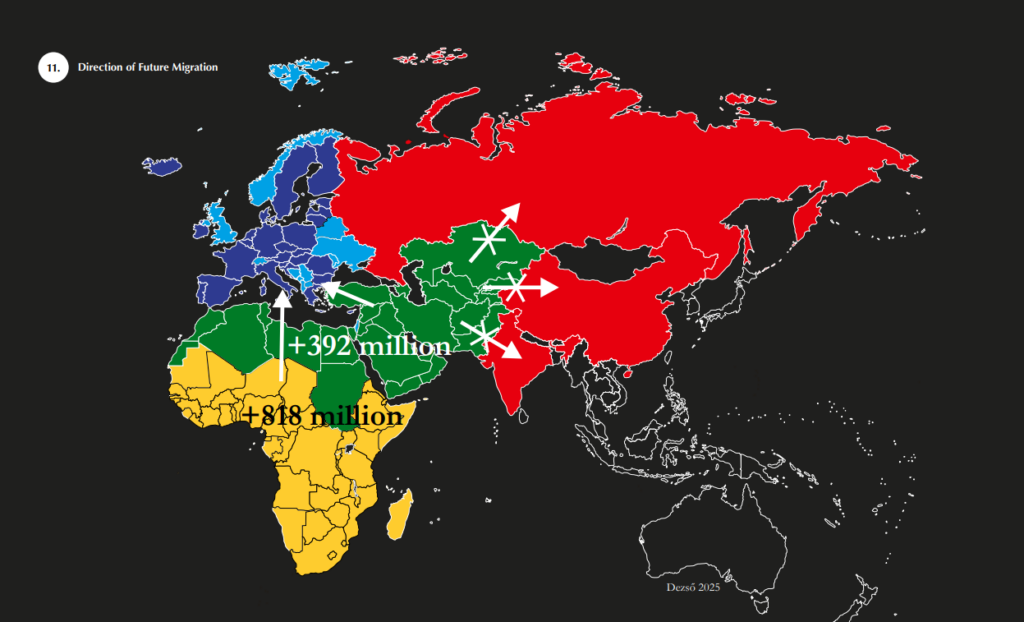
In China, the communist regime under President Xi Jinping is also unlikely to open up its borders for waves of Muslim migrants, for the same waryness of Islamist separatists. China’s treatment of its Uyghur Muslim minority is a clear testament to that.
This leaves only one viable path: Europe.
‘Europe is no longer an actor, no longer a player in the global geostrategic chess game, but rather a target,’ the author writes about the Old Continent’s position on the generational geostrategic crisis.
As he points out, during the first wave of the European migration crisis, Hungary was first to erect a physical barrier to a section of the external EU border in 2015, under the direction of Prime Minister Viktor Orbán.
The projected decrease in available freshwater resources in the next few decades, which is also expected to cause major difficulties for agriculture, adds additional emigration pressure to the high-population Muslim-majority areas, Dr Dezső warns.
Read next:
At a time when public debate is increasingly polarized and superficial, Hungarian Conservative remains committed to depth, intellectual honesty, and independent conservative thought.
Producing high-quality journalism requires resources. Your contribution helps us expand our coverage, reach new audiences, and keep our content accessible.

Please consider supporting our mission.