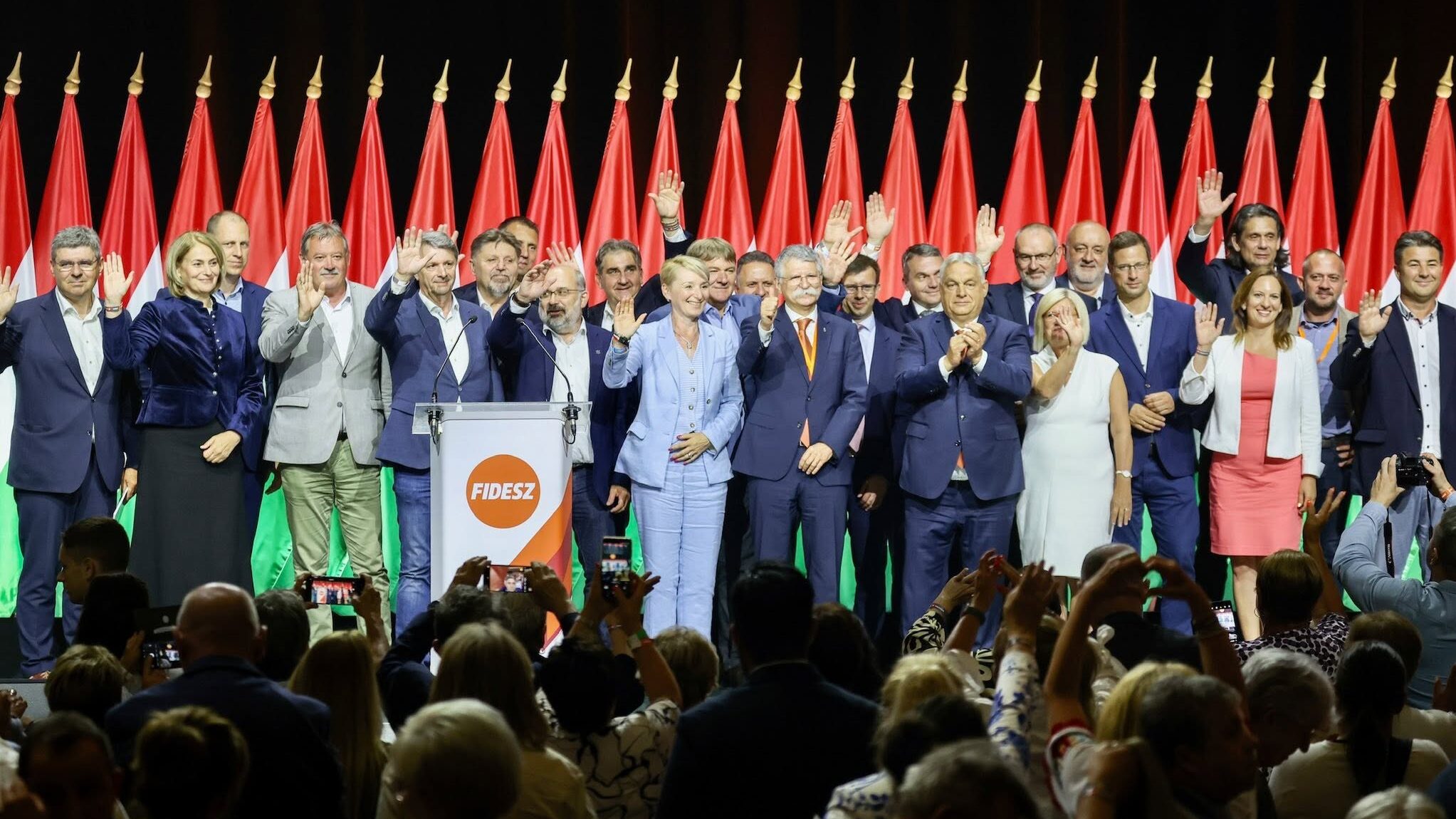
Viktor Orbán has been re-elected as president of Fidesz with an overwhelming majority, securing another year at the helm despite the party’s historic defeat in April’s parliamentary election.
According to the results announced at the party’s congress on Saturday, Orbán received 729 of 737 delegate votes. There were no challengers for the position. The congress also elected four vice-presidents: János Bóka, Kinga Gál, Alpár Gyopáros, and Bálint Kreicsi.
The result comes two months after Fidesz suffered its first parliamentary election defeat since 2006, losing power to Tisza Party led by Hungarian Prime Minister Péter Magyar, which secured a constitutional supermajority in the National Assembly. Following the defeat, Orbán briefly offered to step down as party leader, but the party’s leadership rejected the proposal and urged him to remain at the head of Fidesz.
In his address to delegates following the vote, Orbán thanked members for their confidence and reiterated that he regarded the creation of a sovereign Hungary as his life’s mission. Reflecting on Fidesz’s electoral defeat, he argued that, after sixteen years in government, a majority of Hungarians had ‘laid down their weapons’ and allowed ‘liberals to return to power’.
The former prime minister warned that the new government would open the country to ‘migration and foreign influence’, while insisting that Fidesz must reorganize itself into an effective opposition force capable of returning to government in the future. He also took responsibility for the election defeat and vowed not to retreat from political life.
‘In his speech, Orbán also offered a blunt assessment of why he thinks Fidesz lost power after 16 years in government’
In his speech, Orbán also offered a blunt assessment of why he thinks Fidesz lost power after 16 years in government. He acknowledged that the party’s campaign message had failed to resonate with voters, that Fidesz had underestimated both Tisza’s strength and the record turnout, and that its traditional mobilization methods had been outperformed by the opposition’s campaign innovations. The former prime minister further admitted that Fidesz had suffered a ‘catastrophic defeat’ in the digital sphere and lost the battle for younger voters, describing this as a personal failure.
Orbán also conceded that his government had failed to deliver the level of economic growth voters expected during its final term despite a series of family, pension, and housing measures. At the same time, he argued that corruption allegations against Fidesz had gone largely unanswered, while the economic consequences of the war in Ukraine and the EU’s sanctions policy had also contributed to the party’s defeat.
Orbán nevertheless signalled that a generational transition within the party had become necessary. He called on younger members, particularly those in their thirties and forties, to assume greater responsibilities and said he had deliberately requested only a one-year mandate in order to accelerate the renewal process.
The congress was marked by a mixture of defiance and self-criticism. Several speakers portrayed the Tisza government as ‘pursuing a politically motivated campaign’ against former Fidesz officials and public servants, while others urged organizational reform and greater openness to younger generations.
One of the most notable speeches came from long-time Fidesz member and former minister István Stumpf, who argued that Fidesz had lost its moral and intellectual leadership role in recent years and failed to learn from warning signs such as declining support among younger voters. Stumpf also criticized what he described as the excesses of politically connected business elites associated with the former governing system.
At the conclusion of the congress, Orbán struck a defiant tone, declaring that he would not change his character or abandon politics.
‘I never retreat,’ he later wrote on social media following his re-election.
Related articles:
At a time when public debate is increasingly polarized and superficial, Hungarian Conservative remains committed to depth, intellectual honesty, and independent conservative thought.
Producing high-quality journalism requires resources. Your contribution helps us expand our coverage, reach new audiences, and keep our content accessible.

Please consider supporting our mission.