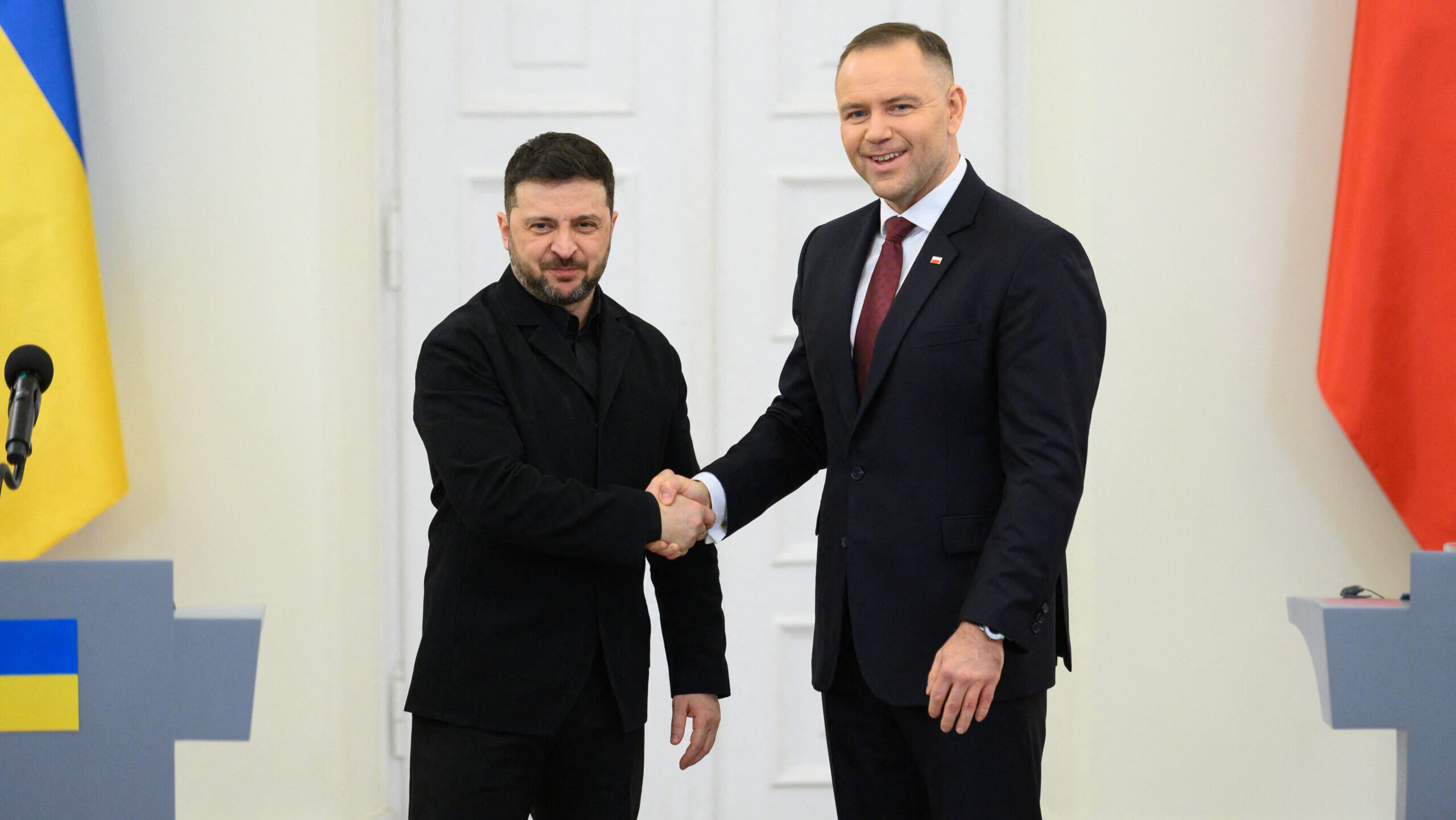
Ukrainian President Volodymyr Zelenskyy has accused Polish President Karol Nawrocki of exploiting anti-Ukrainian sentiment for domestic political gain, comparing his behaviour to that of former Hungarian prime minister Viktor Orbán as a rapidly escalating dispute over the legacy of the Ukrainian Insurgent Army (UPA) deepens tensions between Kyiv and Warsaw.
The latest exchange comes days after Nawrocki formally revoked the Order of the White Eagle—the highest Polish state decoration previously awarded to Zelenskyy by former Polish president Andrzej Duda in 2023. The unprecedented move was triggered after Zelenskyy approved the naming of the Separate Special Operations Centre North of Ukraine’s Special Operations Forces in honour of the ‘Heroes of the UPA’, reigniting one of the most contentious historical disputes between the two nations.
Speaking to Ukrainian television channel TSN, Zelenskyy dismissed Nawrocki’s decision as part of an internal Polish political struggle rather than a genuine foreign policy dispute.
‘I see this purely as an electoral process. President Karol Nawrocki is fighting for his party’s premiership against Prime Minister Tusk. It has nothing to do with us—it is an internal matter for them,’ Zelenskyy said.
The Ukrainian president went further, accusing Nawrocki of deliberately fostering hostility towards Ukrainians to strengthen his domestic political position.
‘That’s what Orbán did. This is a bad business. I believe it will end badly,’ Zelenskyy said, warning that politicians cannot build lasting political support by encouraging hatred towards neighbouring nations. He argued that such tactics ultimately damage relations between people and risk creating long-term instability.
Nawrocki quickly rejected the accusation, insisting that the disagreement has nothing to do with Poland’s domestic political rivalry and instead concerns historical memory.
‘The President of Ukraine is mistaken,’ Nawrocki said. ‘The dispute does not concern Poland’s internal politics. All patriots understand how many crimes were committed by Ukrainian nationalists on Polish lands.’ He added that Poles are not prepared to accept the glorification of the Bandera movement and that ‘all Poles know and understand how much harm Ukrainian nationalists caused to the Polish people’. According to the Polish President, the disagreement stems from fundamentally different interpretations of history rather than contemporary political calculations.
The dispute centres on the legacy of the UPA, an ultranationalist military group linked to Stepan Bandera and the Organization of Ukrainian Nationalists (OUN) that many Ukrainians regard as a symbol of resistance against Soviet domination. In Poland, however, the organization is primarily remembered for its role in the Volhynia and Galicia massacres during the Second World War, in which tens of thousands of Polish civilians were killed. Poland officially recognizes the killings as genocide and has made remembrance of the victims a central element of its historical policy.
One reason Zelenskyy’s argument may be flawed is that the controversy has generated an unusually broad consensus across Poland’s deeply divided political landscape at the time of its emergence back in May. While Nawrocki is aligned with the conservative Law and Justice (PiS) camp and remains a political rival of Prime Minister Donald Tusk, both the president and the government have condemned Kyiv’s decision to honour the UPA. Polish Minister for Foreign Affairs Radosław Sikorski previously warned that such moves undermine historical reconciliation and could be exploited by Russian propaganda.
Former Polish prime minister Leszek Miller argued that honouring the UPA is comparable to Germany naming a military unit after the Einsatzgruppen, the Nazi mobile killing squads responsible for mass murder across Eastern Europe.
‘Former Polish prime minister Leszek Miller argued that honouring the UPA is comparable to Germany naming a military unit after the Einsatzgruppen’
Zelenskyy also revealed that historical grievances had surfaced during his first meeting with Nawrocki. According to the Ukrainian president, the Polish leader presented him with a book about the Volhynia massacres during their initial encounter.
‘I’d come to see him, and his gift to me as we shook hands was a book about the Volhynia tragedy,’ Zelenskyy said, adding that he had refrained from discussing the episode publicly until now. He argued that Poland is ‘a democracy, not a monarchy’ and should continue building relations with Ukraine, which he described as defending not only itself but also the security of Europe, including Poland.
The diplomatic row has since widened beyond the two presidents. After Nawrocki revoked the Order of the White Eagle, several Ukrainian public figures, including intelligence chief Kyrylo Budanov and former Ukrainian presidents Leonid Kuchma, Petro Poroshenko and Viktor Yushchenko, announced that they would return Polish state decorations in protest. Ukrainian Foreign Minister Andrii Sybiha described the decision as a strategic mistake that benefits only Moscow and called for renewed dialogue between the two countries.
A similar position was echoed by Donald Tusk on Sunday, as he urged both sides to lower tensions and likewise described the conflict as a ‘strategic mistake’, arguing that Poland and Ukraine stand to lose economically, geopolitically, and reputationally if the dispute continues.
He said he was working with European partners to reduce tensions and stressed that ‘the conflict between Poland and Ukraine pleases Putin and shocks our allies’. Tusk added that the responsibility of both Zelenskyy and Nawrocki should be to calm emotions rather than inflame them, noting that ‘the front line is elsewhere’.
Related articles:
At a time when public debate is increasingly polarized and superficial, Hungarian Conservative remains committed to depth, intellectual honesty, and independent conservative thought.
Producing high-quality journalism requires resources. Your contribution helps us expand our coverage, reach new audiences, and keep our content accessible.

Please consider supporting our mission.