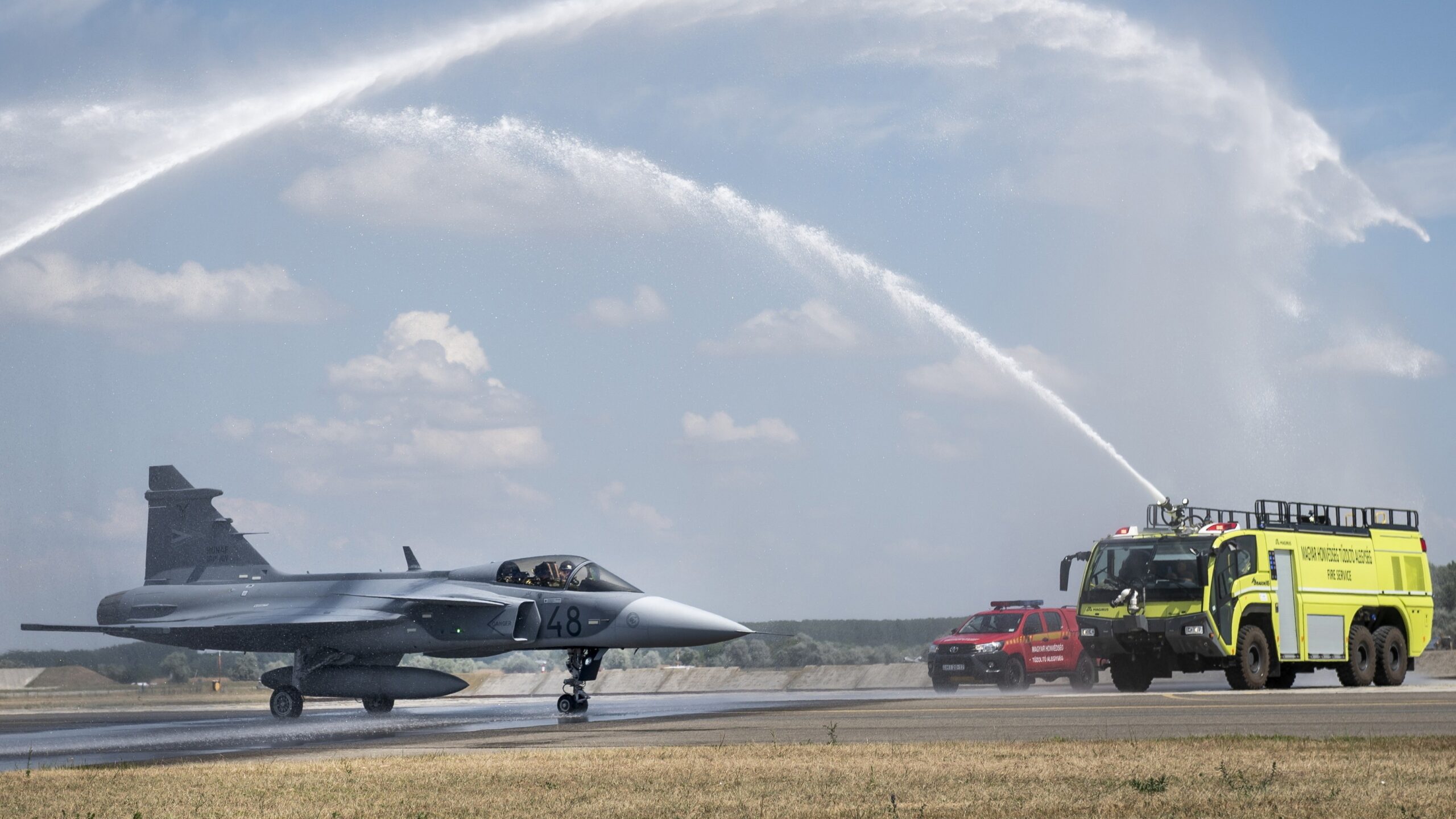
Hungary has officially inducted two new SAAB JAS 39 Gripen fighter aircraft into service, increasing the Hungarian Air Force’s fleet to 18 aircraft and marking the 20th anniversary of Swedish–Hungarian military cooperation.
The aircraft, which arrived in Hungary on 18 June, was formally received during a ceremony at the Hungarian Defence Forces’ 101st Szentgyörgyi Dezső Air Wing in Kecskemét on Tuesday. László Kürtös, parliamentary state secretary at the Ministry of Defence, said the partnership between Hungary and Sweden extends well beyond the procurement of fighter aircraft. He noted that both countries are members of the European Union and NATO, while around 40,000 Hungarians live in Sweden as respected members of society.
Kürtös also recalled the humanitarian legacy of Swedish diplomat Raoul Wallenberg, who helped save thousands of Hungarian Jews during the Second World War, and highlighted Sweden’s decision to accept approximately 8,000 Hungarian refugees following the 1956 Revolution.
Marking two decades of Gripen operations, the state secretary recalled that the first Swedish-built fighter aircraft entered Hungarian service in 2006. After achieving full operational capability, the Gripens assumed responsibility for protecting Hungarian airspace. Today, the aircraft not only form the backbone of Hungary’s air defence but also contribute to NATO air policing missions over Slovenia, Croatia, and Slovakia, as well as regular deployments to the Baltic region.
Kürtös said the completion of Hungary’s planned fleet expansion comes at a particularly important time, given the current security environment and Hungary’s proximity to the war in Ukraine. ‘The completion of the Hungarian fleet with the delivery of four additional Gripen fighter aircraft further strengthens NATO’s eastern flank,’ he said. He added that Sweden also benefits from the partnership, as Hungary has committed to operating the Gripen fleet until at least 2036, while Hungarian participation in Baltic Air Policing missions contributes to Sweden’s security.
The Hungarian government also aims to broaden strategic cooperation with Sweden, particularly in research, development, and innovation. Kürtös highlighted SAAB’s recently established Flight Development Centre in Hungary, which focuses on Gripen software development, describing it as a significant opportunity for the country’s aerospace industry.
Major General Carl-Fredrik Edström, representing the Swedish Defence Materiel Administration (FMV), described the Gripen as a reliable and cost-effective fighter aircraft designed to deliver high performance with a relatively small logistical footprint. He said the platform continues to evolve through ongoing software, sensor, and weapons upgrades, enabling it to respond to changing security threats.
According to Edström, the newly delivered aircraft are considerably more advanced than those introduced two decades ago, while future generations of Gripen fighters will offer even greater combat capabilities. As NATO allies, Sweden and Hungary will increasingly cooperate on missions extending beyond aircraft procurement, particularly in the fields of integrated air and missile defence, he added.
Lars Tossman, head of SAAB’s business development division, said Hungary’s fleet of 18 Gripens provides enhanced capabilities for protecting both national sovereignty and NATO airspace.
He added that SAAB’s Flight Development Centre in Budapest represents a long-term partnership that extends beyond aircraft operations. The facility will become part of SAAB’s global Gripen development network, contributing to research and development of future technologies for the fighter platform and reinforcing Hungary’s role as a strategic partner in its continued modernization.
With the arrival of the two new aircraft, the Hungarian Air Force now operates a fleet of 18 Gripens, consisting of 16 single-seat combat aircraft and two twin-seat variants used for both operational and training purposes. The ceremony concluded with an aerial demonstration by First Lieutenant Csongor Mészáros.
Related articles:
At a time when public debate is increasingly polarized and superficial, Hungarian Conservative remains committed to depth, intellectual honesty, and independent conservative thought.
Producing high-quality journalism requires resources. Your contribution helps us expand our coverage, reach new audiences, and keep our content accessible.

Please consider supporting our mission.