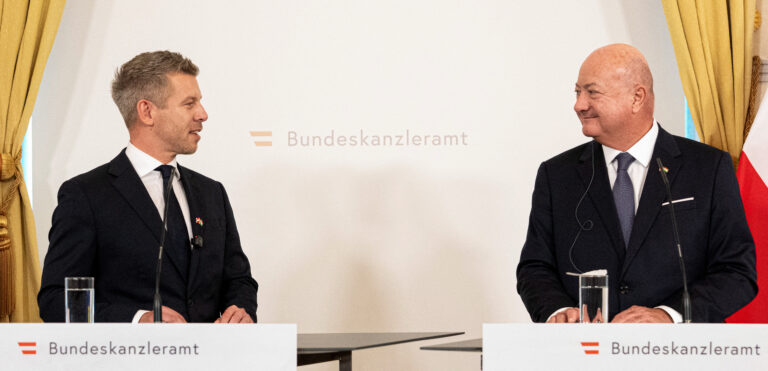

After last week’s historic vote in the European Parliament to approve the new Return Regulation—which, among other stricter measures, creates the legal framework for establishing so-called return hubs outside the bloc—EU member states are already working to set up the facilities and accelerate the currently lagging deportation of illegal migrants and rejected asylum seekers.
According to a letter seen by POLITICO Brussels, more than half of the EU’s 27 member states called this month for swift action to establish the first return hubs, with Denmark, Austria, Greece, and the Netherlands spearheading the push. ‘Our goal is to conclude the first agreements for the creation of these structures in 2026, so that they are operational from 2027,’ Greek Prime Minister Kyriakos Mitsotakis explained ahead of last week’s vote.
The new Return Regulation was passed on 17 June by 418 votes to 218, with 30 abstentions, after being backed by a coalition of the European People’s Party (EPP), Patriots for Europe (PfE), the European Conservatives and Reformists (ECR), and the Europe of Sovereign Nations (ESN). The legislation introduces the toughest deportation framework in EU history, including detention periods of up to 24 months, limits on appeal-based delays to removals, expanded entry bans for those ordered to leave, and, most importantly, the formal authorization of return hubs outside the bloc.
The Search for Europe’s First Offshore Return Hubs
According to POLITICO, there is also increasing speculation about which countries could host the first centres. Two EU diplomats speaking to the outlet said there are no concrete proposals yet, as the ‘political and diplomatic process still needs to play out’.
However, discussions have reportedly focused on three countries: Rwanda, Uzbekistan, and Uganda. As Cypriot Migration Minister Nicholas Ioannides pointed out, the general idea is to establish the centres somewhere in ‘Africa or Asia’, not geographically close to EU borders. Countries such as Egypt or Libya are generally ruled out because of concerns related to human traffickers and smugglers.
The EU has funnelled hundreds of millions of euros into Rwanda through its Global Gateway programme, announcing a €900 million investment package in 2023. Uganda has also been a major beneficiary of EU funding, receiving €539 million in development assistance for the 2021–2027 period alongside a Global Gateway investment package worth more than €200 million announced in 2024. The bloc has likewise allocated €119 million in grant funding to Uzbekistan.
Of the three countries reportedly being discussed as potential hosts, one already has experience with previous European efforts to outsource deportations. Rwanda was the centrepiece of both Boris Johnson’s and Rishi Sunak’s plans to relocate asylum seekers for processing and potential resettlement. However, the scheme was repeatedly blocked by courts because of human rights concerns and was ultimately abandoned following Labour’s victory in 2024, despite costing hundreds of millions of pounds. Denmark also explored a similar arrangement with Rwanda after adopting legislation allowing asylum processing outside Europe, but the initiative never became operational. Italy’s Albania centres have similarly been repeatedly delayed by court rulings.
Next Hurdle: Making Return Hubs Actually Work
Despite the approval of the new EU deportation rules, these failed attempts by individual member states already foreshadow how difficult the establishment of return hubs may prove in practice. Ministers from member states have already stressed that ‘the protection of human rights will be a yardstick’ in agreements between EU countries and host states, while calling on international organizations to help ensure that ‘the rules are upheld’.
As examples from recent years demonstrate, expansive judicial interpretations of human and asylum rights can significantly hinder deportation efforts. Opponents of the recently approved legislation and the return-hub concept are already attacking the policy from this perspective, arguing that the EU cannot guarantee that the rights of migrants transferred to such facilities would be adequately protected.
‘Failed attempts by individual member states already foreshadow how difficult the establishment of return hubs may prove in practice’
French President Emmanuel Macron has emerged as one of the most vocal critics of the scheme. While supporting a tougher return policy in principle, he argued that he had ‘never seen a return centre in a third country that actually works’. Speaking after last week’s EU summit, Macron also questioned whether the proposal was compatible with European values, stating that he was ‘not sure that’s what our Europe is about’ and that he did not believe such centres were effective.
Spain has similarly opposed the idea, while Green MEP Mélissa Camara argued that return hubs in countries such as Rwanda or Uzbekistan would make it impossible to guarantee compliance with migrants’ fundamental rights.
While discussions about potential host countries are taking place at the EU level, it will ultimately be up to individual member states to negotiate and conclude their own agreements. The European Commission—which has not been directly involved in the discussions on selecting host countries—and other EU member states must be informed before any return hubs become operational.
Related articles:
At a time when public debate is increasingly polarized and superficial, Hungarian Conservative remains committed to depth, intellectual honesty, and independent conservative thought.
Producing high-quality journalism requires resources. Your contribution helps us expand our coverage, reach new audiences, and keep our content accessible.

Please consider supporting our mission.