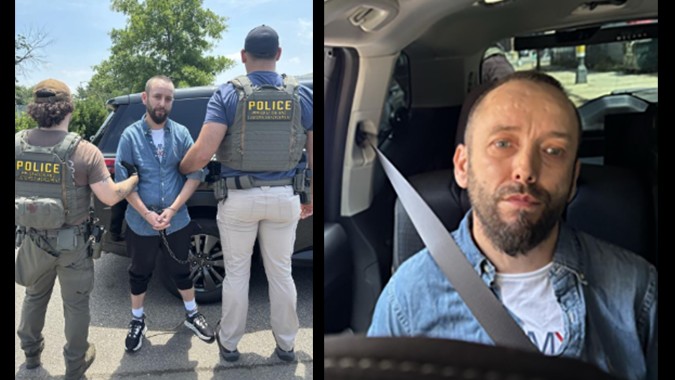
A Hungarian Romanian national with a previous credit-card-fraud conviction is awaiting deportation from the United States after Immigration and Customs Enforcement (ICE) officers tracked him down in Washington, DC, where he was also wanted in neighbouring Virginia for allegedly returning to the same kind of crime.
Sebastian Mihai Caraba was arrested on 10 June by ICE Washington’s Fugitive Operations Team. Authorities say he was wanted in Fairfax, Virginia, for illegal use of credit cards. An immigration judge issued a final removal order on 22 June, and ICE says he will remain in federal custody until physically removed from the country.
The case stretches back years. ICE says Caraba had previously been convicted abroad of illegal use of credit cards and sentenced to three years in prison. He later entered the US through San Juan, Puerto Rico, on 11 August 2018 under the Visa Waiver Program, after two earlier visits in which he left on time. This time, he stayed. The programme permits visits of no more than 90 days, meaning his authorized stay would have expired in late 2018.
Visa Waiver entrants also waive most rights to contest removal, apart from asylum claims. Just 12 days separated Caraba’s arrest from his final removal order. Acting ICE Director David J Venturella said he had allegedly ‘returned to the same criminal conduct’ after overstaying his admission.
His Hungarian nationality appears to have been what allowed the visa-free entry: Hungary joined the Visa Waiver Program in 2008, while Romania was not designated until 2025, and that designation was later rescinded. Romanian municipal records, meanwhile, repeatedly list a Sebastian-Mihai Caraba at an address in Satu Mare, north-western Romania, including in 2014, 2022 and 2025.
ICE’s recent Facebook post showing his photograph and calling him a ‘Hungarian-Romanian criminal illegal alien’ prompted a bitter debate in the comment sections between Hungarians and Romanians, fighting over whose criminal he was.
‘If nothing else, this post has accomplished something remarkable: it gave Romanians and Hungarians a point of unanimous agreement. Neither side wants to take credit for this gentleman,’ one commenter joked. Another user similarly pointed out how ‘both Hungarians and Romanians got triggered by this’.
Others turned to basic linguistic characteristics, highlighting that ‘Sebastian’, ‘Mihai’ and ‘Caraba’ are unmistakably Romanian rather than Hungarian names. The rebuttal came almost immediately: ‘He’s 100% Hungarian….you guys can have him,’ one commenter wrote, while another pleaded: ‘Please send him to Hungary, not Romania. Thx.’ By then, the question of who should claim Caraba had become an ‘online war’ of its own, with people on both sides joking that neither Romania nor Hungary appeared particularly eager to welcome him home.
The jokes sit on top of a very real historical fault line. Transylvania belonged to the Kingdom of Hungary before the First World War, but the 1920 Treaty of Trianon transferred it to Romania, leaving a large Hungarian community on the Romanian side of the new frontier. Northern Transylvania returned to Hungary in 1940 before being awarded to Romania again after the Second World War.
Since then, minority rights and successive Hungarian governments’ relations with ethnic Hungarians in Romania have remained sensitive issues. In 2011 the Orbán government introduced simplified naturalization for people able to demonstrate Hungarian citizenship or ancestry and sufficient language knowledge. The scheme precisely targeted those Hungarians living beyond the country’s modern borders but historically part of the nation. The largest share of applicants came from Transylvania.
Related articles:
At a time when public debate is increasingly polarized and superficial, Hungarian Conservative remains committed to depth, intellectual honesty, and independent conservative thought.
Producing high-quality journalism requires resources. Your contribution helps us expand our coverage, reach new audiences, and keep our content accessible.

Please consider supporting our mission.