
The latest PISA results have delivered another grim milestone for global education. Across the OECD, 15-year-olds recorded an average reading score of 461 in 2025, down 14 points in just three years and 28 points since 2015. Reading and mathematics are now at their lowest OECD averages since PISA began, while science has proved markedly more resilient. Across 35 OECD countries with comparable data, reading fell by 25 points between 2018 and 2025—roughly the difference the OECD associates with at least one year of schooling.
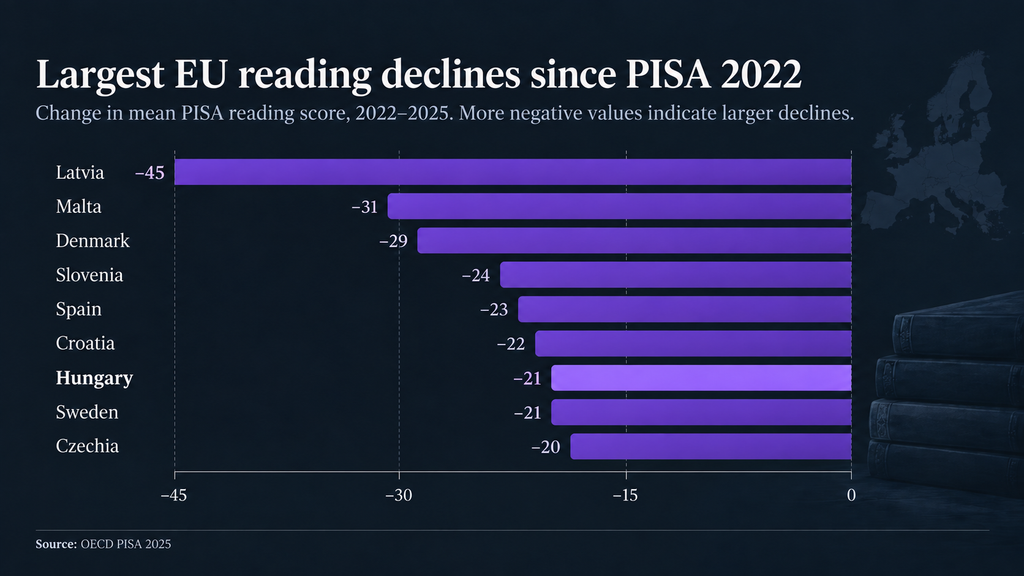
If one looks at the European results, it is hard to find anything that gives reason for optimism. Latvia lost 45 reading points since 2022, Malta 31, Denmark 29, Slovenia 24, Spain 23, while Hungary and Sweden both lost 21. Hungary’s 452-point reading result is its worst in PISA history; Spain’s results are among its weakest ever. Yet this is not a specifically European problem. Of 74 education systems with comparable data since 2018, 56 recorded a significant decline in reading.
More revealing than the league tables is what pupils increasingly struggle to do. PISA found particularly large losses on longer texts and tasks requiring students to evaluate, reflect, remember, and integrate information, while simple information retrieval held up better. The share of accurate, fluent readers fell by around seven percentage points between 2018 and 2025, while ‘hasty readers’—those giving fast but incorrect answers—almost doubled, from 6.6 to 11.4 per cent. Performance also deteriorated more towards the end of the test, pointing to weaker sustained engagement rather than a uniform loss of knowledge.
The problem is even clearer if we look at the motivational side of the question. Curiosity, perseverance, and engagement with learning have weakened across much of the PISA universe.
A Generation That Never Has to Be Bored
Many attribute the downward trajectory to COVID-19 and its negative impact on students. The 2025 cohort, whose results are now being examined, was around ten or eleven when the pandemic struck, at an age when children normally progress from acquiring basic literacy towards more advanced comprehension. Looking deeper into the data, however, the deterioration was already visible well before COVID. The pandemic appears more likely to have accelerated a deeper change than created it.
Digitalization is an obvious common pressure, even if PISA cannot prove it is the cause. This generation grew up during the rapid spread of personal electronic devices and an information environment increasingly dominated by social media, games, rapid switching, and short-form content. The OECD itself points to changes in digital behaviour as relevant context.
And we only need to go back a generation or so to find the contrast that might have a major role in what is now reflected in deteriorating PISA reading results. Imagine a child reading a book in 1995. Twenty pages in, the story slows. He becomes bored. He can stare at the ceiling, look out of the window, go outside, or switch on the television—if there is anything worth watching. The alternatives exist, but they involve some effort, waiting, or a change of activity. Quite often, the child eventually returns to the book.
The equivalent child in 2026, the so-called Generation Alpha, needs only move a thumb. A meme, football highlight, message, game, or 15-second video arrives instantly; if it fails, another replaces it within a second. The emergence of artificial intelligence itself has made the palette of these choices almost infinite in scale. The difference, therefore, is not that children once had no distractions, but rather that escaping boredom now requires almost no effort: an effectively endless stream of immediately rewarding alternatives is permanently within arm’s reach.
‘Escaping boredom now requires almost no effort: an effectively endless stream of immediately rewarding alternatives is permanently within arm’s reach’
Living in such an environment may contribute to weaker tolerance for sustained, low-stimulation tasks, as one increasingly discussed hypothesis suggests, pointing to the fact that the deterioration itself is characterized by fast but inaccurate answers, weaker persistence, and difficulty maintaining engagement with longer texts. Reading requires almost the opposite habit: confusion or boredom followed by concentration, understanding, and delayed reward.
Technology, however, cannot explain everything. If it did, a highly digitalized society such as Japan should be collapsing too. Instead, 81 per cent of Japanese students still reach at least baseline reading proficiency, while 11 per cent reach Level 5 or higher. Japan has also spent decades promoting reading habits through schools, libraries, families, reading aloud, and practices including morning reading.
That leads us to the missing variable, which may lie partly in what happens before and beyond school. Early storytelling, parents reading aloud, children seeing adults read, books in the home, conversations about stories, quiet routines, and adults themselves putting their phones away all form habits of attention before a child ever encounters a PISA paper.
The OECD reports that family support declined between 2022 and 2025 in almost all participating countries, with particularly pronounced falls among boys and disadvantaged students. The problem, therefore, may not be phones versus schools, but a new digital pressure interacting with weakening habits that once counterbalanced it.
Solution Beyond Educational Reform
Hungary fits that pattern uncomfortably well. Only 68 per cent of Hungarian students now reach at least Level 2 in reading, while just 3 per cent reach Level 5 or above, where pupils must comprehend lengthy texts and handle abstract or counterintuitive ideas. Hungary is not an EU bottom performer like Romania or Bulgaria; its problem is the speed of deterioration. Spain, at 451 and down 23 points, is a close parallel.
Hungarian family indicators have weakened as well. The share of students discussing problems at school with their parents at least weekly fell from 67 to 57 per cent between 2022 and 2025. Only 67 per cent now say they are curious about many different things, 6.1 percentage points fewer than three years earlier.
Speaking on Tuesday, 8 September, Education Minister Judit Lannert explicitly linked the global deterioration in reading comprehension to greater use of digital devices at the expense of traditional reading. She also highlighted that Hungarian parents are talking less with their children about school and announced that the ministry intends to establish a dedicated working group to improve parental engagement.
Some of the government’s response was already taking shape before the PISA release. In August, the ministry sent primary schools its voluntary ‘Make Learning an Experience!’ package, recommending shared morning reading, story listening, quieter starts to the school day, more flexible learning blocks, and methods explicitly intended to reduce attentional strain and create more space for deeper learning.
While education policy is an area where assessment is only possible after years of implementation, these are already positive early indications that the problem is being addressed where it should be. There is, however, significant room for improvement; the good thing is that the necessary policies do not need to be invented from scratch.
‘While reading has declined across most of the developed world, several countries have either resisted it better or stabilized after an earlier fall’
While reading has declined across most of the developed world, several countries have either resisted it better or stabilized after an earlier fall. Japan and Italy are the clearest long-term examples, with broadly stable reading performance since 2018. Lithuania has declined only moderately, while Poland and Slovakia suffered larger losses earlier but avoided another collapse between 2022 and 2025.
Japan has institutionalized children’s reading through national plans, school libraries, reading aloud, and morning reading. Italy embedded reading promotion in national legislation in 2020. Lithuania takes intervention into infancy through ‘Book Start’ for children aged zero to three and a ‘Dads Read to Children’ campaign. Poland’s 2021–25 National Reading Development Programme had a planned budget of nearly PLN 1.1 billion (around €255 million) for libraries and wider access to books. Slovakia, although still a comparatively weak reading performer, has recently stabilized, with family-support and curiosity indicators holding up much better than in many countries.
What is common in these nations? Their education systems, political traditions, and technological cultures are not particularly similar, that much is certain. What several do share is the treatment of reading as something cultivated before and beyond the classroom—through families, preschools, libraries, communities, and protected reading routines.
A Generation Between Two Worlds
Behind their policies lies something older than any literacy programme: preserving a family culture in which parents and children actually spend time together. Reading a story aloud, discussing what was read, sitting through a quiet evening without everyone disappearing into a separate screen, or simply learning to enjoy one another’s company without constant digital stimulation may look like ordinary features of traditional family life. But they are also forms of education.
A child discovering that a long story eventually rewards the effort invested in it—or simply that an hour without a phone need not be filled immediately—is practising patience, sustained attention, delayed gratification, and the ability to remain with something after the first moment of boredom. Preserving those habits therefore means simultaneously preserving a culture and transmitting skills that the modern technological environment may no longer offer automatically.
And that gives Millennials and the oldest members of Generation Z a serious generational responsibility. People now around 30, including the author of these lines, belong to one of the last broad generations to remember a pre-smartphone childhood while also living fully inside the digital world. When we were teenagers in the early 2010s, only around one in 20 Hungarians aged 14 or over owned a smartphone; today, three-quarters of Hungarian children already have their own mobile phone by age ten. We encountered the transition gradually, while today’s children are born into a highly developed, mature system.
‘We are among the only generations capable of understanding what it is like to grow up both with and without much of the digital world around us’
That means we are among the only generations capable of understanding what it is like to grow up both with and without much of the digital world around us, and the positive and negative impacts of it, while also having some idea, from our own experiences, of what needs to be conserved from the ‘real’ world. That responsibility towards future generations could hardly be heavier.
We cannot hand children the most sophisticated attention-capturing technologies ever created and then blame them for failing to develop habits their environment rarely asks them to practise. Earlier generations did not have to deliberately manufacture boredom, uninterrupted conversation, or long stretches without personalized entertainment; those conditions simply existed.
The task, however, is not to recreate the 1990s or turn technological progress backwards. It is to ensure that the human capacities and skills developed in that older environment survive in the new one. Otherwise, the generation with more written knowledge within reach than any before it may become progressively less able to remain with that knowledge long enough to understand it.
Related articles:
At a time when public debate is increasingly polarized and superficial, Hungarian Conservative remains committed to depth, intellectual honesty, and independent conservative thought.
Producing high-quality journalism requires resources. Your contribution helps us expand our coverage, reach new audiences, and keep our content accessible.

Please consider supporting our mission.