On 24 March Russian forces launched a drone attack upon the historic centre of Lviv. A residential building was damaged and reports indicate that the assault may have affected UNESCO World Heritage sites. This was reported by the head of the Lviv Regional Military Administration Maksym Kozytskyi and Lviv’s Mayor Andrii Sadovyi.
The war in Ukraine has once again carved a wound into the body of Europe: a wound that ought not to exist in the 21st century. The drone strike upon Lviv’s historic heart set ablaze the Bernardine Monastery, a sacred site that for centuries has stood as a bastion of Christian faith and European culture.
The fire consumed more than stone and timber; it seared itself into the collective memory of civilization. The monastery’s silhouette in flames is no mere image of war: it is indictment, warning, and mourning all at once. It demonstrates that the sacred heritage of Ukraine is gravely vulnerable under the relentless pressures of a full‑scale war. At least 22 people were injured, some grievously. Yet the true loss cannot be measured in numbers alone, for these wounds rend the very fabric of shared European memory.
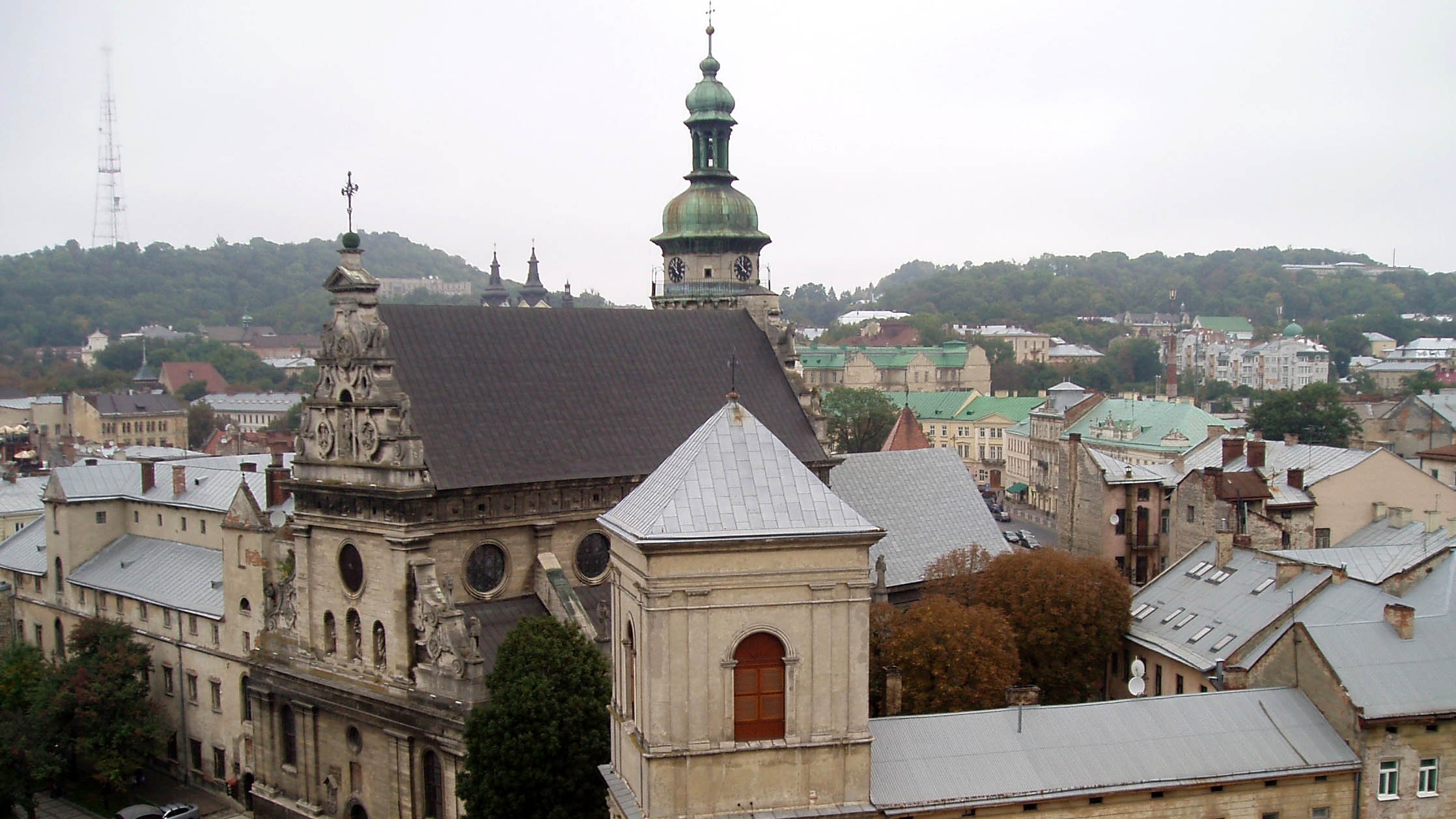
The significance of the monastery extends far beyond its walls. Built between 1600 and 1630 in the late Renaissance and Mannerist style, the three‑aisled basilica is crowned by a 38‑metre Baroque clock tower, a defining feature of Lviv’s cityscape. Its interiors are adorned with rich Baroque frescoes painted by Benedykt Mazurkevych between 1738 and 1740, and the church is graced with 18 carved wooden altars. Originally situated beyond the city walls, it also served defensive purposes; traces of this role remain visible in the Hlyniany Gate and surviving fortifications. The Church of St Andrew continues as a functioning Greek Catholic parish under the Basilian Order, while the monastery buildings house the Central State Historical Archives, one of Central and Eastern Europe’s most extensive collections, preserving documents dating back to the 12th century.
The Bernardine Monastery of Lviv was founded in the 15th century, belonging to the Observant branch of the Franciscan Order, which maintained an extensive network across the Kingdom of Hungary. Active connections flourished between Hungarian and Polish Franciscan communities; friars moved between provinces, fostering both theological and organizational cooperation. Later, in 1772, Lviv fell under the Habsburg Monarchy following the First Partition of Poland and remained within its administration until 1918, strengthening Central European, particularly Hungarian, ecclesiastical and cultural ties.
‘The atrocities against Christian life are occurring practically on our doorstep’
Roughly 70 to 75 per cent of Ukraine’s population identifies as Christian. One of the war’s less frequently remarked, yet profoundly disturbing, consequences is that the faithful themselves, along with their churches and monasteries, are becoming victims of destruction. Persecution of Christians is not merely a distant issue in the Middle East; it is a present and pressing reality in Eastern Europe. For centuries, a fundamental principle of Christian Europe was respect for sacred spaces, even amidst conflict. The current war, however, demonstrates that modern warfare increasingly disregards these moral boundaries, which once formed the bedrock of civilized society.
Lviv is scarcely 150 kilometres from Záhony in a straight line. The atrocities against Christian life are occurring practically on our doorstep. This is not the first time Europe has witnessed churches in flames. The 2019 fire at Notre Dame in Paris shook the continent even in peacetime, and during the Balkan wars Orthodox and Catholic churches became deliberate targets. Yet, in the 21st century, hybrid warfare has escalated the destruction: sacred sites have become instruments of war.
Numbers are relentless and carry a grim message. In Ukraine, more than sixteen hundred cultural heritage sites have been damaged or destroyed by the ravages of war. These are not isolated accidents, nor a sequence of unfortunate events; they constitute a deliberate assault upon the memory, identity, and history of a nation, striking at the spiritual and cultural foundations of Europe itself.
The views expressed by our guest authors are theirs and do not necessarily represent the views of Hungarian Conservative.
Related articles:
At a time when public debate is increasingly polarized and superficial, Hungarian Conservative remains committed to depth, intellectual honesty, and independent conservative thought.
Producing high-quality journalism requires resources. Your contribution helps us expand our coverage, reach new audiences, and keep our content accessible.

Please consider supporting our mission.