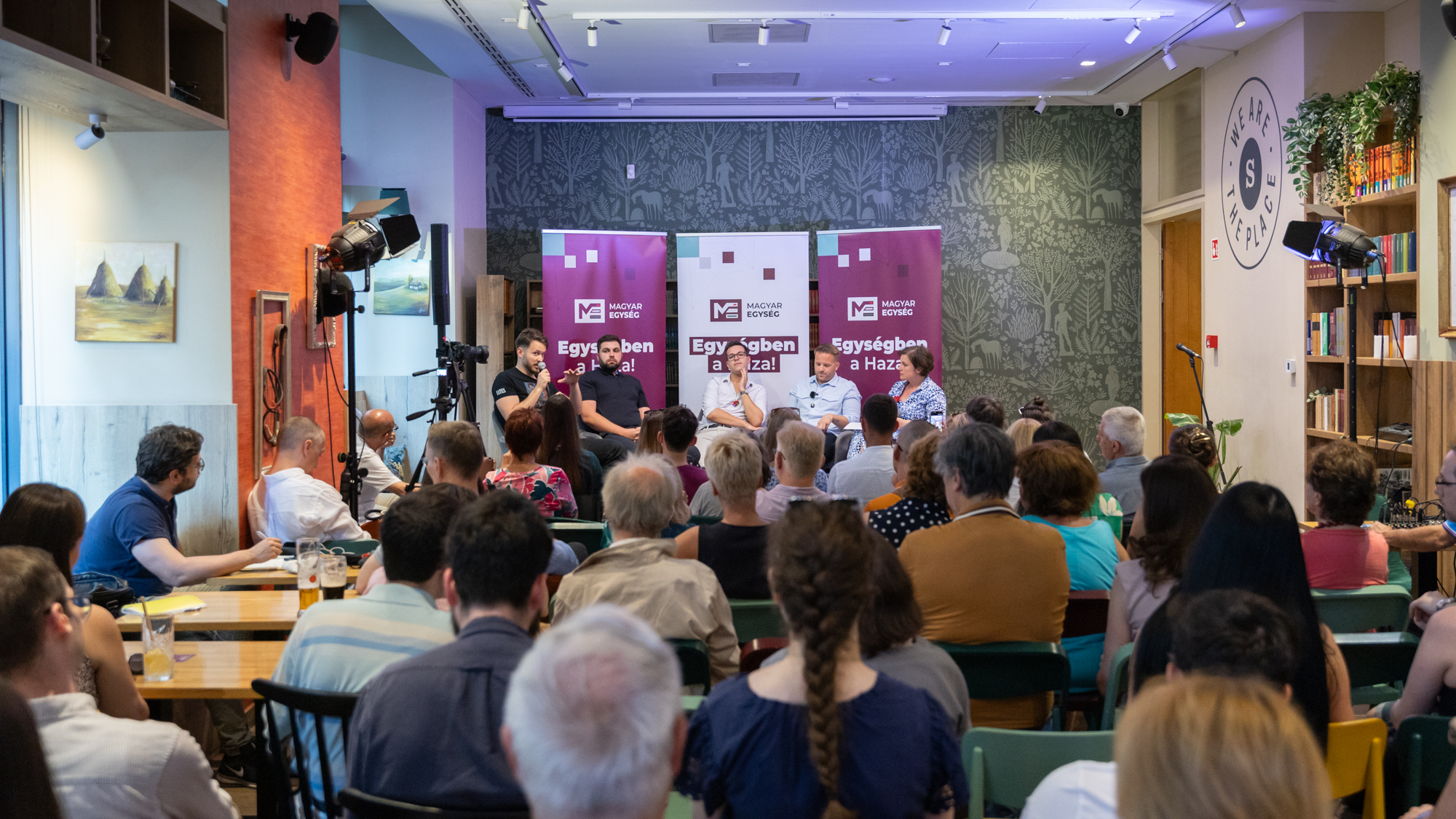
The result of the 12 April election in Hungary has impacted the funding of many right-leaning media outlets in the country. To discuss the way forward, the Hungarian Unity Movement (Magyar Egység Mozgalom) organized an event at the Scruton Café V.P. in Budapest, Hungary, on Thursday, 25 June.
Máté Litkei, President of the Hungarian Unity Movement, was the first to address the audience. He started by quoting Hungarian hero of the 1848 Revolution, Lajos Kossuth, who said: ‘Take everything from us, just give us free press.’ Mr Litkei told the audience that this declaration is relevant today as well, as the press has the power to influence the public and decide what questions are important and what questions are to remain in the background.
He added that while much legitimate criticism can be levelled at the previous Fidesz government, it is important to acknowledge that a strong opposition media operated throughout its tenure. Any actions taken against opposition media outlets were mistakes, Mr Litkei argued.
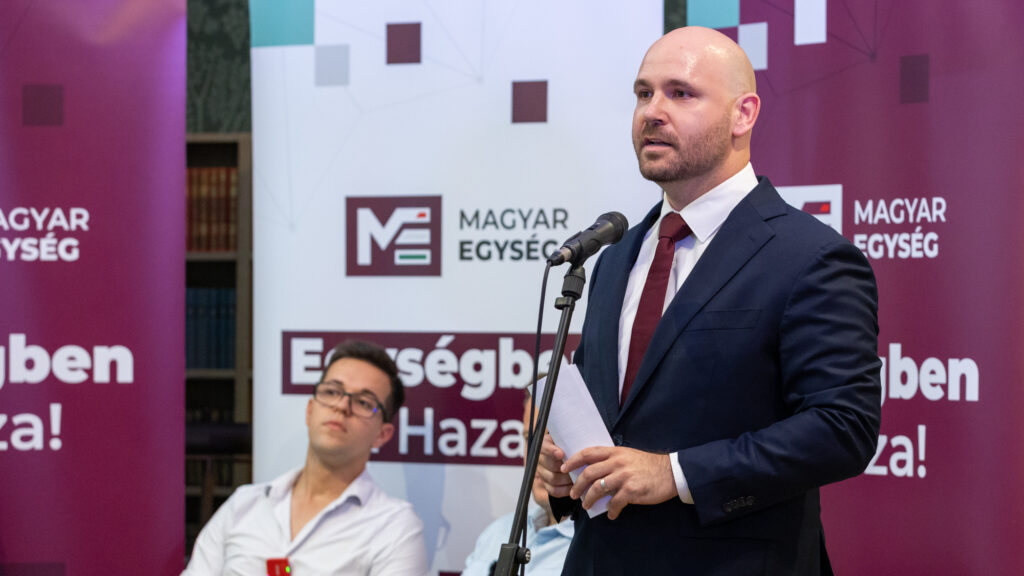
The speaker also stated that the business models for right-wing media companies of the previous government will not work under this administration, and companies must mobilize their audiences for support. ‘We are now dependent on each other,’ he told those in attendance.
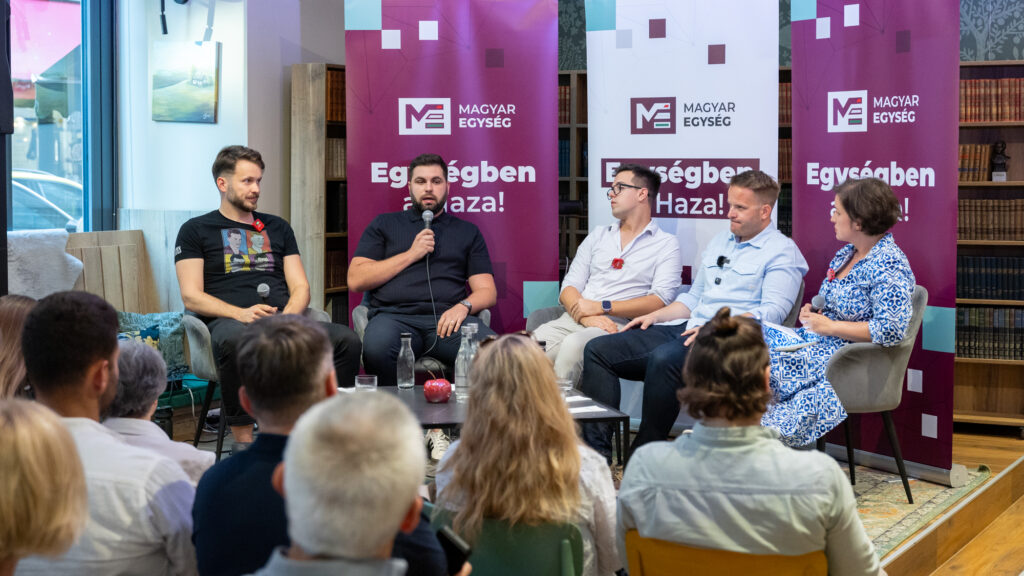
After Mr Litkei’s opening remarks, a panel convened on stage to further explore the topic. It featured reporter Dániel Bohár, foreign affairs journalist Mátyás Kohán for Mandiner, Editor-In-Chief of Magyar Jelen Tamás Horváth, and Editor-In-Chief of Köztér Dániel Kurucz. Mariann Őry, journalist for Demokrata, served in the role of the moderator.
Mr Bohár started by lauding the fact that the event had a packed house despite the summer heat. He jokingly blamed the heatwave on Prime Minister Magyar, making fun of the attitude of the opposition media under the Orbán administration. On a more serious note, he acknowledged that no one on stage—including himself—or in the broader Hungarian right-wing media foresaw the landslide victory of PM Magyar’s Tisza Party in the April election.
However, the last two and a half months have taught him to see the opportunity in every situation. For example, he is enjoying the content he has been creating lately, where he visits the Budapest Parliament Building to shoot videos of himself questioning the ‘politician trainees’ of Tisza.
Mr Kohán declared that there is a ‘credibility crisis’ in Hungarian right-wing media, due to the widely inaccurate forecasts they gave for the 2026 parliamentary election. This, in his opinion, makes their audience wonder if the pundits were intentionally lying to them or were genuinely that wrong in their predictions. He added that this is a major problem, as a journalist’s professional value comes from people believing that they are honest and have knowledge about the subjects they are reporting on.
Thus, the speaker continued, conservative media in Hungary has a two-prong problem: one of credibility and one of funding. Mr Kohán argues that the former should be fixed first, which then, in turn, will help fix the latter. On the issue of funding, he also stated that most people in the conservative media sphere understood that the previous model of financing under PM Orbán’s government was not sustainable anyway.
Mr Horváth pointed out that right-wing content creators with creativity and genuine convictions in their beliefs can still have a large reach in social media, even after the 12 April election. He also stressed the importance of allowing debate on conservative platforms and stated that the right-wing voters of Tisza are starting to realize that the party is ‘SZDSZ reincarnated’, referring to the now-defunct Hungarian socially liberal political party of the 2000s.
Mr Kurucz opined that taking responsibility is the most important task of conservative politicians and media figures in Hungary at this time. ‘Many in the Fidesz Party are “analogue clocks” in a digital age,’ he added in his criticism. He then stated that the most important duty of a journalist is to inform the public, even when they are trying to hold you down.’
Mr Bohár pointed out that, in retrospect, it is hard to take the accusations of bias and lack of objectivity from the opposition media under the previous administration seriously, since now ‘half of the RTL newsroom is in the Tisza government’, as he put it. RTL is one of the two major commercial TV stations in Hungary, the news programme of which has been highly critical of Prime Minister Orbán and the Fidesz Party. He brought up Vanda Szondi, a former RTL host who is now a Deputy State Secretary in PM Magyar’s administration, as one example.
Mr Kohán added that what left-wing media described as government propaganda under PM Orbán is actually ‘politically parallel media’, which is the norm in politically polarized countries, he explained, such as Germany. He shared that such partisan media does not exist only in countries where national support is very segmented among many parties.
Related articles:
At a time when public debate is increasingly polarized and superficial, Hungarian Conservative remains committed to depth, intellectual honesty, and independent conservative thought.
Producing high-quality journalism requires resources. Your contribution helps us expand our coverage, reach new audiences, and keep our content accessible.

Please consider supporting our mission.