

Numerous scholars over the last century have described the Enlightenment as the pivotal moment in the emergence of our modern secular, if not atheistic, society. This intellectual crusade, often viewed as the bête noire of modern human civilization, was driven by individuals such as François-Marie Arouet, more commonly known by his nom de plume, Voltaire (1694–1778). As one of the most prominent philosophes, who championed individual liberty and the unrestricted application of reason as fundamental principles, he denounced organized religion—particularly Roman Catholicism—as an obstacle to human progress.
The Enlightenment truly ignited a philosophical and social movement within society, wherein evidence was utilized alongside reason to ascertain the most effective methods for enhancing the world.
This was the position of one of the earliest of the French materialists of the Enlightenment, Julien Offray de La Mettrie (1709–1751), who in his 1747 work L’homme machine (Man a Machine) argued that man is a composite animal who does not possess a soul any more than other animals that might relate him to God. For La Mettrie, the mind is part of the body, and life should be lived in a way that results in hedonism.
The central teaching of the Enlightenment, at least in the latter part of the 18th century, was that man was perceived first and foremost as an omnipotent demiurge who, contrary to the Providence of God, is in complete command of his destiny as well as his external world. Scientific rationalism and science-related technology left no place for God or His moral norms as stipulated by the Decalogue. Any purported morality was therefore to depend on its acceptance or rejection.
‘Scientific rationalism and science-related technology left no place for God’
This polemical sensibility of the philosophes, who saw faith and religion as antiquated and crude, was championed by Edward Gibbon’s multi-volume The History of the Decline and Fall of the Roman Empire (1776–1788), in which he accused the rise of Christianity of contributing to the fall of Roman civilization:
‘A candid but rational inquiry into the progress and establishment of Christianity may be considered as a very essential part of the history of the Roman empire. While that great body was invaded by open violence, or undermined by slow decay, a pure and humble religion gently insinuated itself into the minds of men, grew up in silence and obscurity, derived new vigour from opposition, and finally erected the triumphant banner of the Cross on the ruins of the Capitol.’[1]
Gibbon, who is considered by fellow historians, like David Hume and William Robertson, as one of the best historiographers of the Enlightenment, tends to omit that Catholicism not only salvaged Roman culture but embedded it into society to shape western civilization.
All things being equal, the proper understanding and application of the Enlightenment, which began in the late 17th century, is one that helped the human person reach his God-given faculties in order to bring harmony to society.
In Hungary, from 1772 to 1825, the Enlightenment played a crucial role in shaping Hungarian identity and produced a small group of distinguished writers who promoted self-determination from Habsburg rule.
The publication in 1772 of György Bessenyei’s inaugural literary work, a translation from French of Alexander Pope’s Essay on Man, in which Pope sought to justify or rather ‘vindicate the ways of God to man’, marked the commencement of a new era that would eventually lead to the Hungarian Revolution on 15 March 1848.
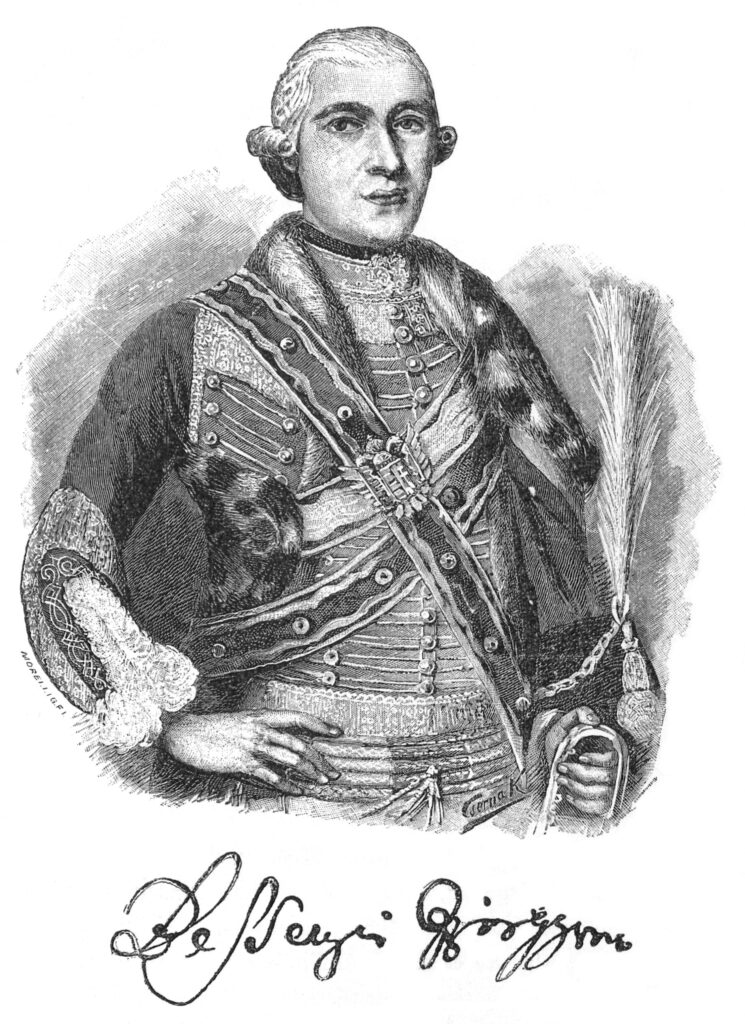
All of Bessenyei’s writings were intended for educational purposes. His 1772 play, Ágis tragédiája (The Tragedy of Agis), functioned as a somewhat unwieldy vehicle for articulating his liberal ideas.
His most notable work, Tariménes utazása (Tarimenes’ Journey), written between 1802 and 1804, is recognized as the first true novel in Hungarian and offers a sharp critique of all that opposed the Enlightenment.
With a keen sense of irony, Bessenyei, who served as an officer in the Hungarian Guards, examined the shortcomings of the society in which he lived. His personal influence motivated several of his fellow officers, including Sándor Báróczi and Ábrahám Barcsay, to strive to convey Enlightenment concepts in Hungarian to a local audience.
‘Traditionalist Hungarian groups regarded foreign ideas with suspicion, and the government grew increasingly wary of the rising intellectual freedom’
Similarly, driven by innovative ideas yet fundamentally adhering to tradition, József Gvadányi and András Dugonics produced engaging works that held both literary importance and widespread appeal. Gvadányi’s most distinguished work in 1790, Egy falusi nótáriusnak budai utazása (The Journey to Buda of a Village Notary), acts as a defence of national and traditional values amidst the rising tide of foreign influences. Dugonics’ novel, Etelka (1788), a sentimental romance set against a historical context, emerged as the first Hungarian bestseller. Both authors employed the language of the common folk, which can be regarded as their most significant accomplishment.
The Enlightenment, nonetheless, was not free from controversy. Traditionalist Hungarian groups regarded foreign ideas with suspicion, and the government grew increasingly wary of the rising intellectual freedom, which it linked to the French Revolution and, in Hungary, the Jacobin conspiracy led by Martinovics, quelled in 1794. Many writers were imprisoned for voicing radical views. Among them, the most talented was János Batsányi, who secured his place in Hungarian literary history with his 1789 poem ‘Franciaországi változásokra’ (‘On the Changes in France’), a compelling warning to all tyrants ‘to cast their watchful eyes on Paris’—a view not welcomed by the enlightened despot, Holy Roman Emperor Joseph II, who, notwithstanding his Patent of Toleration of 1781, which eliminated discriminatory civil regulations against granted non-Catholics, still required the Catholic clergy to teach in state schools.
As Hungarians commemorate their national holiday this Sunday, it is crucial to understand that their pursuit of self-determination is rooted in the beneficial aspects of the Enlightenment.
[1] Edward Gibbon, The History of the Decline and Fall of the Roman Empire, Vol I, New York, Harper Brothers, 1845, p. 504.
Related articles:
At a time when public debate is increasingly polarized and superficial, Hungarian Conservative remains committed to depth, intellectual honesty, and independent conservative thought.
Producing high-quality journalism requires resources. Your contribution helps us expand our coverage, reach new audiences, and keep our content accessible.

Please consider supporting our mission.