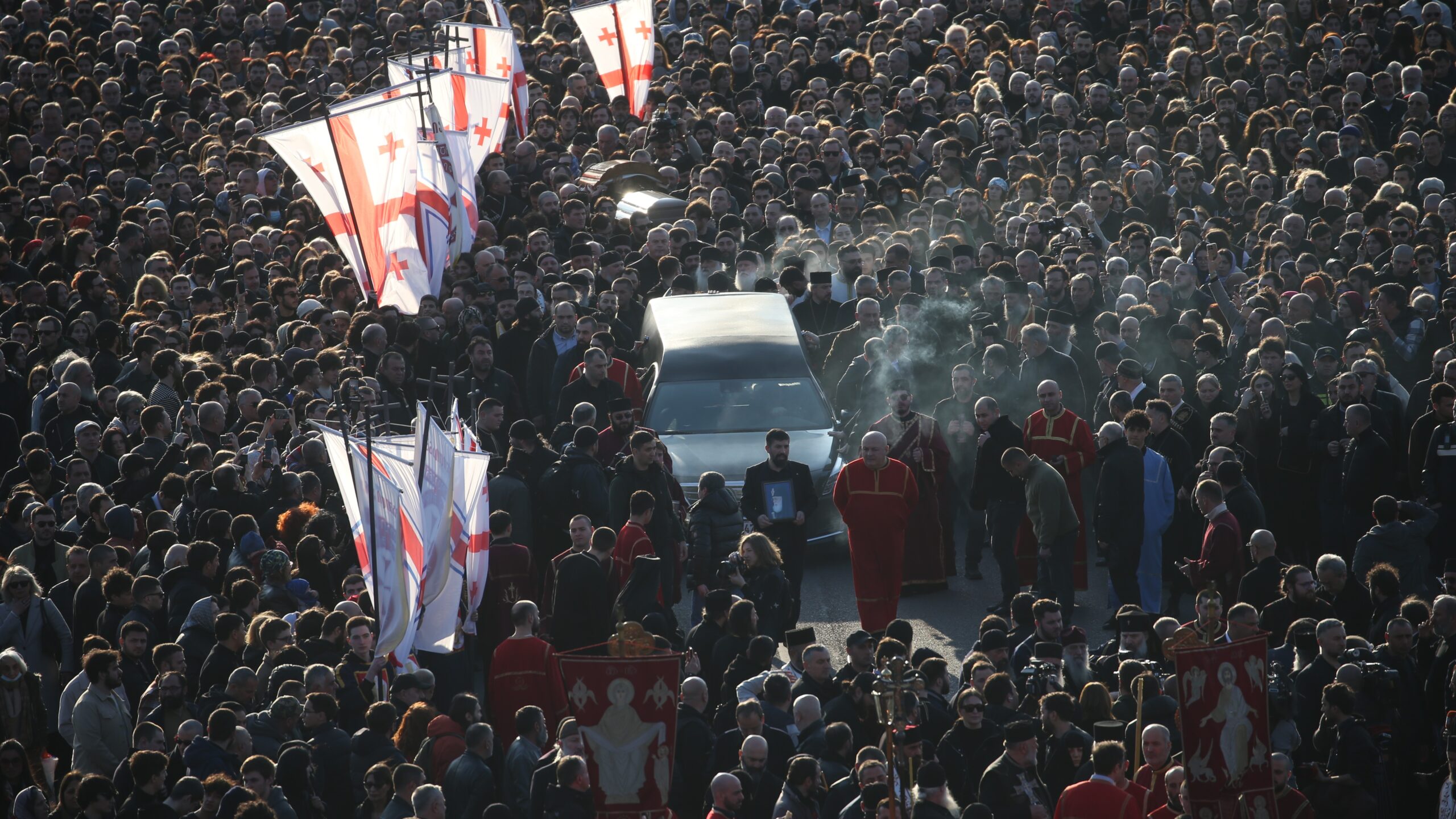
The streets between the monumental, modern Sameba Cathedral and its historical counterpart in Sioni were crowded. Soldiers lined up on the sides, Georgian flags in hand. Between them passed a procession of tens of thousands, led by secular and religious authorities. On that Sunday, Georgians gathered to mourn and honour the man who, for the past 48 years, had been their Spiritual Father. Thus was known and regarded Catholicos-Patriarch Ilia II, who had headed the Georgian Orthodox Church since 1977.
His long tenure at the helm of the Church coincided with some of the most important moments of recent Georgian history: the restoration of independence after the fall of the USSR, a civil war, two wars against Russia, and decades of political turbulence. It was also thanks to his own efforts that Georgia, one of the oldest Christian nations, would undergo one of the most remarkable religious revivals of the post-Soviet world. Georgians, known for their Christian devotion, have, over the course of their long history, given the world their fair share of Saints and great Orthodox clergymen and scholars. Patriarch Ilia II, in his works, writings, and ideas, now joins in this Pantheon, his life defined as much by service to his Church as it was to his nation.
Patriarch Ilia II was a rare case of a consensus in a country where debate and controversy abounded even in Soviet times. In traditional Georgian dinners, known as supra, a toast is always offered to his name by the tamada, or toastmaster. When asked who among their compatriots one admires the most, Georgians of all ages are quick to bring up the bearded, calm Patriarch. And, when in the mid-2000s he offered to become the godfather of every third child born to a Georgian couple, the country’s total fertility rate increased by 17 per cent—or as high as 42 per cent in religious couples. By the time of his passing, the Patriarch had 50,000 godchildren.
‘By the time of his passing, the Patriarch had 50,000 godchildren’
Politicians, sportsmen, artists, as well as ordinary people, would flock to the leafy complex of the Patriarchate to get his blessing. Parishioners across the country and in Georgian diasporic churches eagerly awaited his epistles. Between Wednesday and Sunday, one-and-a-half million people would go through the long lines that formed around Sameba Cathedral, in prayer and reference, to pay their final respects to their Patriarch. Among them are the highest authorities of the State: President Mikheil Kavelashvili and Prime Minister Irakli Kobakhidze, both known for their long-standing support for the Church.
Outside of Georgia, the Patriarch is best-known for his efforts for national demographics. Within Georgia, Patriarch Ilia will be best remembered as the man through whom Georgian Orthodoxy was revived. Punished by Soviet state structures for its piety, Orthodox Georgians had a semi-legal existence under the USSR. The Church was not outwardly banned, though participation therein was highly discouraged. Priests were subjected to harassment and State persecution, theological education was inaccessible in Georgia, and lay faithful were often forced to hide their religiosity from their fellow countrymen. The Church, much as it had been during Tsarist Russia, became thus a means of resistance, of assertion of one’s national identity—of Georgianness. The fall of the USSR allowed for this religiosity to flourish, alongside Georgia’s national consciousness. And, when the country was plunged into a civil war shortly after a turbulent independence process, it was in the Patriarchate that it found unity and guidance.
Patriarch Ilia, by the early 1990s at the helm of the Church for little more than a decade, ensured this renewed religiosity would not be a fleeting sparkle but an enduring flame. Thousands of churches were built – including the Sameba Cathedral, the largest in Georgia, financed by Bidzina Ivanishvili, a former Prime Minister and current Honorary Chairman of the ruling Georgian Dream party. Religious schools and universities were founded, and the Tbilisi Theological Academy was reestablished to provide training for priests and theologians in Georgian. The Patriarchate, either directly or through the several foundations and institutions it supports, became one of the foremost charitable, educational, and humanitarian institutions in the country.
A known composer and iconographer, the Patriarch also supported the development of associations promoting folk art, music, and dance, and the use of the iconic chokha dress, which is incentivized through respective, Church-led organizations. And, at times when liberalism was aggressively promoted and financed by some of Georgia’s external partners, the Patriarchate served as a bulwark of traditional values and Orthodox doctrine.
Patriarch Ilia II, as was told to me by a religious Georgian, understood his responsibilities as a Patriarch as two-fold: he was, at once, leader of the Church and shepherd of the nation, particularly in its most difficult moments. His legacy, in the strength of his Church and the faith of his people, is now the inheritance of all Georgians.
Related articles:
At a time when public debate is increasingly polarized and superficial, Hungarian Conservative remains committed to depth, intellectual honesty, and independent conservative thought.
Producing high-quality journalism requires resources. Your contribution helps us expand our coverage, reach new audiences, and keep our content accessible.

Please consider supporting our mission.