

On 27 June, the University of Public Service commissioned its new officers in front of the Ludovika Campus in Budapest.
173 graduates from the National University of Public Service’s Faculty of Law Enforcement took their oath before a replica of the Holy Crown and Hungary’s historic flags in the presence of senior government officials, university leaders and the country’s law enforcement command.
After the new officers were sworn in, Prime Minister Péter Magyar called on them to serve with integrity, uphold the rule of law and remain loyal to the nation. The prime minister urged them to speak up when they witness unlawful conduct, report orders that violate professional or ethical standards, and defend the honour of their profession whenever it is threatened.

‘Those who obey and enforce the law have nothing to fear. Those who abuse their position do,’ Magyar said. ‘The uniform serves our country, not political power, and the law belongs to every Hungarian citizen, not to those who hold office.’
He described the officers’ oath as a lifelong commitment encompassing service to the nation, responsibility, respect for the law and personal integrity.
‘The oath is taken only once, but honour must be preserved every day,’ he said.
Magyar said the graduates were beginning their careers at a time when Hungary was redefining the meaning of freedom, public service and the rule of law. He argued that genuine reform requires not only changing what no longer works but also returning to the best traditions of Hungarian public service, referring to the establishment of Hungary’s national law enforcement institutions in 1849.
He also criticized periods in Hungary’s history when political power stood above the law, professional standards gave way to political loyalty and public accountability was replaced by avoidance of responsibility. The prime minister said modern law enforcement requires professionalism, appropriate equipment, well-functioning institutions and people willing to help others even in the most difficult situations. He pledged that the government would support law enforcement personnel by improving salaries, providing a predictable career path, modern equipment, better working conditions and leadership that supports officers rather than merely directing them.

‘This is a debt the Hungarian state will repay step by step to you and to the entire law enforcement community,’ Magyar said.
He added that the everyday decisions made by newly commissioned officers would shape the future of Hungarian law enforcement, from how they interact with citizens to how they respond in difficult situations and support one another in service. ‘Our goal is to build and preserve an order in which people can live in safety, the vulnerable can rely on protection and the law is applied fairly to everyone,’ he said.
Speaking on behalf of the graduating class, Second Lieutenant Anna Kókány of the National Tax and Customs Administration reflected on the challenges the cadets had overcome during their training.
‘Our journey was not always easy. There were times when we had to push ourselves to our limits, and moments when only faith and determination carried us forward,’ she said. ‘The years we spent here taught us perseverance, responsibility and how to preserve our humanity even in the most difficult situations.’
Kókány said the bonds formed among classmates would continue to unite them throughout their careers, regardless of where their service might take them. She noted that the new officers were beginning their careers in an era changing faster than ever before, with technological advances, digitalization and emerging security threats requiring constant adaptation.
Referring to the oath of office, she stressed that the words spoken during the ceremony were ‘not merely part of a formal event—they are a commitment for life.’ Public service, she added, is not simply a job but a vocation in which people must always remain at the centre of every decision.
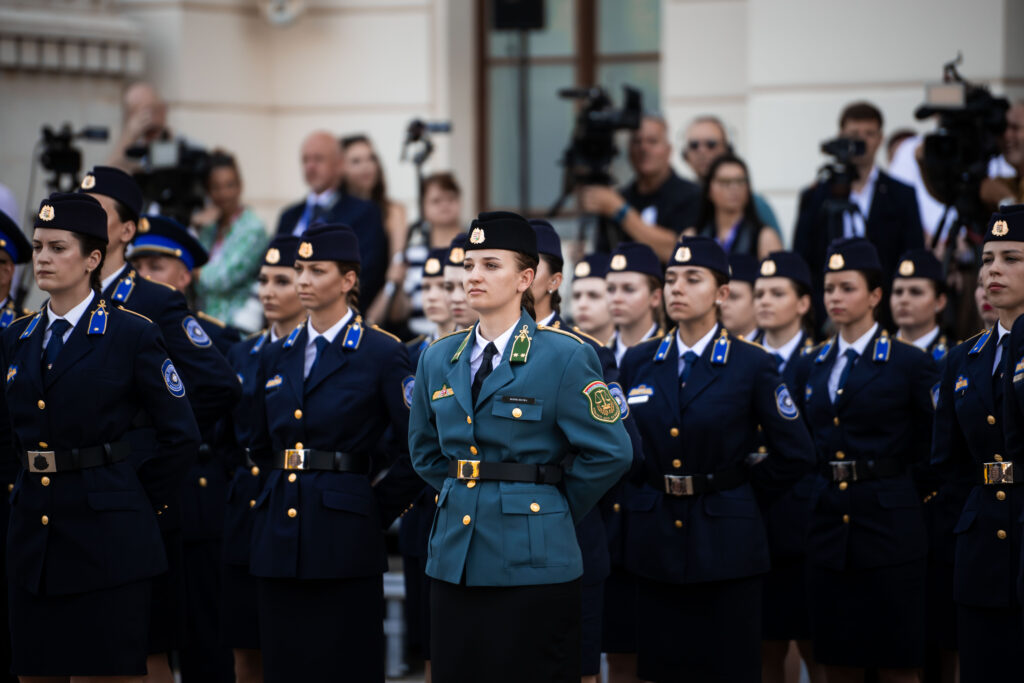
According to the university, 99 graduates will begin their careers with the police on 1 July, 36 with the National Tax and Customs Administration, 21 with the prison service, 13 with the disaster management authority and four with the National Directorate-General for Aliens Policing. 28 students graduated with distinction.
The university also announced that beginning with the 2026–2027 academic year, it will launch a new master’s degree programme in fire protection engineering under the professional supervision of its Institute of Disaster Management.
During their studies, cadets participated in several major national assignments, including security operations during Pope Francis’ visit to Hungary in 2023, flood protection efforts along the Danube in 2024, and security duties at major international sporting events in 2026. The university said these practical experiences contributed significantly to their professional preparation.
Law enforcement programmes remain the university’s most popular courses, with nearly five applicants competing for each available place. The four-year criminal investigation programme continues to attract the highest number of applicants.
Related articles:
At a time when public debate is increasingly polarized and superficial, Hungarian Conservative remains committed to depth, intellectual honesty, and independent conservative thought.
Producing high-quality journalism requires resources. Your contribution helps us expand our coverage, reach new audiences, and keep our content accessible.

Please consider supporting our mission.