
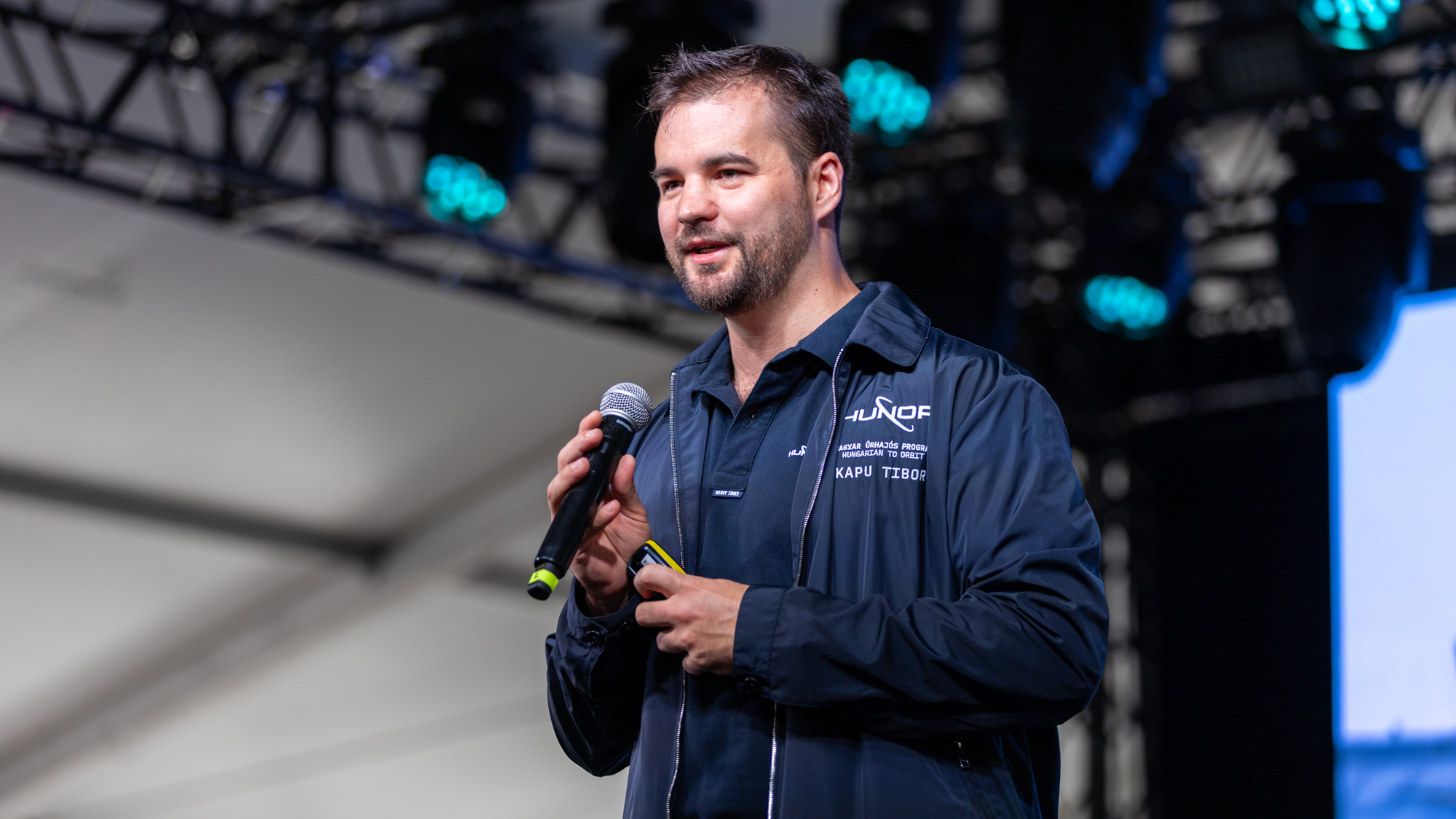
Tibor Kapu became the second Hungarian person to visit outer space in June 2025. As part of the Hungarian government’s HUNOR space programme, he spent 20 days outside our planet’s atmosphere after being launched from the Kennedy Space Center in Merrit Island, Florida.
On Thursday, 7 May, Kapu, alongside reserve astronaut Gyula Cserényi, held a lecture at the opening event of the annual Ludovika Festival. The festival is taking place on 7–9 May this year.
Mr Kapu started by telling the audience that he still gets goosebumps when he thinks about his space travel experience. As he recalled, his journey started 3–4 years ago, when the selection process for the HUNOR programme started. He also lauded the achievements of the American astronaut Peggy Whitson, the Commander of Axiom Mission 4, the mission during which he too travelled to the International Space Station.
Mr Cserényi then explained his role, saying that it is standard to have a primary and reserve crew for space missions, and that the reserve crew are fully aware that they most likely will not visit space, unless something unfortunate happens to someone in the primary crew.
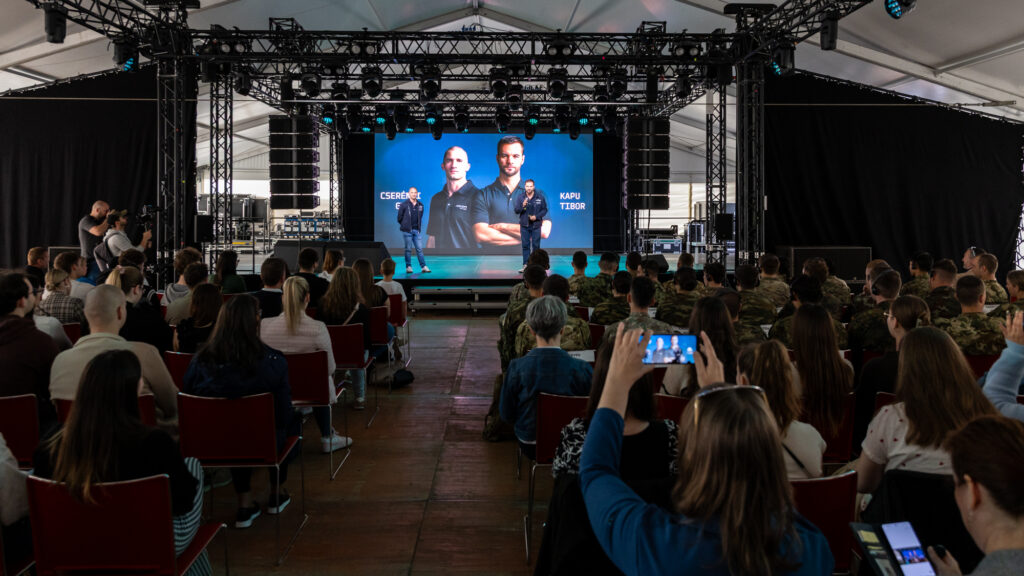
Taking back the word, Mr Kapu elaborated on the training and selection process. The HUNOR candidates had to get pilot skills, which are essential for astronauts, he shared. He then added that he flew a Grippen fighter jet under the supervision of members of the Hungarian Air Force, and later had to get his pilot’s licence as well.
Testing how one’s body reacts to multiple G-force impacts is also part of that training, the speaker stated, as during the take-off of a spaceship, 4.5 Gs are concentrated mostly on the astronaut’s chest in a lying position.
Mr Cserényi then talked about survival training, which astronauts undergo in case the return landing ends up being off-target, which has happened in the past, he shared. In such a case, the crew members must be prepared to survive in the wilderness until the rescue team finds them. The speaker revealed that their training included land and water survival training, the latter of which was more relevant to them as they were planning to splash down into the Pacific Ocean. As part of that preparation process, he had to jump into the oxbow lake section of the Tisza River from a moving helicopter at 16 feet high, which he dreaded.
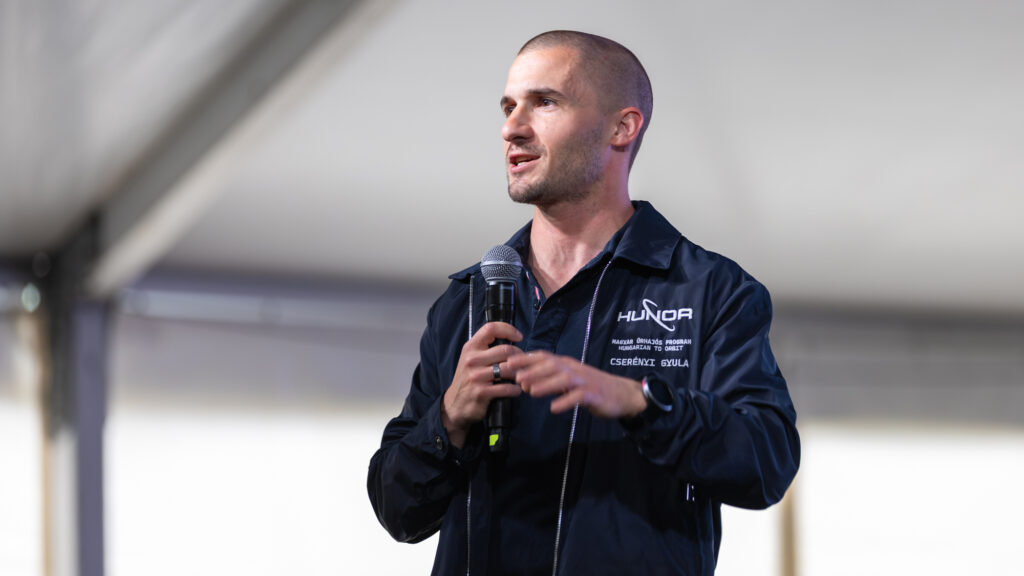
Cserényi then went on to talk about another special exercise, the so-called isolation training. The last four remaining HUNOR candidates were taken by members of the Hungarian Counter Terrorism Centre (TEK) to an unknown location, and they were not told in advance how long they would have to stay there. They only got to interact with each other, and communication with the outside world was forbidden to test their psychological endurance.
Despite these hardships, Mr Kapu described training as the second-best part of being an astronaut, after the actual space travel.
As for the space travel part of the mission, Kapu shared that it took 28 hours from launch to reach the International Space Station. The ISS has seven pressurized modules where astronauts live during the mission, he explained, as well as a dome that has a 360° view of the Earth. During sleep, astronauts have to be tied down, the speaker also shared. Mr Cserényi then spoke of a special phenomenon in space: due to the lack of gravity and the surface tension, water sticks to other surfaces there.
‘Despite these hardships, Mr Kapu described training as the second-best part of being an astronaut’
Kapu also told the audience that the SpaceX rocket he travelled in is about 230 feet (70 metres) long and weighed about 550 metric tonnes at launch, 500 tonnes of which was the fuel’s weight. He talked about the scientific research aspect of his mission as well, saying that 25 experiments were conducted on the ISS, the results of which were shared with Hungarian universities and research centres. Eight research papers have already been published about those experiments, and more are due to come out.
Together, Kapu and Cserényi’s presentation offered festivalgoers a rare firsthand glimpse into the immense preparation, resilience, and adaptability required not only to travel to space—but to survive every possible outcome along the way.
Related articles:
At a time when public debate is increasingly polarized and superficial, Hungarian Conservative remains committed to depth, intellectual honesty, and independent conservative thought.
Producing high-quality journalism requires resources. Your contribution helps us expand our coverage, reach new audiences, and keep our content accessible.

Please consider supporting our mission.