
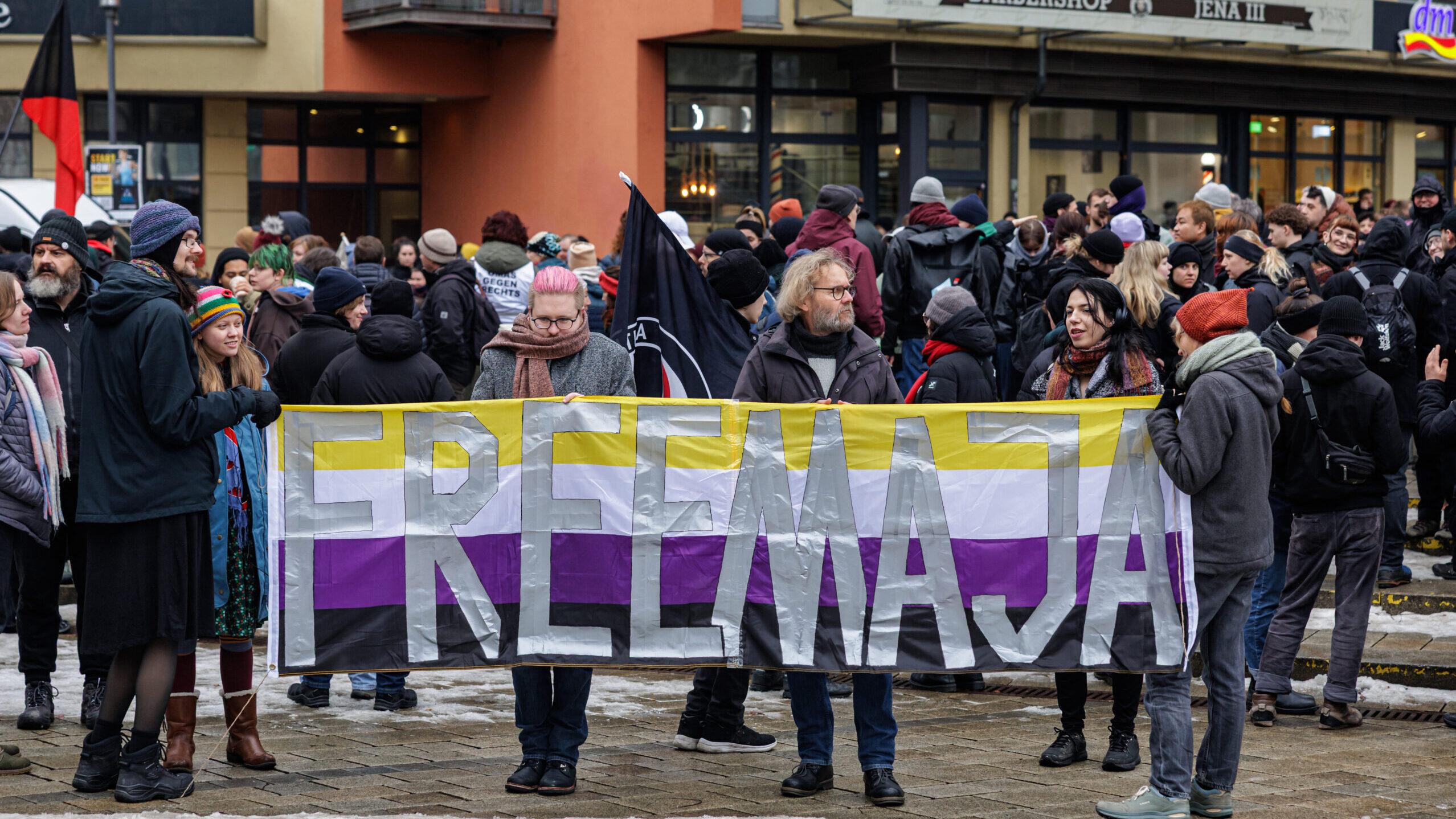
Prosecutors are seeking harsher sentences for all three defendants, including Maja T, in Hungary’s infamous Antifa case, a spokesperson for the Budapest Appellate Chief Prosecutor’s Office told Hungarian news agency MTI.
Gábor Csiha stated that the prosecution had maintained its previously announced appeal for stricter punishment following the first-instance ruling and has now formally submitted its motion to the Budapest Regional Court of Appeal in the criminal case concerning the street attacks carried out in February 2023.
In the case of the third defendant, German national Anna M—who was sentenced in the first-instance ruling announced by the Budapest Metropolitan Court on 4 February to two years in prison, suspended for five years, for participation in a criminal organization—the prosecution requested an unsuspended prison sentence exceeding two years.
In the case of German national Maja T, born Simeon T, who was sentenced to eight years in a high-security prison for four counts of attempted grievous bodily harm endangering life committed within a criminal organization—two as a co-perpetrator and two as an accomplice—as well as attempted grievous bodily harm committed with base motives within a criminal organization, the prosecution requested a longer prison sentence.
The same request was submitted regarding Italian national Gabriele M, who was sentenced to seven years in a high-security prison for three counts of attempted grievous bodily harm endangering life committed as a co-perpetrator within a criminal organization.
Proceedings against the first defendant, Italian national Ilaria Salis, were suspended after she was elected a Member of the European Parliament for the Italian far-left party Alleanza Verdi e Sinistra (AVS) and subsequently obtained parliamentary immunity.
The second defendant, German national Tobias E, had already been convicted earlier and is currently under criminal supervision in Germany.
On 11 February 2023, an Antifa mob—consisting primarily of German and Italian nationals—attacked individuals in Budapest solely based on their assessment that the victims appeared ‘far-right’. One of the most seriously injured victims, László Dudog, was beaten on the head with iron bars, resulting in what was described as the ‘complete paralysis of the left side of his face’. Both Hungarian and foreign nationals were among the victims. Six suffered serious injuries, while three sustained minor injuries.
The trial quickly became one of the most closely followed criminal cases in recent Hungarian history, as both Maja T and Ilaria Salis repeatedly accused Hungarian authorities of violating fundamental rights during detention. These allegations were reiterated by Maja T in an interview published by German public broadcaster Deutsche Welle at the beginning of 2026.
The Hungarian public prosecutor’s office had initially requested a 24-year prison sentence as a ‘deterrent’. Prosecutors argued that Maja T belonged to a far-left extremist group comprising 19 members who attacked nine people, causing broken bones and serious head injuries.
Far-left activists appeared at the trial in support of Maja T, wearing shirts bearing the word ‘Schauprozess’, the German term for a ‘sham trial’.
The case later served as part of the political basis for former Hungarian prime minister Viktor Orbán’s proposal—following a similar move by US President Donald Trump—to designate Antifa as a terrorist organization.
Related articles:
At a time when public debate is increasingly polarized and superficial, Hungarian Conservative remains committed to depth, intellectual honesty, and independent conservative thought.
Producing high-quality journalism requires resources. Your contribution helps us expand our coverage, reach new audiences, and keep our content accessible.

Please consider supporting our mission.