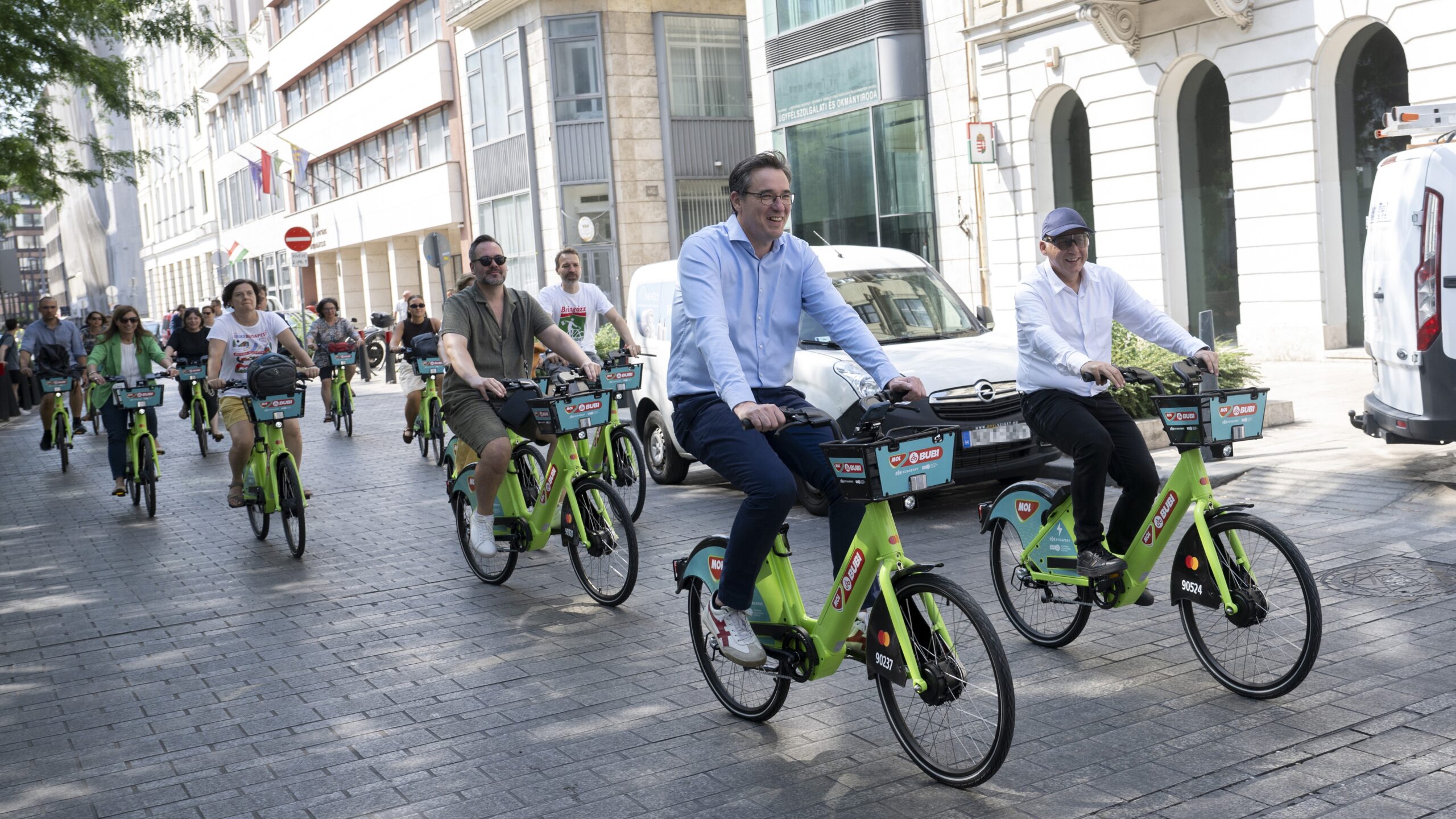
Budapest officially launched the renewed MOL Bubi public bike-sharing system on Monday, introducing a larger fleet that now includes electric bicycles alongside conventional bikes.
Speaking at the launch event, Budapest Mayor Gergely Karácsony said the new generation of the service, MOL Bubi 3.0, represents a significant improvement in both quality and scale compared with previous versions.
He said more bicycles will be available across a wider area, the bikes are easier to ride and the redesigned MOL Bubi mobile application offers a more user-friendly experience.
Karácsony added that the bike-sharing system helps Budapest rely on ‘its most natural resources’ at a time when the vulnerability of the modern world has become increasingly apparent.
Ádám Bodor, Deputy Chief Executive for Mobility at the Budapest Transport Centre (BKK), said the upgraded system begins operation with 2,000 bicycles, including 500 electric-assist bikes.
The fleet will be expanded rapidly to 3,300 bicycles, of which 800 will be electric, he said, adding that the service also features a new and improved mobile application.
Bodor noted that the system currently covers around 40 square kilometres of Budapest. The long-term goal is to double coverage to 80 square kilometres, serving every major public transport interchange where more than 30,000 passengers transfer.
Péter Pantl, Communications and Marketing Director at MOL, recalled that the company has served as the naming sponsor and strategic partner of the capital’s bike-sharing scheme since 2014. He said it has been encouraging to see the continuous improvement of the service and the growing role of digitalization in making the system easier to use.
Representing Mastercard, the service’s digital payments partner, Business Development Director Balázs Györffy said digital payment solutions simplify access to Budapest’s public transport network and expressed hope that the partnership would contribute to greener and more digital urban mobility.
Damien Vander Heyden, Business Development Director at Inurba Mobility, the new operator of the system, said the company manages public bike-sharing services in six countries across Europe and South America.
He noted that the upgraded network includes virtual mobility hubs that require no physical infrastructure, allowing the system to expand rapidly during this year and next.
According to BKK, the number of bicycles will continue to increase following the public launch. By 2027, the network is expected to include around 5,000 bicycles across an expanded service area with more docking locations.
The transport authority said the system could eventually grow to as many as 8,000 bicycles if additional funding becomes available, further improving accessibility throughout the capital.
During the pilot phase, nearly 9,000 users tested the new service. BKK said feedback from participants played an important role in refining the system before its official launch.
The authority added that Inurba Mobility was awarded the operating contract through a public procurement process for an initial five-year period, with an option to extend it by a further 18 months.
The upgraded system is available through the new MOL Bubi application, with users able to choose between pay-per-minute pricing or discounted monthly and annual subscriptions. Holders of BudapestGO travel passes are eligible for discounted access to standard bicycles, while the first 100 customers purchasing an annual subscription will receive a limited-edition MOL Bubi sweatshirt.
Related articles:
At a time when public debate is increasingly polarized and superficial, Hungarian Conservative remains committed to depth, intellectual honesty, and independent conservative thought.
Producing high-quality journalism requires resources. Your contribution helps us expand our coverage, reach new audiences, and keep our content accessible.

Please consider supporting our mission.