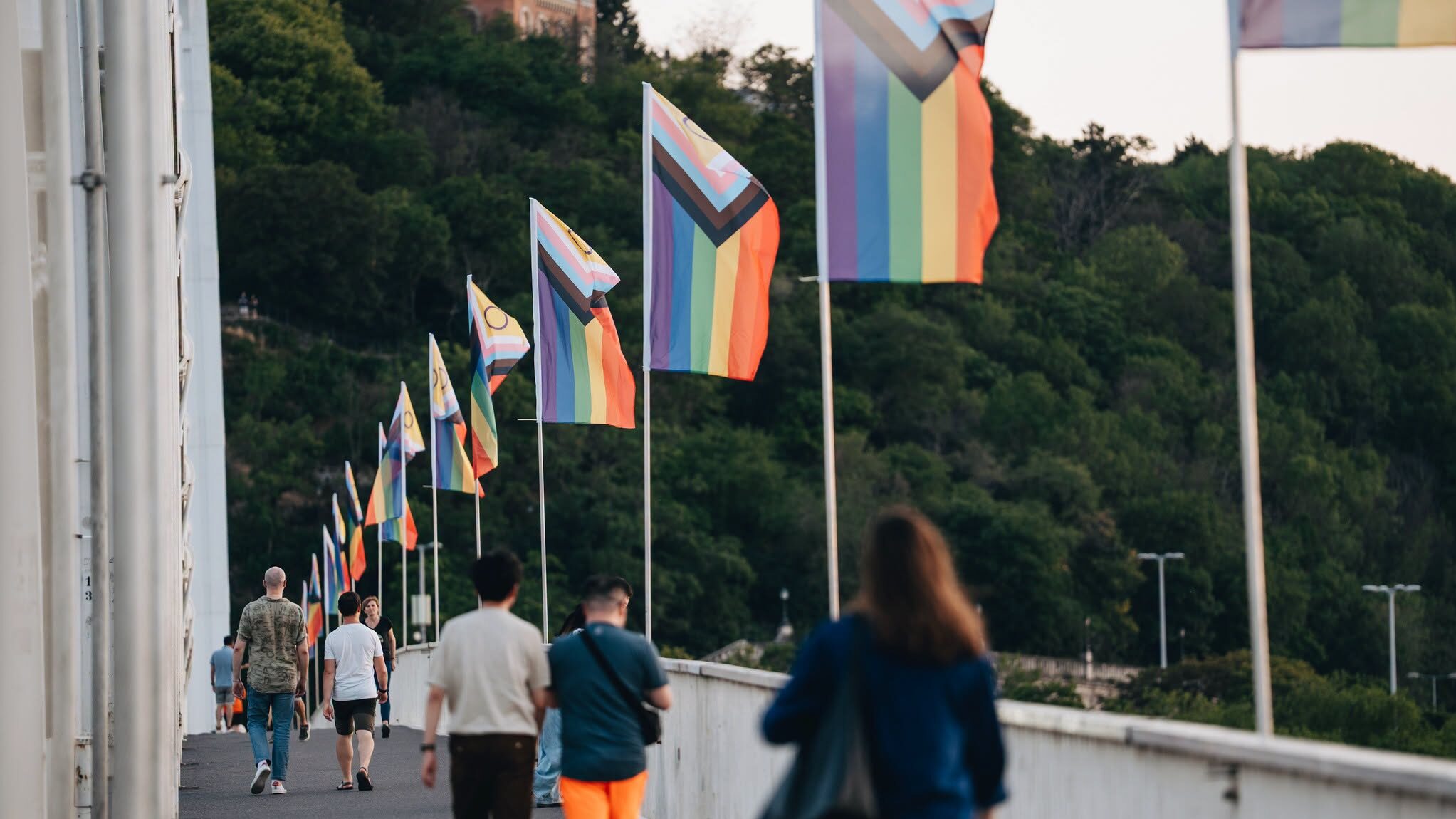
Budapest city authorities have announced that they will file a police report after several Progress Pride flags displayed on the Erzsébet Bridge disappeared less than a day after being installed, in what officials suspect was an act of deliberate vandalism.
The issue came to light after residents noticed that the flags were no longer hanging from the bridge and alerted local media. Responding to questions, the office of liberal Mayor Gergely Karácsony confirmed that the reports were accurate and stated that ‘intentional damage is suspected’.
On Sunday, a video showing a man removing one of the flags from the bridge and throwing it into the Danube began circulating on Hungarian social media. City officials said the missing flags would be replaced ‘within days’, arguing that they belong in a ‘free, diverse and supportive Budapest’ during Pride Month and ahead of the Budapest Pride march.
The flags were not traditional rainbow Pride flags but Intersex-Inclusive Progress Pride flags, a design incorporating symbols representing transgender and intersex people, as well as racial minorities, alongside the original rainbow colours.
Reacting to the display of the flags, Christian Democratic MP Zsuzsa Máthé criticized the decision, arguing that it conflicted with constitutional provisions recognizing biological sex as male or female. Referring to the disappearance of the flags, she suggested that public opposition to their display may have played a role in their removal.
The incident comes less than a week before the 2026 Budapest Pride, scheduled for 27 June. Organizers notified police of the event on 27 May in accordance with Hungary’s assembly law requirements. According to the organizers, ‘Hungary’s democratic transition remains incomplete’ without ‘restoring assembly rights and repealing legislation’ they consider discriminatory towards LGBT people.
The debate surrounding Pride in Hungary intensified significantly in 2025. In March of that year, Parliament adopted legislation restricting assemblies deemed to promote homosexuality or gender transition to minors, creating the legal basis for banning Pride marches and similar events. The measure sparked protests from opposition parties, civil rights groups, and European institutions, including the European Commission.
After police prohibited the march, Budapest Mayor Gergely Karácsony attempted to circumvent the ban by organizing it as a municipal event. Despite legal threats and the official prohibition, tens of thousands of people attended what became the largest Pride event in Hungary’s history and one of the largest anti-government demonstrations of the Orbán era. According to analysts, the 2025 Budapest Pride was a clear sign of weakening central authority during the 16 years of Fidesz–KDNP rule under Viktor Orbán and foreshadowed the party’s defeat in the April 2026 election.
‘Péter Magyar and the Tisza Party has already indicated a more permissive approach towards LGBTQ rights than its predecessor’
Criminal proceedings were subsequently launched against Karácsony for his role in organizing the event. However, prosecutors dropped the case earlier this month following an April ruling by the Court of Justice of the European Union (CJEU). In its verdict, the EU’s highest court found that Hungary’s 2021 Child Protection Act—which served as the legal foundation for the 2025 Pride ban—violated EU law, fundamental rights, and the bloc’s core values. The court concluded that the legislation unlawfully restricted access to content depicting homosexuality and gender diversity, discriminated against LGBT people, and contributed to their stigmatization and marginalization.
Following the judgment, prosecutors concluded that the legal basis underpinning the case against Karácsony could no longer be sustained and dropped the charges.
This year’s Pride carries particular symbolic significance as it will be the first march held after Viktor Orbán’s electoral defeat and the end of his 16-year tenure as prime minister. The new government led by Prime Minister Péter Magyar and the Tisza Party has already indicated a more permissive approach towards LGBTQ rights than its predecessor. While there are currently no legislative proposals on the issue before Parliament, Prime Minister Magyar has repeatedly emphasized since the April election victory that no Hungarian should face discrimination because of whom they love.
Related articles:
At a time when public debate is increasingly polarized and superficial, Hungarian Conservative remains committed to depth, intellectual honesty, and independent conservative thought.
Producing high-quality journalism requires resources. Your contribution helps us expand our coverage, reach new audiences, and keep our content accessible.

Please consider supporting our mission.