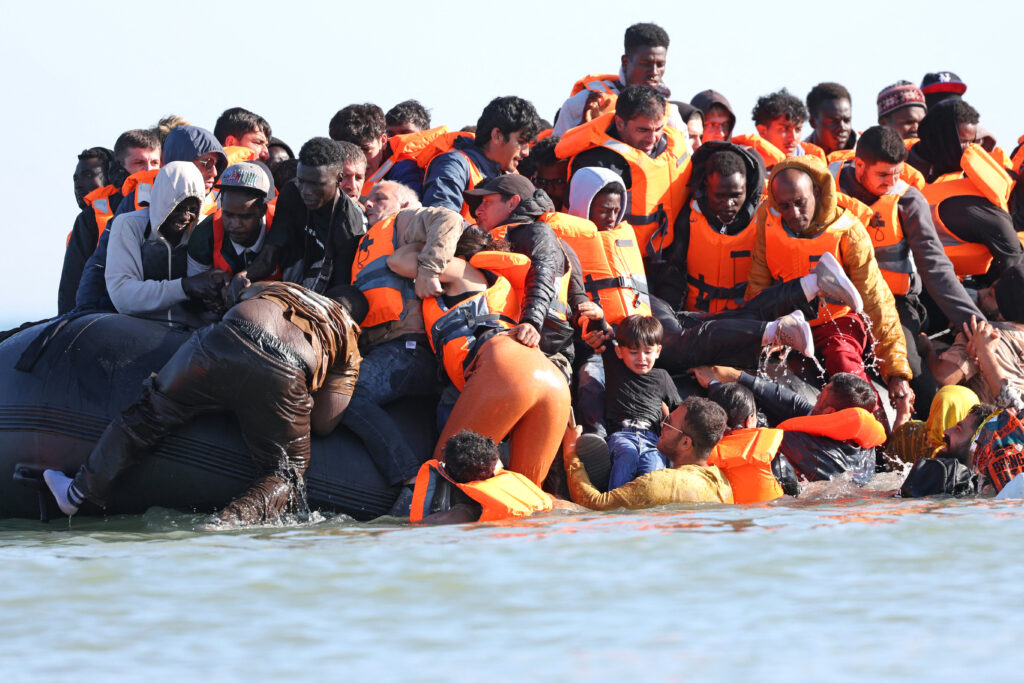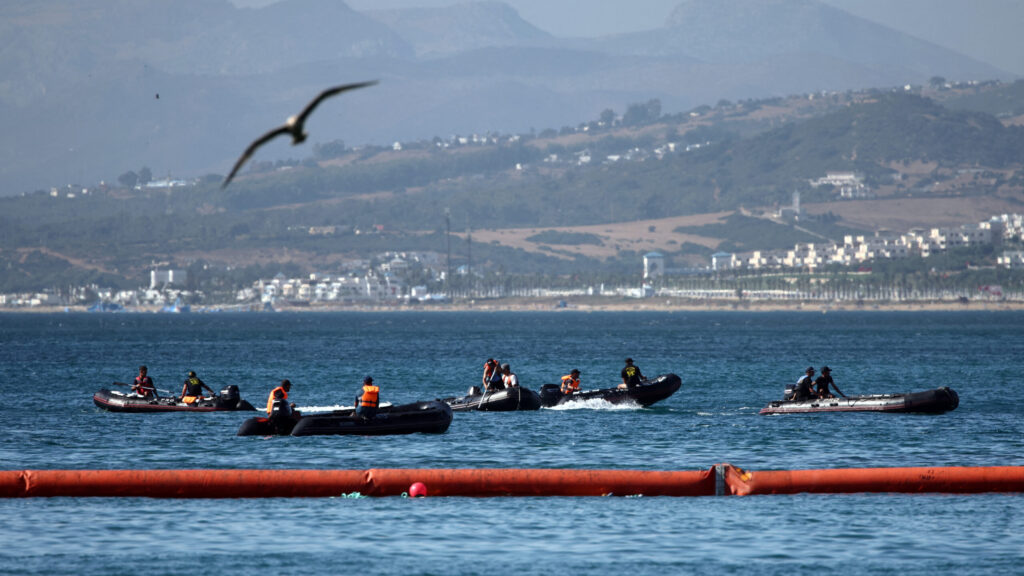
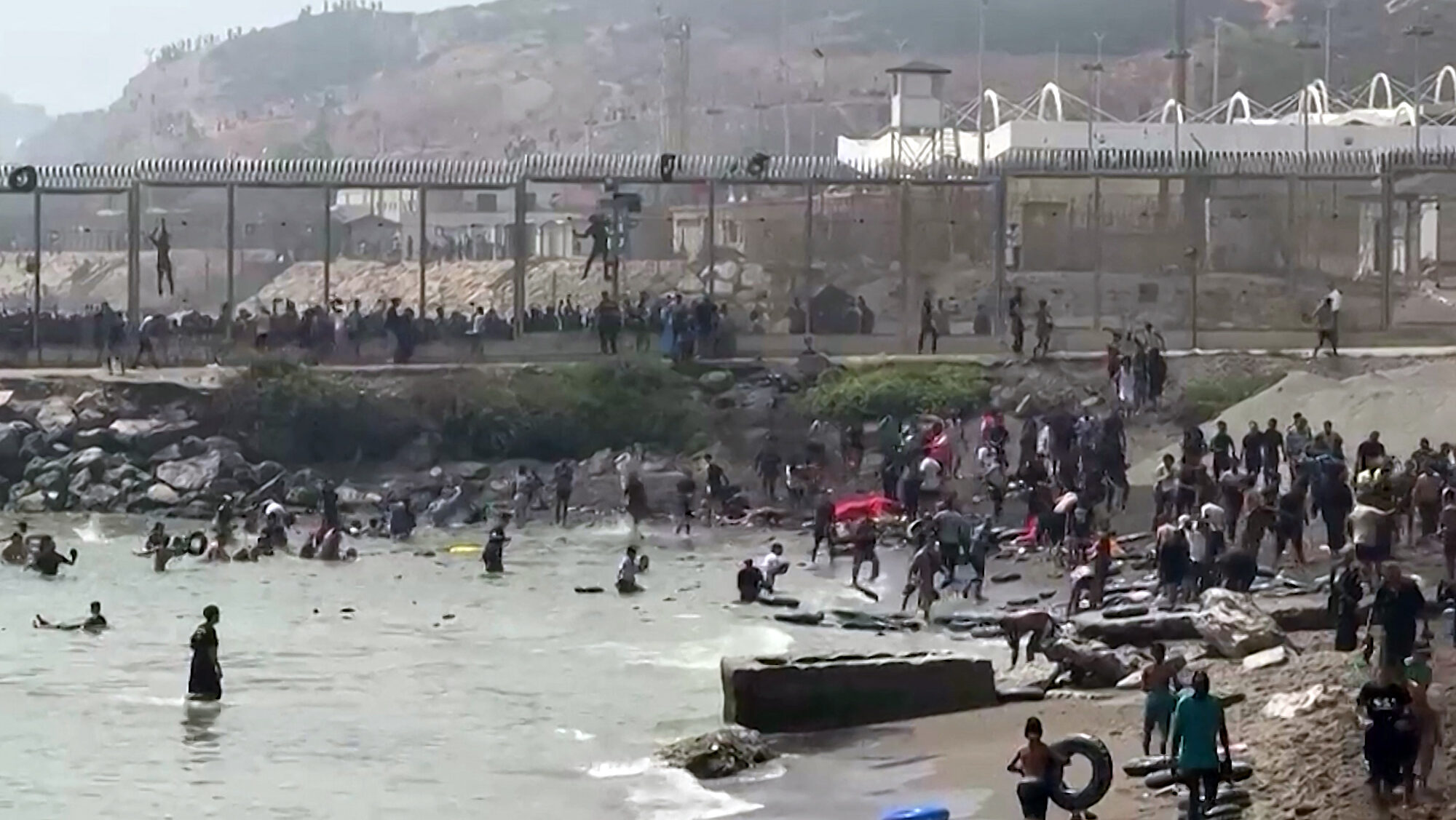
The migrant invasion of Spain’s North African territories continued into Friday, with crossings around Ceuta’s Tarajal breakwater still underway after midnight and a second wave reaching Melilla. Police sources warned that more than 10,000 people from Morocco may have entered Ceuta illegally, while local reports described confrontations and break-ins at residents’ homes.
In Melilla, security sources estimated that around 400 mainly young Moroccan men entered overnight, most by swimming from the neighbouring coast. Thousands more had reportedly gathered around Nador, Beni Enzar, and Farhana, but Moroccan security forces contained the majority using riot-control equipment. Spain closed the Beni Enzar crossing after clashes, injuries, and fires around the frontier.
Residents in Ceuta circulated videos of confrontations, threats, and migrants entering residential courtyards or private property. In one case documented by local media, a Moroccan couple carrying a baby used a ladder, broke an upstairs window, and entered a home in Loma Colmenar.
The crisis began on Thursday when thousands of migrants crossed from Morocco, swimming around the Tarajal breakwater, passing through border installations, and running into the city after Spanish forces lost control. Initial television estimates put the number at 2,000–3,000 within hours, but the continuous flow throughout the afternoon, evening, and night rapidly overtook those figures. Police representatives described ‘absolute chaos’, while footage showed crowds moving from the waterfront onto the roads of Ceuta.
Social media videos also showed confrontations between migrants and residents, producing scenes widely characterized by right-wing commentators as increasingly civil war-like. Shops, supermarkets, restaurants, and a shopping centre closed as residents feared robberies, riots, and further clashes, while overwhelmed security forces deployed across the city.
Ceuta’s conservative mayor-president, Juan Jesús Vivas, demanded that Madrid declare a national emergency, establish a single command, reinforce the police, and deploy the army to protect the border and residents. The city’s reception system was already overwhelmed after around 1,500 arrivals during the previous week, with facilities for unaccompanied minors reportedly operating at 2,400 per cent of capacity.
Prime Minister Pedro Sánchez said the government was mobilizing resources and coordinating with Morocco. At the same time, the Interior Ministry blamed people-smuggling networks for exploiting a recent Supreme Court ruling restricting the immediate return of migrants intercepted while swimming.
Madrid initially rejected the emergency request on legal grounds but later mobilized army units to support the Civil Guard. Spain and Morocco also pledged to return illegal arrivals as quickly as possible.
Right-wing anti-immigration Vox leader Santiago Abascal described the event as an ‘invasion’ and accused Sánchez of creating an enormous pull factor through his government’s ongoing extraordinary regularization programme, launched in April, which received nearly 1.2 million applications—more than twice the government’s initial estimate. Vox demanded the immediate closure of the border, military deployment and rapid pushbacks. People’s Party leader Alberto Núñez Feijóo likewise described the breakdown as a national-security crisis.
The surge’s precise trigger remains disputed. Madrid says traffickers weaponized the 29 June court decision; Vox points to the government’s regularization programme; and some analysts suspect Morocco deliberately relaxed enforcement amid Spanish overtures to Algeria. Summer conditions and mounting pressure around the enclave may also have contributed.
The scenes spreading rapidly on social media prompted strong reactions from Europe’s right. Alternative für Deutschland (AfD) co-chair Alice Weidel said Ceuta was being ‘overrun’ and demanded closed borders and rigorous refusals of entry, while National Rally leader Jordan Bardella accused Sánchez of opening Europe’s doors through mass regularization. Dutch right-wing leader Geert Wilders called the episode an ‘Islamic invasion’, while Reconquête leader Éric Zemmour demanded restored borders and ‘remigration’.
Even the centre-right EPP described the arrivals as massive and uncontrolled, urged Spain and the European Commission to act immediately, and said it would demand answers in the European Parliament. EPP President Manfred Weber issued an especially strong-worded statement on X, blaming Morocco for using migration as hybrid coercion; and Spain for the mass regularization policy. The ECR and Patriots for Europe groups likewise blamed permissive policies and regularization for turning the EU’s external frontier into what Patriots called ‘an open door’.
The crisis has also resulted in a diplomatic confrontation between Italy and Spain. Italian Prime Minister Giorgia Meloni threatened extraordinary measures, including suspending Schengen free movement with Spain, while Foreign Minister Antonio Tajani argued that Madrid’s regularization policy threatened European security. Spanish Foreign Minister José Manuel Albares summoned the Italian ambassador, calling Rome’s intervention ‘partisan demagoguery’ rather than solidarity from a European ally.
A similar invasion unfolded in May 2021, when around 8,000 migrants—including some 1,500 minors—entered Ceuta within two days after Moroccan border controls collapsed, forcing Spain to deploy troops and return more than 6,500 people. The crisis was sparked by a diplomatic dispute between Rabat and Madrid.
This article has been updated with overnight developments in Ceuta and Melilla, as well as the diplomatic rift between Spain and Italy.
Read more:
At a time when public debate is increasingly polarized and superficial, Hungarian Conservative remains committed to depth, intellectual honesty, and independent conservative thought.
Producing high-quality journalism requires resources. Your contribution helps us expand our coverage, reach new audiences, and keep our content accessible.

Please consider supporting our mission.