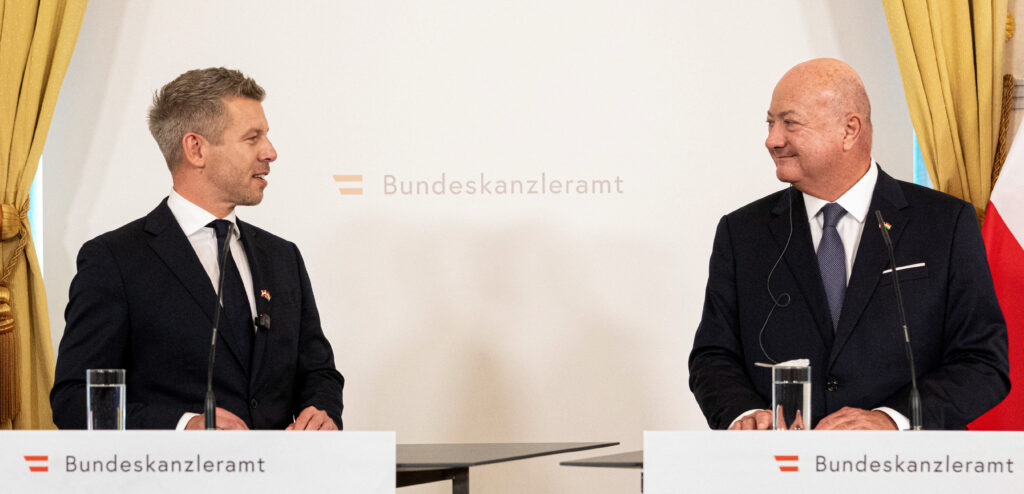

The Hungarian Atheist Association has called on the incoming Tisza government to ‘represent the interests’ of voters who are mostly non-religious or atheist and to ‘make gestures toward them’, rather than appealing to ‘Christian-conservative’ voters.
In a Facebook post, the association pointed out that 77 per cent of non-religious voters supported the Tisza Party, compared to 16 per cent for Fidesz within the same demographic. ‘Among those who never attend church, support for the two parties stood at 59 versus 23 per cent,’ the statement continued, adding that among regular churchgoers, support for Fidesz was twice that of Tisza.
‘This undoubtedly means that the majority of the 3.4 million citizens who voted for Tisza came from among those leading a non-religious lifestyle, the non-religious, and atheists,’ the association stressed, calling on Tisza and prime minister-elect Péter Magyar to represent them once in government.
From Electoral Umbrella to Governing Party
The statement reflects a broader structural challenge for the Tisza Party, which secured a landslide victory in the 12 April election, defeating Viktor Orbán’s Fidesz–KDNP and winning a constitutional supermajority in the next parliament.
While originally a centre-right party to the core, Tisza functioned during the campaign more as an umbrella movement of anti-Orbán forces and voters, with several, mostly liberal and progressive parties choosing not to run in the election in order to avoid weakening their chances of defeating Orbán.
However, now that the election has concluded, these voters and parties are seeking representation—arguably a natural expectation. One of the first clear examples of such internal tensions within the anti-Orbán coalition emerged just days after the vote, when a potential candidate for Minister of Education was put forward.
Hungarian outlet Telex reported last week that the position—which had been vacant since 2010, as successive Orbán governments placed education under so-called super ministries—may be filled by Rita Rubovszky, Director of the Cistercian School Authority. This directorate oversees administrative responsibilities related to schools founded by the Cistercian Abbey of Zirc.
‘Tisza functioned during the campaign more as an umbrella movement of anti-Orbán forces and voters’
During her career, Rubovszky has established herself within Hungary’s educational and ecclesiastical system, consistently associated with conservative values, and previously worked in the 2000s with one of Viktor Orbán’s closest associates, Árpád Habony.
The emergence of Rubovszky’s name triggered what Péter Magyar described as a ‘verbal lynching’ from within Tisza’s own voter base. Public figures who supported Tisza during the campaign strongly criticized her potential nomination, primarily due to her ties to conservative and religious circles. 17 secondary school principals signed a letter to Magyar, urging him to take their concerns into account when selecting the Minister of Education.
Speaking at a press conference last Friday, Magyar responded to the backlash by stating that Rubovszky’s nomination has not been finalized and that several other candidates are under consideration.
Next Up: LGBTQ Issues
These dynamics will be important to monitor in the coming period, as the Tisza Party transitions from an electoral umbrella movement into a governing political force—potentially giving rise to internal fractures and tensions both within its parliamentary faction and its broader national organization.
A potential next point of conflict could arise over LGBTQ issues, which Magyar deliberately avoided during the campaign in order not to provide Fidesz with grounds for attack. However, yesterday’s ruling by the European Court of Justice ordering Hungary to roll back its 2021 child protection law—which banned the promotion of homosexuality and gender transition in media accessible to children—makes it increasingly difficult to avoid the issue.
The Hungarian government must now decide whether to implement the Court’s ruling or face financial penalties similar to those imposed for non-compliance with EU migration rules.
One of Tisza’s main campaign promises was to unblock billions of euros in EU funding currently frozen by the European Commission under the rule-of-law conditionality mechanism. Some of the conditions for unlocking these funds are related to LGBTQ rights. During his first international press conference as prime minister-elect on 13 April, Magyar stated that ‘according to Tisza and the many million Hungarian people supporting it, everyone can live with whoever they love as long as they do not violate laws and are not harmful to others’.
Related articles:
At a time when public debate is increasingly polarized and superficial, Hungarian Conservative remains committed to depth, intellectual honesty, and independent conservative thought.
Producing high-quality journalism requires resources. Your contribution helps us expand our coverage, reach new audiences, and keep our content accessible.

Please consider supporting our mission.