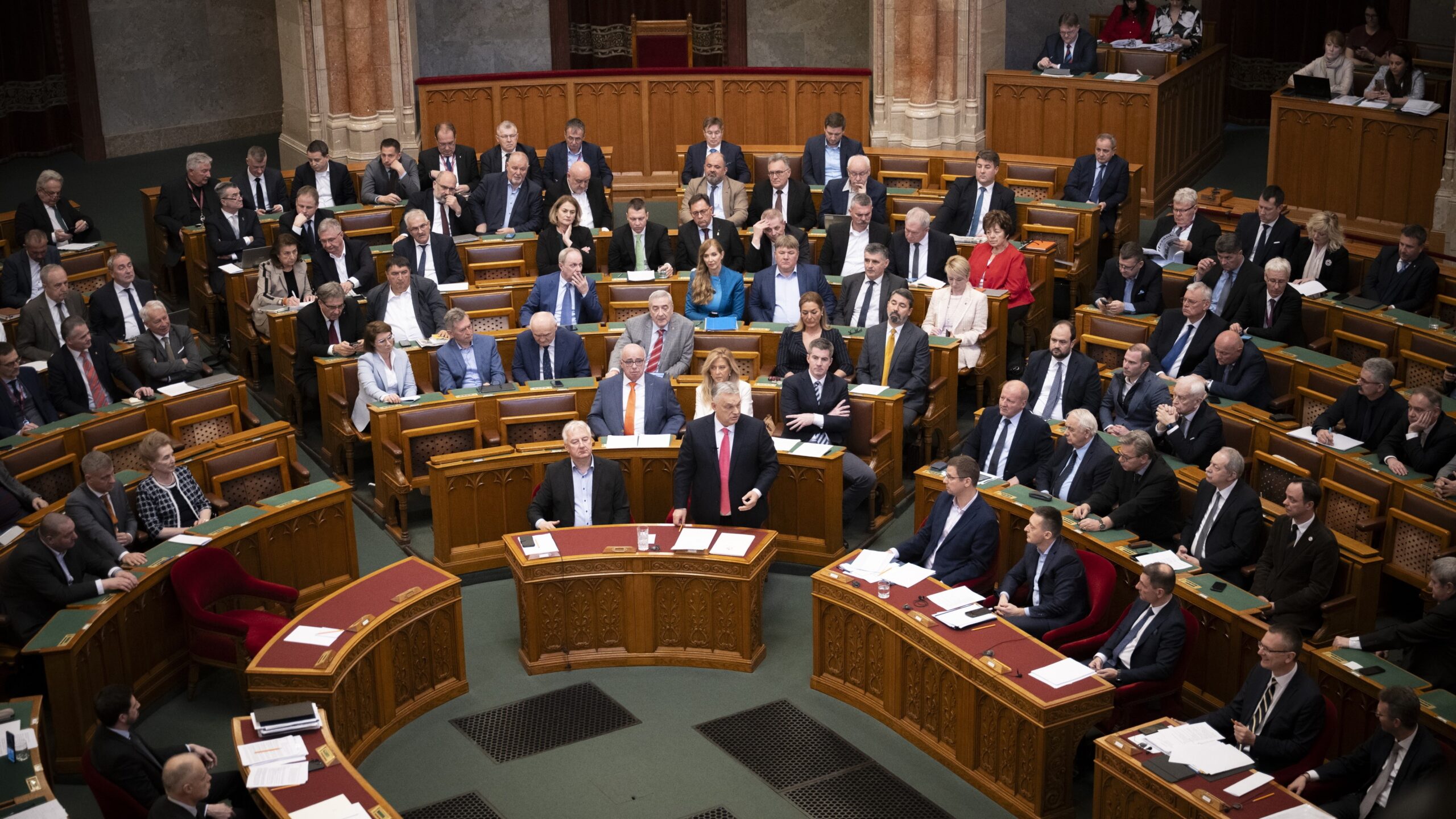
Hungary’s National Assembly adopted a total of 447 legislative proposals during the 2022–2026 parliamentary cycle, including five amendments to the country’s constitution, according to official parliamentary data.
One of the first major acts of the term was the tenth amendment to the Fundamental Law in May 2022, enabling the government to declare a state of emergency in response to war, armed conflict or humanitarian crises in neighbouring countries.
Further constitutional changes followed in quick succession. A July 2022 amendment aligned the timing of local and European Parliament elections from 2024 and formally reintroduced the historical term ‘vármegye’ for counties.
In December 2023, lawmakers approved another amendment allowing for the establishment of an independent body tasked with protecting national sovereignty, while also permitting the government to regulate the legal status of soldiers by decree rather than statute.
The 13th amendment in June 2024 came in response to a high-profile pardon case, enabling the president to grant individual pardons without ministerial countersignature. It also restricted the use of clemency in crimes committed against children.
A further change in December 2024 modified judicial rules, allowing the chief prosecutor to be elected from outside the ranks of prosecutors.
The most recent, 15th amendment adopted in April 2025 introduced provisions defining biological sex as either male or female, stating that ‘the mother is a woman, the father is a man,’ guaranteeing the right to cash payments, and banning drug production, use and promotion.
Beyond constitutional changes, around 100 of the adopted laws ratified international agreements. The Ministry of Justice Hungary submitted the highest number of successful proposals, while 44 bills originated from individual lawmakers, primarily from the ruling parties.
Among opposition groups, only Our Homeland succeeded in passing a legislative proposal, restoring the system of electing Budapest’s municipal assembly members via party lists.
Budget legislation largely followed the post-2015 practice of summer adoption, though in 2024 the budget was delayed until December due to economic uncertainty.
Lawmakers used expedited procedures for 28 bills, allowing adoption on the same day as debate. One of the final such measures addressed national security concerns related to unusually large cash and gold transfers through Hungary.
During the term, the president returned six laws to parliament for reconsideration—three under Katalin Novák and three under Tamás Sulyok.
Parliament also approved 133 resolutions, nearly half concerning parliamentary immunity cases. Opposition parties initiated eight political debate days, though only four were held.
In total, lawmakers submitted hundreds of parliamentary questions, with ministries responding to more than 9,600 written inquiries.
The current parliamentary term will formally end with the formation of the new legislature following the 12 April election. President Sulyok has convened the inaugural session of the next parliament for 9 May.
Related articles:
At a time when public debate is increasingly polarized and superficial, Hungarian Conservative remains committed to depth, intellectual honesty, and independent conservative thought.
Producing high-quality journalism requires resources. Your contribution helps us expand our coverage, reach new audiences, and keep our content accessible.

Please consider supporting our mission.