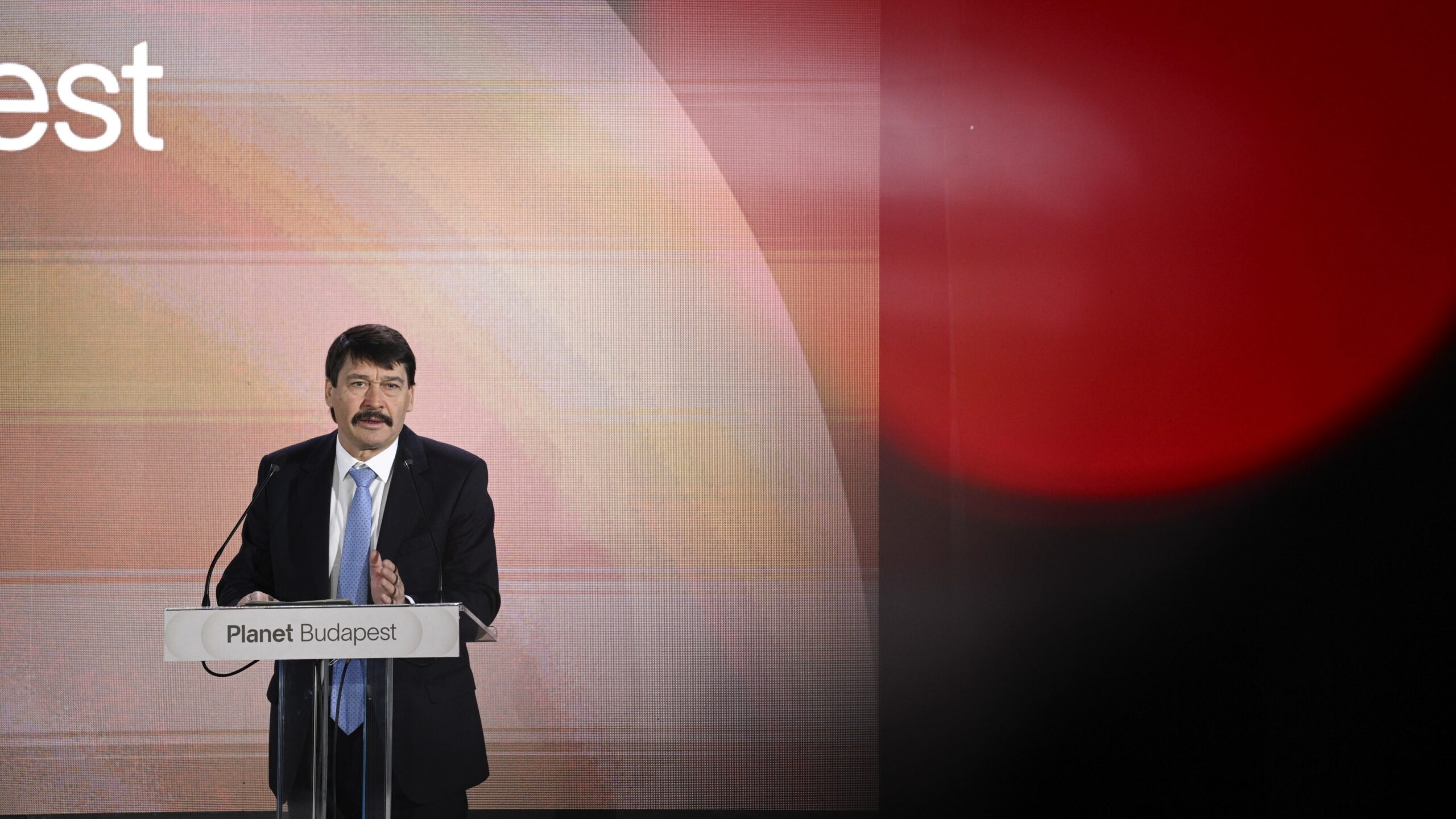
Former Hungarian President János Áder has warned that the risk of war in Europe appears greater today than it was two years ago, based on recent statements by leading European Union politicians.
Speaking on the Kossuth Radio on Monday, Áder said many European leaders are trapped in what he described as an ‘ideological bubble’.
He cited statements by several politicians, including Poland’s prime minister and foreign minister, Austria’s defence minister, the former president of the European Council, and President of the European Commission Ursula von der Leyen.
Among the remarks he highlighted were comments made about a month ago in Zagreb by Manfred Weber, leader of the European Parliament group of the European People’s Party.
According to Áder, Weber suggested that the European Union should evolve into a military alliance and that the Treaty of Lisbon should be reinterpreted. This could involve extending provisions requiring member states to assist one another so that they explicitly include military support, while also abolishing national veto rights in favour of qualified majority voting. Áder argued that such a development could eventually lead to a situation in which Ukraine, as a potential EU member, might request military assistance from the bloc, potentially resulting in European soldiers being deployed to the battlefield. ‘This logic is frightening, but it was presented publicly by Manfred Weber at a press conference, so we are not talking about imagined scenarios,’ the former president said. Áder added that he has long believed that Russia would not attack a member of NATO.
‘Weber suggested that the European Union should evolve into a military alliance and that the Treaty of Lisbon should be reinterpreted’
He recalled that two years ago, Jens Stoltenberg, then secretary general of NATO, said he did not see an immediate risk of Russia launching a military attack against any NATO ally. According to Áder, such cautious voices are now rarely heard. Instead, he said, public discourse increasingly suggests that Russia cannot be allowed to win the war and may eventually attack the Baltic states or Poland. Drawing a historical parallel, Áder compared current rhetoric to the period preceding World War I, when political leaders and military commanders made confident predictions about victory while underestimating the scale of the coming conflict. He also criticized what he called common political slogans used by some EU leaders, including the claim that ‘Ukraine is defending Europe’. According to Áder, Ukraine is primarily defending its own independence and freedom.
Another frequently repeated claim, he said, is that the EU must support Ukraine with every available means, including military assistance. Áder argued instead that political leaders should prioritize achieving peace. ‘We should be doing everything possible to ensure that peace is achieved,’ he said. However, he warned that European politicians are increasingly convincing themselves that Russia poses an imminent threat and that Ukraine must therefore receive all forms of support, potentially leading to a broader confrontation.
Áder described the strengthening of what he called a ‘war psychosis’ against a nuclear power as ‘extremely dangerous’.
He noted that Europe has largely avoided large-scale war since 1945, with the exception of the conflicts in the Balkans. As a result, he said, younger generations may underestimate the destructive consequences of war. To illustrate his point, Áder suggested people look at historical images of cities such as Berlin, Warsaw and Budapest after wartime destruction, as well as photographs from Hiroshima and Nagasaki following atomic bombings.
Even if there is only a small chance of such a catastrophe occurring, he said, politicians have a responsibility to work to prevent it.
Related articles:
At a time when public debate is increasingly polarized and superficial, Hungarian Conservative remains committed to depth, intellectual honesty, and independent conservative thought.
Producing high-quality journalism requires resources. Your contribution helps us expand our coverage, reach new audiences, and keep our content accessible.

Please consider supporting our mission.