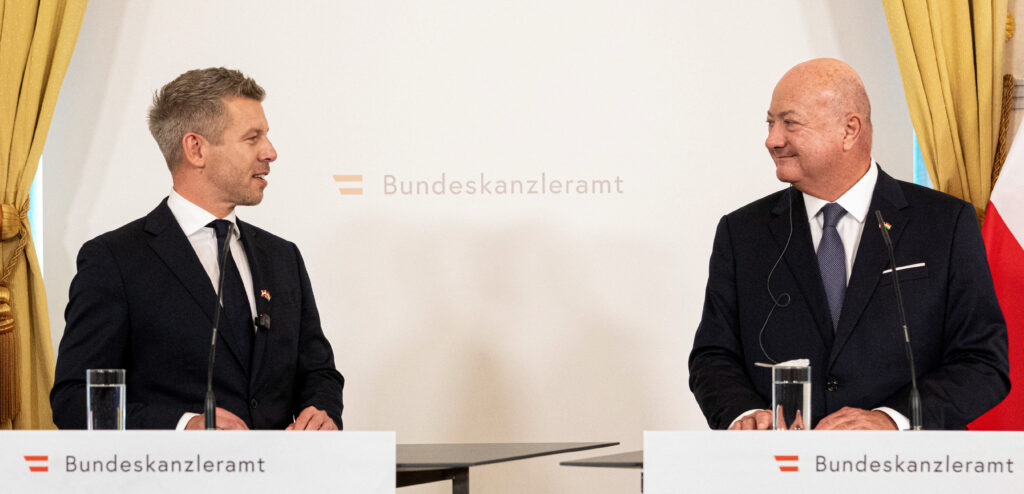
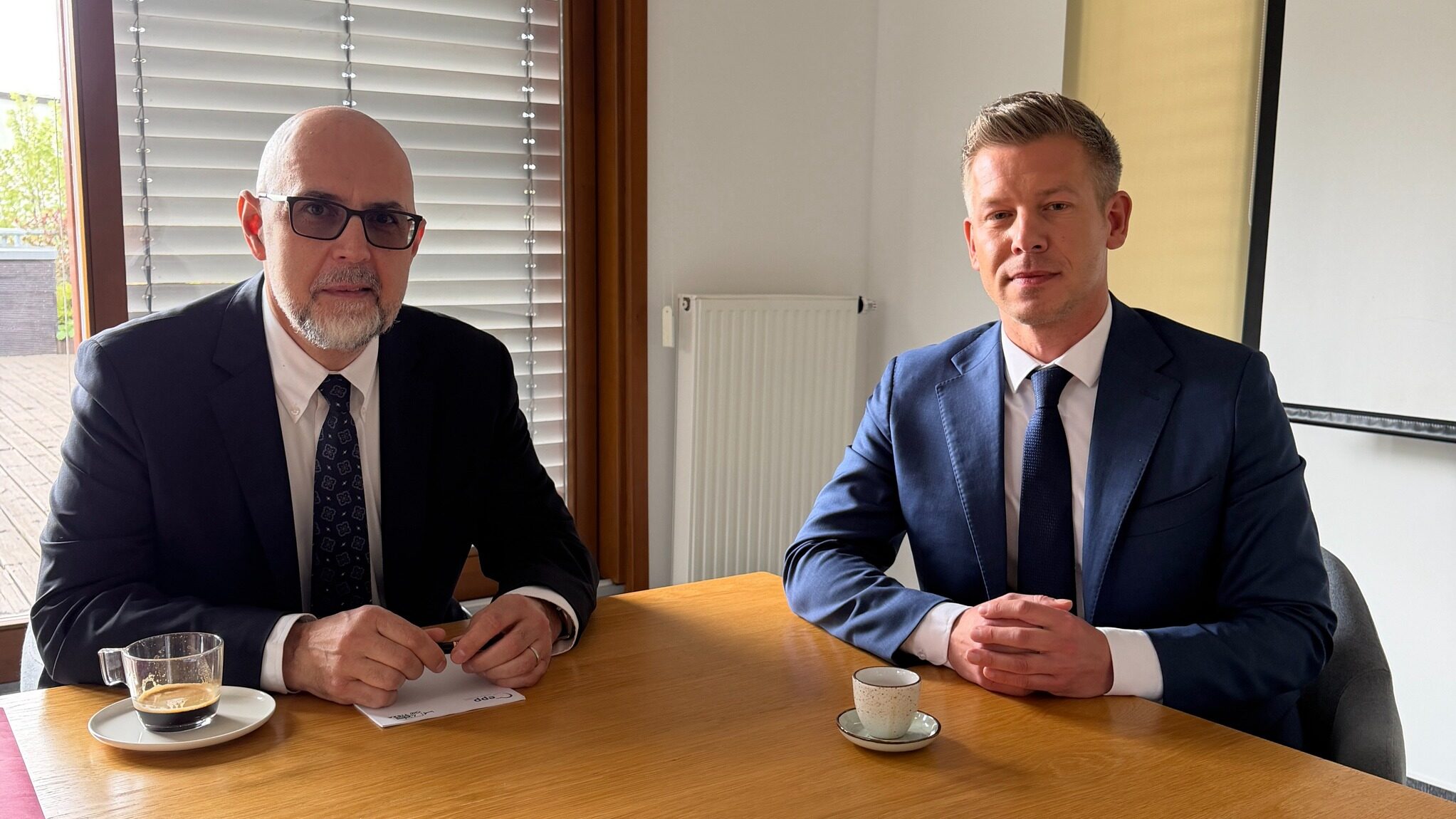
Hungarian prime minister-elect Péter Magyar held a personal meeting with President of the Democratic Alliance of Hungarians in Romania (RMDSZ) Hunor Kelemen on Tuesday, 21 April, addressing earlier disputes between the two leaders and agreeing to work together for the ‘survival and development’ of the Hungarian community in Transylvania.
After securing a landslide in the 12 April election, Tisza Party leader Péter Magyar sharply criticized the close ties between Viktor Orbán’s Fidesz–KDNP and RMDSZ, accusing Kelemen’s party of influencing Transylvanian Hungarians to support Orbán in the election. Magyar had earlier accused RMDSZ of acting as a proxy for the Hungarian government and claimed that its MEPs in the European People’s Party (EPP)—of which Tisza is also a member—were effectively spying on behalf of Fidesz.
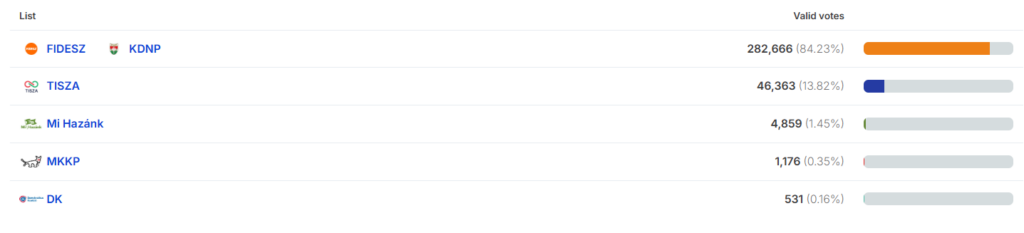
According to the final results, more than 218,000 postal votes—nearly two-thirds of all mail-in ballots (337,439)—came from Hungarians living in Romania. 84.23 per cent of all postal voters cast their ballots in support of Fidesz–KDNP, while the Tisza Party secured 13.82 per cent. This indicates that Fidesz–KDNP’s support among Hungarians living beyond the country’s borders declined, as its share had exceeded 90 per cent in each of the previous four elections.
Kelemen responded to Magyar’s accusations by stating that RMDSZ supported Fidesz due to the shift in national policy under the party’s 16 years in power. One of the first acts of Orbán’s government in 2010 was the introduction of simplified naturalization, a move that cemented his support among ethnic Hungarian minorities. Transylvania has since become central to Orbán’s nation-unity narrative, with the outgoing prime minister delivering major policy speeches at the annual Bálványos Summer Free University and Student Camp (Tusványos) in Băile Tușnad.
That consensus fragmented last May, when Orbán made a strategic miscalculation and implicitly endorsed Romanian ultranationalist George Simion in the presidential race. As Hungarian Conservative reported at the time, Orbán’s remarks disrupted the long-standing dynamic, making Hungarian voters in Transylvania appear increasingly open to political actors beyond Fidesz and potentially prompting RMDSZ to re-evaluate its alliance with the party.
‘The acquired rights of Hungarians in Transylvania will continue to be respected’
Following their meeting on 21 April, prime minister-elect Magyar said he had received assurances from Kelemen that RMDSZ ‘will refrain in the future from interfering in Hungarian party politics’. The two also agreed that the rules governing voting should be ‘reviewed for the future in order to prevent electoral fraud’.
‘I also made it clear that the acquired rights of Hungarians in Transylvania will continue to be respected, and that they can count on the support of the mother country in all matters,’ Magyar wrote in a post on X, adding that, at the same time, the two sides would conduct a ‘retrospective review’ of how funds awarded over the past decade had been used in Transylvania.
I held a personal meeting in my office with Hunor Kelemen, President of the RMDSZ, and former Deputy Prime Minister of Romania.
— Magyar Péter (Ne féljetek) (@magyarpeterMP) April 21, 2026
We agreed that we will leave the past behind us, and that the TISZA government and the RMDSZ will work together for the survival and development of the… pic.twitter.com/PwziE8xRWj
In his post, Magyar also sent a symbolic message to Transylvanian Hungarians, ‘firmly opposing’ the expulsion of Premonstratensian abbot Rudolf Anzelm Fejes in Oradea (Nagyvárad), stating that he had requested the intervention of Hunor Kelemen in the matter.
As Hungarian Conservative reported last week, armed Romanian gendarmes and police entered a Catholic church in Oradea during a Hungarian-language Mass on 14 April to enforce the eviction of Premonstratensian abbot Rudolf Anzelm Fejes. They attempted to access the sacristy, where the abbot and parishioners physically blocked their entry, resulting in a prolonged standoff with a court bailiff present.
The eviction stems from a long-running legal dispute over ownership of the church complex, parts of which were confiscated during Romania’s communist era and later repurposed. The municipality of Oradea maintains that certain rooms currently used by the Premonstratensian Order belong to the city and form part of a school building slated for renovation. The abbot, however, argues that the property belongs to the Order and that the eviction procedure is unlawful.
Köszönöm Magyar Péternek, hogy betartotta az ígéretét, amelyet az Országházban tett a pártok delegációinak tárgyalása után, amikor arra kértem, hogy álljon ki a nagyváradi premontrei apát, Fejes Rudolf Anzelm atya mellett, egyúttal védjük meg a 18. századi templomot, valamint az… pic.twitter.com/tk3ScdwZfI
— Toroczkai László (@ToroczkaiLaszlo) April 21, 2026
Leader of the hard-right Mi Hazánk (Our Homeland) party—the only parliamentary party besides Tisza and Fidesz–KDNP—László Toroczkai was present during the raid last week and called on both the outgoing and incoming governments to intervene diplomatically. He reiterated his call last Friday, when party delegations met in parliament to begin preliminary work for the inaugural session of the new legislature scheduled for 9 May.
In a post on X, Toroczkai thanked Magyar ‘for keeping his promise’ to stand up for Father Rudolf Anzelm Fejes. ‘As I said during our brief conversation, there are moments when party politics—and especially ego, personal considerations, and grievances—must be set aside, because the interests of the homeland and the Hungarian nation take precedence over all of these,’ Toroczkai said, adding that this does not mean ‘we have to like each other’ and that they will certainly continue to have ‘heated debates’ in the future over policy. ‘Politics should be—or at least ought to be—about service,’ he concluded.
Related articles:
At a time when public debate is increasingly polarized and superficial, Hungarian Conservative remains committed to depth, intellectual honesty, and independent conservative thought.
Producing high-quality journalism requires resources. Your contribution helps us expand our coverage, reach new audiences, and keep our content accessible.

Please consider supporting our mission.