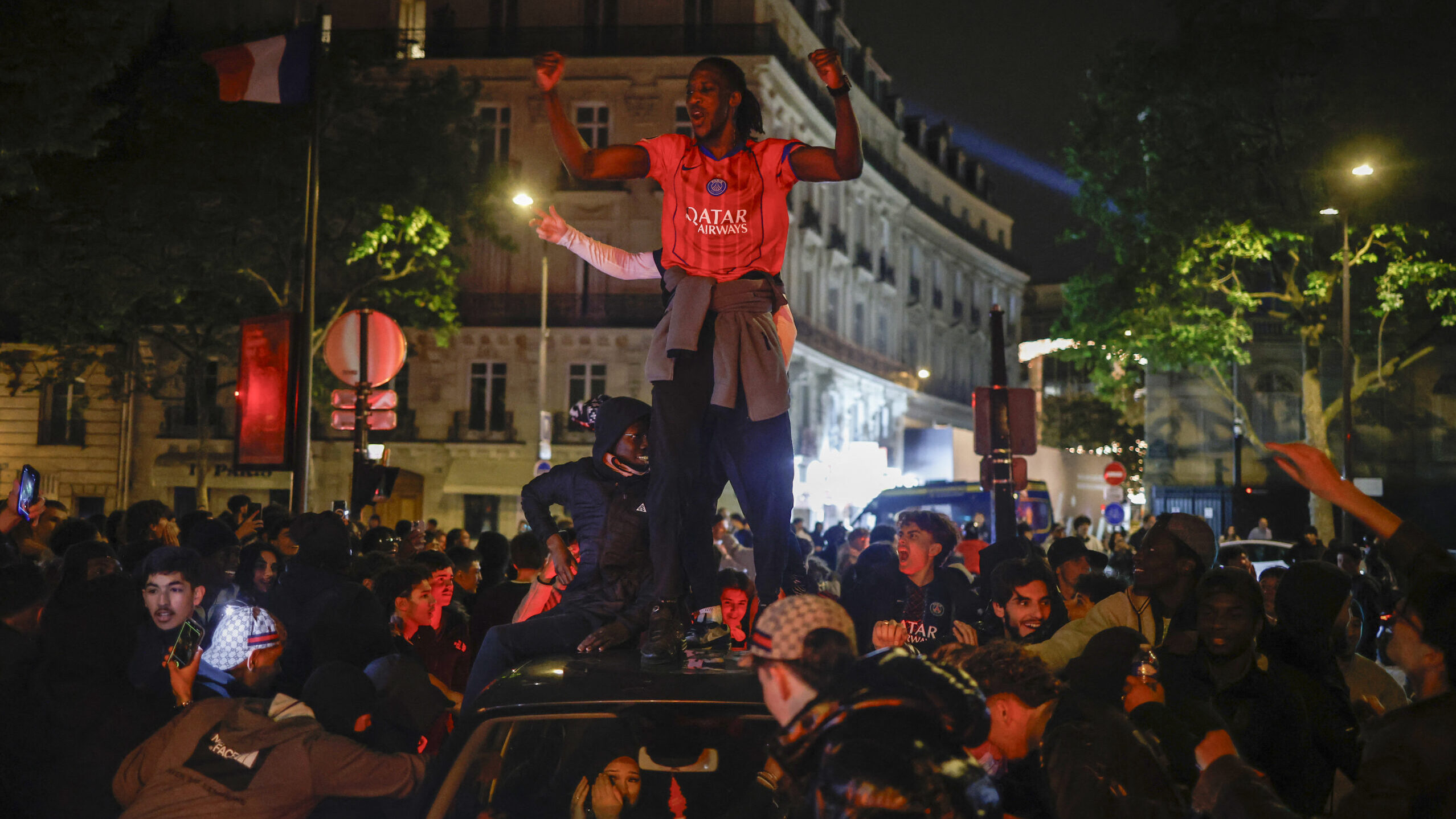
Paris once again descended into chaos after Paris Saint-Germain drew with Bayern Munich on Wednesday night, securing qualification for the UEFA Champions League final in Budapest on 30 May, as celebrations across the French capital turned into violent unrest, with clashes erupting near the Eiffel Tower, the Champs-Élysées, and the Parc des Princes stadium.
According to French authorities, 127 people were arrested overnight, including 107 in Paris itself, after crowds confronted riot police, launched fireworks, vandalized property, and set multiple vehicles on fire. Authorities also confirmed that 23 police officers sustained minor injuries, while 11 other individuals were injured during the clashes.
🇫🇷🔴Absolute chaos in Paris:
— Remix News & Views (@RMXnews) May 7, 2026
PSG football supporters charge the police in front of the Eiffel Tower.
🚨127 arrests
🩸33 injured
🔥Multiple vehicles set on firepic.twitter.com/LPcI2frLwR
Videos and photos of the unrest, widely circulated on social media, showed groups of predominantly young men—reportedly often from immigrant backgrounds—charging police lines, forcing riot police to respond with tear gas and other crowd-dispersal measures. Footage of burning vehicles and fireworks exploding in central Paris spread rapidly online.
The events echoed similar unrest in previous years linked to major football matches in France, particularly in terms of the demographic profile of the crowds, often consisting of youths from immigrant-heavy suburban areas surrounding Paris.
The scenes also revived memories of the widespread riots that accompanied Morocco’s matches during the 2022 FIFA World Cup, especially after France’s defeat to Argentina in the final. At the time, celebrations similarly led to clashes with police in Paris and several major cities across the country—and, more broadly, in many Western European countries such as Belgium and Italy, where Moroccan populations are significant.
‘Across France, authorities recorded more than 550 arrests, nearly 200 injuries, and over 260 vehicles set on fire’
Following Morocco’s semi-final defeat to France in December 2022, French authorities deployed over 10,000 police officers nationwide amid fears of unrest. More than 260 people were arrested across France that night, while dozens of police officers were injured in clashes involving fireworks, vandalism, and attacks on vehicles. A 14-year-old boy was also killed in Montpellier during celebrations linked to the tournament. In Brussels, Belgian police detained over 100 people after riots erupted in the city centre, with cars burned and officers attacked.
Last year, when PSG won the Champions League, similar—but more severe—unrest erupted. Across France, authorities recorded more than 550 arrests, nearly 200 injuries, and over 260 vehicles set on fire. Two people died during the night of the final, as looting, arson, and attacks on officers occurred in major French cities.
French conservative and right-wing politicians argued that these disturbances exposed deeper fractures within French society, particularly concerning identity, assimilation, and the relationship between communities of immigrant origin and the French nation-state.
Il n’y a plus une seule fête populaire épargnée par les insultes, les destructions et les menaces de la « nouvelle France ».
— Jordan Bardella (@J_Bardella) May 7, 2026
Encore quelques mois et nous remettrons de l’ordre. pic.twitter.com/Ek3UHiwQ9P
Reacting to the current unrest, National Rally (RN) leader and presidential candidate Jordan Bardella said in a post on X that there is no longer a ‘single public celebration spared from the insults, destruction, and threats of the “new France”’, adding that, if elected, RN would ‘restore order’.
French Minister of Interior Laurent Nuñez, however, stated on Thursday morning that the situation had gradually stabilized overnight, although isolated clashes reportedly continued into the early hours near several iconic landmarks in central Paris. Speaking about the 30 May final, Nuñez warned of potential similar ‘disturbances’, promising there would be the ‘same firm response as last night’. ‘We can celebrate a sporting event, but there are always a few hundred individuals who come to cause trouble, and they will always receive a very firm response from the State,’ he concluded.
Related articles:
At a time when public debate is increasingly polarized and superficial, Hungarian Conservative remains committed to depth, intellectual honesty, and independent conservative thought.
Producing high-quality journalism requires resources. Your contribution helps us expand our coverage, reach new audiences, and keep our content accessible.

Please consider supporting our mission.