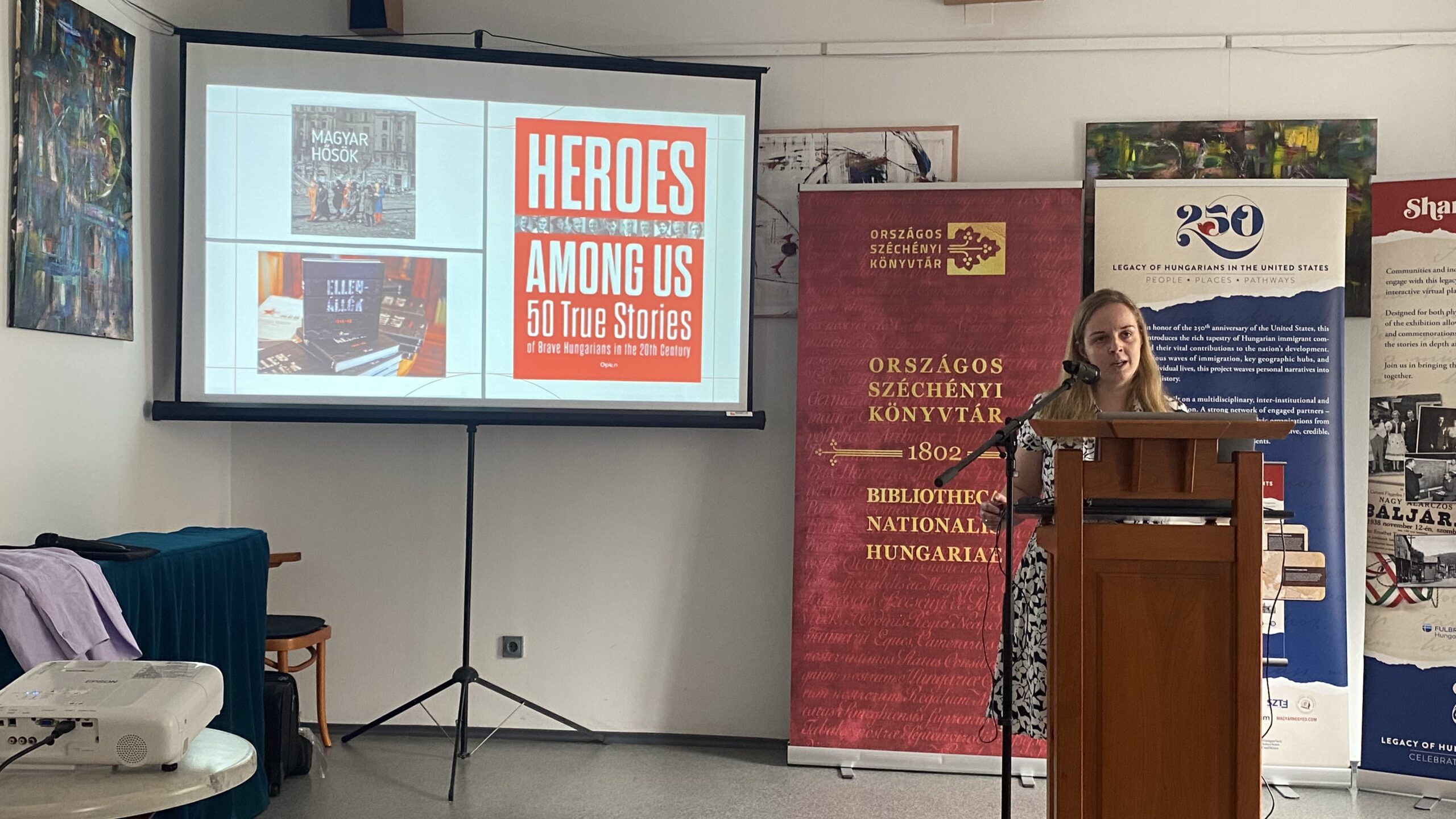
The Emigrants’ Heritage Workshop series, launched in 2025, aims to provide a forum for institutions, researchers, and community initiatives engaged in the study of Hungarian emigration and diaspora life in North America. The third event of this series placed emphasis not only on presenting ongoing research projects and initiatives, but also on joint planning and the development of frameworks for long-term cooperation. Similarly to the previous occasions, the program of the latest event was structured around presentations followed by two afternoon workshop sessions: the first discussed the 2026 schedule and future plans of the exhibition initiative previously introduced under the title Legacy of Hungarians in the United States: People, Places, Pathways (USA 250 exhibition), while the second examined the concept and the possible operational framework of a new research network.
The forthcoming 250th anniversary of the founding of the U.S. and the approaching 70th anniversary of the 1956 Hungarian Revolution and War of Independence make it particularly timely to present the initiatives relating to the past, present, and future of Hungarian–American relations. The aim of the Emigrants’ Heritage professional workshop series is to provide a forum for this purpose and to initiate the establishment of a research and institutional network capable of operating over the long term. According to program coordinator Réka Bakos, the meetings held so far have confirmed that there is considerable institutional and community interest in exploring and preserving the heritage of Hungarian emigration to the U.S. During the morning session, we heard a series of short presentations on ongoing projects, primarily linked to the USA 250 anniversary, several of which are highlighted below.
The workshop was opened by Director General Dávid Rózsa of the National Széchényi Library (NSZL), who reminded participants of the extent to which Hungarians have helped shape America. This contribution included not only the intellectual achievements of well-known (American) Hungarians such as Mihály Kováts, Lajos Kossuth, the founding fathers of the U.S. film industry, and the mid-20th-century scientists known as the ‘Martians’, but also the sweat and hard labor of the masses of emigrant manual workers. Among the NSZL’s collections, he highlighted the History of Hungarian Emigration Handbook (NSZL, 2023) of Béla Nóvé, and announced the establishment of a new Emigration History Research Group named after the famous writer Sándor Márai. In his view, these developments demonstrate that emigration studies are ‘not a closed file, but remain an integral and vibrant part of contemporary research’, accompanied today by growing public interest. He described this third professional meeting as a step forward, centered on joint planning and the development of frameworks for long-term cooperation. The welcome address was continued by Gergely Bokodi-Oláh, Head of the Department of Research and Special Collections (NSZL), who revealed that, as a researcher of 1956, he is well acquainted with Béla Király’s work, adding that it is no coincidence that the institutionally organized diaspora research is most prominent at the NSZL.
Béla Nóvé (NSZL), outlining the background to the newly established research group, spoke about Kossuth’s offer of his library of 4,000 volumes to the NSZL before his death; the collection containing publications, letters and posters relating to Kossuth’s American tour of 1851–52; the gathering of materials from the émigré press, including complete annual runs of 16 Hungarian American newspapers published around the turn of the 19th-20th century; and 18 completed research projects. These include studies on Hungarian–American musical life and theatre, Hungarian connections to Arlington National Cemetery, the life of Gideon Ács, and, as elements of collective memory, the histories of Árpádhon, Ellis Island, and Camp Kilmer, as well as the lives and careers of Ágoston Haraszthy, Mihály Kováts, Lajos Kossuth, Zsuzsanna Kossuth, Gyula Váralljai, and János Xantus, the history of the Association of Hungarian Scouts in Exteris (abbreviated KMCSSZ in Hungarian), Lincoln’s Hungarian heroes, etc.
Judit Gerencsér (Hungarian National Museum), speaking on behalf of the curatorial team—including Senior Curators Dr. Angelika Orgona and Dr. Klára Radnóti—presented the forthcoming anniversary exhibition American Dream – Hungarians in the United States, 1776–2026, which will open on 29 July 2026 and remain on view until November. According to the curatorial concept, the exhibition explores the historical and cultural connections between Hungary and the U.S. through narratives of migration, freedom, prosperity, creativity, and success. Particular emphasis is placed on the experiences of Hungarian diaspora and émigré communities, and Hungarian-born individuals whose achievements significantly influenced the development of the U.S. and the wider world.
Visitors are expected to encounter in the museum’s entrance hall, the legendary Ford Model T, whose development was profoundly shaped by József Galamb, the Hungarian-born engineer and chief designer of the Ford Motor Company. Large-scale visual installations in the Grand Staircase will evoke key chapters in the history of Hungarian emigration to America, while the area preceding the Dome Hall will focus on the theme of transatlantic travel and migration. The northern Fireplace Hall, entitled The Promise of Prosperity, will present the great wave of emigration between 1871 and 1914, when hundreds of thousands of Hungarians crossed the Atlantic in search of better opportunities. Through film excerpts, historical artifacts, and archival documents, visitors will gain insight into the formation of Hungarian American communities, the everyday lives of emigrants, and the cultural heritage of the diaspora.
The southern Fireplace Hall, Conquering the World, will highlight the achievements of Hungarian-born individuals who attained international recognition in the United States, including scientists, Nobel Prize laureates, Hollywood filmmakers and artists, politicians, and entrepreneurs whose contributions left a lasting impact on American and global society. The Dome Hall, entitled The Land of Freedom, will explore the ideals and historical narratives associated with liberty and democratic aspirations. Beneath a symbolic star-filled sky, visitors will encounter the story of Mihály Kováts, a hero of the American War of Independence, alongside presentations devoted to Lajos Kossuth, the émigrés of the 1848–1849 Hungarian Revolution and War of Independence, and the subsequent political refugee waves of the 20th century.
As emphasized, the exhibition is primarily based on the Hungarian American heritage collections preserved by the Hungarian National Museum, complemented by significant loans and selected materials from numerous Hungarian public collections and cultural institutions. The project has also benefited substantially from the contribution of Zsolt Máté (University of Pécs), external advisor to the exhibition, and László Aradvári (Consul of Hungary in Chicago and community diplomat), who has assembled a unique collection of memorabilia associated with contemporary Hungarian athletes who have achieved notable success in the United States. The exhibition aims to remind visitors that Hungarians were not merely witnesses to the emergence of the American Dream, but active participants in shaping it. The museum is also preparing a complementary outdoor photographic exhibition entitled We Came from America for 4 July 2026, accompanied by a commemorative wreath-laying ceremony at the Washington Memorial Stone in the Museum Garden.
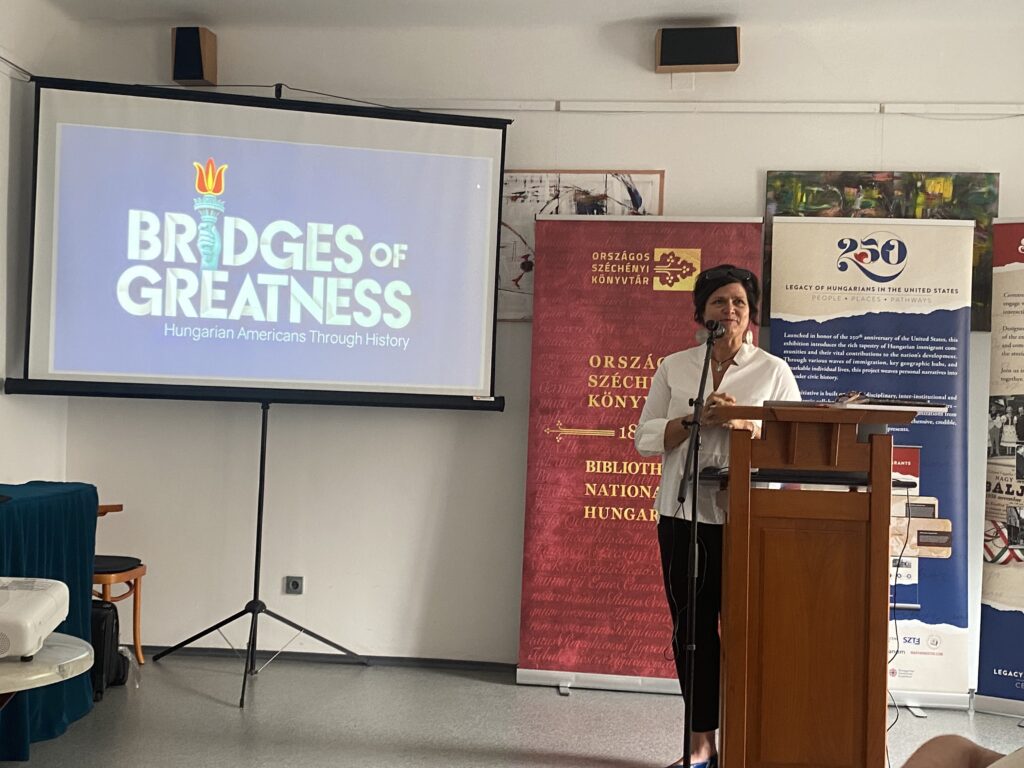
Réka Pigniczky (56Films, documentary filmmaker) presented the documentary series Bridges of Greatness: Hungarian Americans Through History, which was screened at the end of April in Washington, DC, as part of the major USA 250 Gala organized by the Hungarian American Coalition (HAC). The seven-part series aims to demonstrate the defining role played by Hungarian Americans throughout the history of the U.S. Following the screening of the first five-minute-long episode, devoted to science, we learned that interviews are planned with representatives from six additional fields—medicine, politics/public service/journalism, the arts and culture, the entertainment industry, music, and community life. The creators intend to continue blending archival materials, narration, and visual storytelling in a flexible, scalable format, suitable for integration into exhibitions, educational curricula, and digital campaigns tied to the America 250 initiative.
Janka Barkóczi (National Film Institute – Film Archive, Head of Film Collections and Research) presented the Institute’s international research into moving-image Hungarica research, and its antecedents, including the work of Péter Ábel and Gyöngyi Balogh, thematic programs at the Örökmozgó cinema, and the year-long series of events marking the 120th anniversary of the Hungarian cinema in 2021—included a virtual exhibition at the Ludwig Museum, in which the theme of emigration featured prominently—as well as accompanying projects such as the 120 Most Wanted Hungarian films. As she explained, the objective of the research program is to locate and present lost and unknown works from Hungary’s cinematic heritage, to trace the oeuvres of Hungarian and Hungarian-born filmmakers, to collect moving images, related documents, and memorabilia, and to launch restoration projects. Further aims include scholarly processing, public dissemination, and bringing these rediscovered treasures to a wider audience. After presenting several examples of significant discoveries—films, artists, directors, associated memorabilia, archival estates and the online biographical lexicon—she drew attention to the Budapest Classical Film Marathon, held annually and attracting some 20,000 visitors, scheduled this year for 15–20 September, focusing on Hungarian American film directors’ and cinematographers’ work and welcoming guests from overseas.
‘The objective of the research program is to locate and present lost and unknown works from Hungary’s cinematic heritage’
Due to illness, Dorottya Szénási (RETÖRKI Archives, Research Associate) was represented by Deputy Director Barnabás Pálinkás, who introduced the sources and research on North American emigration preserved in the archives. He explained that the documentation center established in 2013 was built upon the Lakitelek Archive of the Democratic Transition, which holds Sándor Lezsák’s private collection on deposit. Since then, through professional and personal connections, the collection has expanded through further donations of archival materials. Following organizational restructuring in 2021, it has operated since 2022 as a public-private archive dedicated to locating, collecting, and preserving sources related to the democratic transition and its associated historical periods, including private papers of particular significance. In this work, it cooperates with other archives through rescue projects and joint publications, as well as with a range of professional partners.
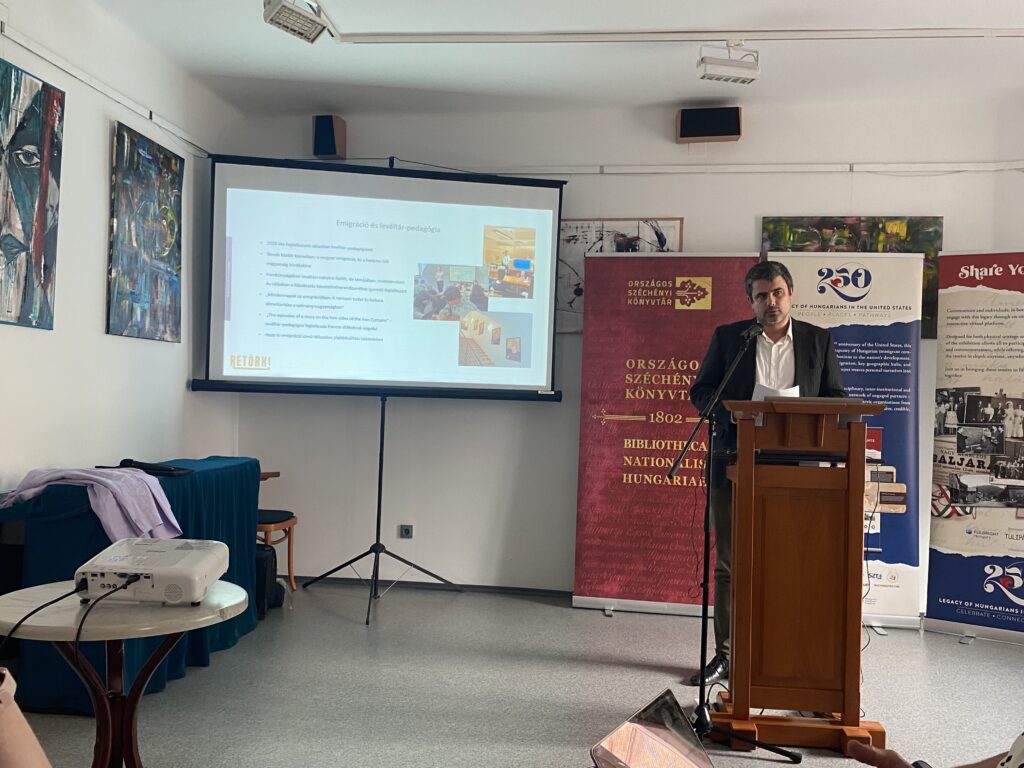
We learned that since 2020, the institution has pursued targeted archival education activities, with a particular focus on Hungarian emigration and Hungarian communities in the Carpathian Basin, beyond Hungarian borders. These have included archival education sessions based on original documents but adapted in subject matter, methodology, and objectives to the requirements of public education. Examples include Everyday Life in Emigration: Maintaining National Identity and Culture among Dispersed Hungarian Communities, delivered in Hungarian; The Episodes of a Story on the Two Sides of the Iron Curtain, presented in English to French students; and the temporary poster exhibition Homeland and Emigration, held in Lakitelek. The archive contains emigration-related materials concerning Sándor Püski, László Varga, György Haas, and Géza Bertalan Fekete OFM, as well as more sporadic materials—primarily correspondence—preserved within private archival estates. We also learned that, through individual research commitments, members of the institution are contributing to the USA 250 exhibition project, while a source publication is among their plans for 2026.
Anita M. Madarász (Committee of National Remembrance, NEBH) shared several insights from the institution’s research in her presentation titled Emigration, Life Paths and Memory. After introducing the NEBH—established by the Hungarian Parliament in 2013 with the principal aim of investigating the operation and power mechanisms of the communist dictatorship, particularly the decision-making networks of the Rákosi and Kádár eras—the speaker emphasized that the institution’s research in this field primarily focuses on the emigration of the Hungarian elite—individuals coming from the spheres of culture, science, the Church, and politics. As noted, the institution was pleased to join the USA 250 exhibition project, and, as a first step, it is preparing a biographical database of nearly 100 key figures in Hungarian emigration. The importance of collecting family documents and oral history materials is well illustrated by the legacy of Béla Varga preserved by his relatives in Börcs, as well as by the reconstructed life histories of emigrants (for example, through the scholarly processing of the legacies of József Közi Horváth, Bálint Czupy, and Lajos Hajdu-Németh). As emphasized, public education is also a task of particular importance for NEBH—leading to volumes such as Hungarian Heroes, its English-language version Heroes Among Us – 50 True Stories, and Resistance Fighters (Ellenállók).
János Rácz (VERITAS Research Institute and Archives) delivered a presentation on the Institute’s holdings relating to the Hungarian diaspora in the U.S. The archives contain a total of 12,000 claims for property compensation submitted from American addresses (individuals were able to submit more than one claim), while 14,000 personal compensation claims were received from applicants residing in the U.S. Of these, 11,000 resulted in decisions granting compensation in whole or in part, and in 7,700 cases, deportation constituted the basis of the grievance. Among the applications were 341 cases relating to Soviet prisoner-of-war captivity and 127 concerning civilian internment, while some applicants had also been subjected to compulsory labor service.
The afternoon program consisted of two collaborative workshop sessions. The first focused on the USA 250 exhibition project, during which participants briefly reviewed achievements to date, the schedule for the remainder of the year, and longer-term plans. This was followed by a joint discussion of potential points of connection and cooperation, as well as ways in which the platform being developed through the project might evolve into a continuously expanding, living community archive suitable for educational purposes. Such an archive would not only preserve but also make the shared Hungarian American heritage visible and accessible for research. The second session introduced the concept of the HUNNA Research Network (Hungarian North American Research Network), which aims to establish a professional platform that connects specialists, institutions, and community initiatives engaged in the study of North American Hungarian emigration and diaspora, to facilitate regular professional dialogue, information-sharing, and the joint development of projects.
Related articles:
At a time when public debate is increasingly polarized and superficial, Hungarian Conservative remains committed to depth, intellectual honesty, and independent conservative thought.
Producing high-quality journalism requires resources. Your contribution helps us expand our coverage, reach new audiences, and keep our content accessible.

Please consider supporting our mission.