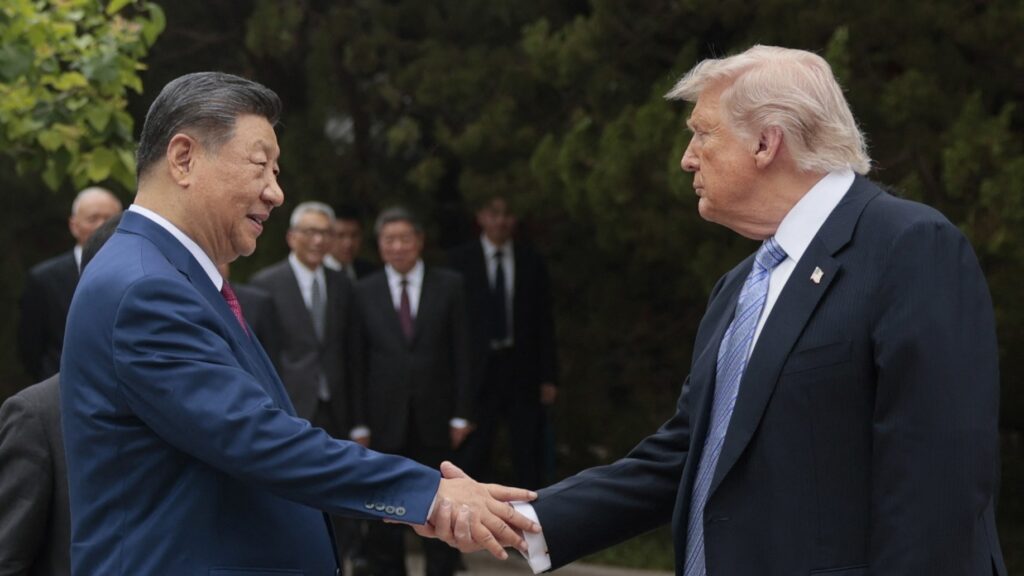
President Donald Trump once more criticized Pope Leo XIV for both denouncing the war in Iran and for not talking about liberating the pro-democracy Catholic activist Jimmy Lai, who has been imprisoned for protesting against the ongoing oppression in China by the Chinese Communist Party (CCP) against anyone who stands for freedom.
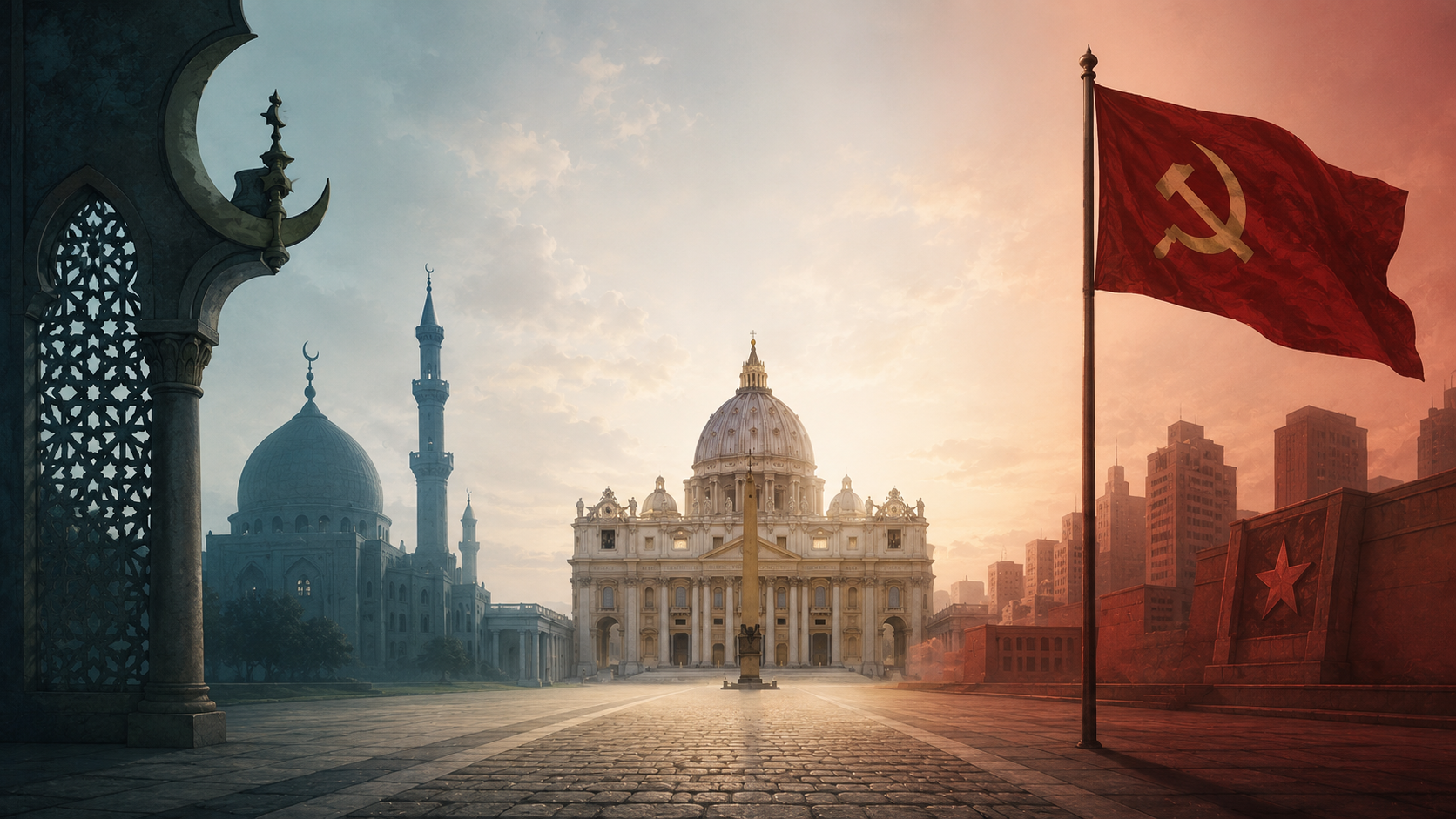
While the Pontiff continues to call for peace, which is his prerogative and duty as the universal shepherd of the Catholic Church, he has also condemned those Muslim terrorists who use the name of God to rationalize violence, calling such acts sacrilege. Yet, at the same time, he has not addressed the aspects of Islam that are often cited as being used to justify such violence in the name of Allah, nor has he called out the atheistic communist doctrine of the CCP—both of which are cancers in society.
The Dangers of Islam
The comprehensive history of Islam illustrates nothing but violence and oppression, all in the name of Allah. This is evident during the final nine to ten years of Muhammad’s life, during which he either directly engaged in or appointed others to partake in 86 battles: averaging over nine battles annually, culminating in increased intensity until his death. Subsequently, the appeal for offensive warfare in the name of God, as Islamic terrorists justify, can be seen in numerous verses from the texts Muslims hold sacred:
‘And when the sacred months have passed, then kill the polytheists wherever you find them and capture them and besiege them and sit in wait for them at every place of ambush.’ (Sura 9, 5)
‘The Messenger of Allah said: “I have been commanded to fight against people so long as they do not declare that there is no god but Allah.”’ (Sahih Muslim, Book 1, hadith 30)
Indeed, ever since the tragedies of 9/11, there have reportedly been over 49,350 Islamic terrorist attacks in the world. Not to mention, these jihadists target Christians at will, knowing that the chances for accountability are slim, at best.
The Christian community in Pakistan, for example, comprising approximately 2.8 million faithful, endures severe discrimination that extends beyond the legal framework, permeating employment, education, and social relationships.
For Muslims who choose to convert to Christianity, the difficulties increase significantly. In Pakistani society, such conversions are perceived as a betrayal of both religious and national identity, given that Islam is integral to the narrative of Pakistan’s establishment. Converts often experience total ostracism from their families and communities. Additionally, they become targets for extremist factions that deem their faith in Jesus as deserving of death in compliance with sharia law:
‘Whoever changes his [Islamic] religion, kill him.’ (Sahih al-Bukhari 6922, Book 88, hadith 5)
‘For Muslims who choose to convert to Christianity, the difficulties increase significantly’
In Iran, the theocratic regime perceives Christianity as a threat to Islamic governance. Although the Iranian constitution ostensibly safeguards acknowledged Christian minorities such as Armenians and Assyrians, it fails to extend any protection to Muslims who convert to Christianity. The authorities regard such conversions as acts of treason, which can result in imprisonment, torture, and in some cases, execution. House churches are frequently subjected to raids, and those involved face the possibility of lengthy prison sentences.
The Dangers of Communism
So far communism is concerned, aside that it professes an atheist doctrine, communist regimes have been accountable for some of the most lethal events in contemporary history, with experts estimating that approximately 100 million individuals perished under communist administrations during the 20th century alone.
In addition to the immense human cost, the ideology’s history is marked by economic stagnation, systematic suppression of fundamental freedoms, environmental disasters, and a ruling elite’s hypocrisy that undermined its own classless principles.
These shortcomings are not isolated incidents or mere implementation errors. They are evident across every continent where communism has been attempted: from the former Soviet Union to China, Cuba, and North Korea, communist regimes do not simply restrict freedom.
They perceive individual autonomy as a danger to the survival of the system, and systematically strive to eradicate it. Freedom of speech, press, assembly, movement, religion, and even personal thought have all been subjected to the control of the communist state. The rationale remains consistent: the collective good supersedes any individual rights. In reality, ‘the collective good’ is defined by whatever the ruling party chooses it to mean.
‘Freedom of speech, press, assembly, movement, religion, and even personal thought have all been subjected to the control of the communist state’
The elimination of private property, for example, is a core principle of communist ideology, rather than a mere consequence. The regimes initiated the confiscation of real estate almost right after their respective revolutions, nullifying the right to possess land in urban areas and appropriating buildings that exceeded certain modest value limits. Karl Marx explicitly referred to communism as ‘the positive expression of annulled private property’, indicating that this was not a fleeting wartime strategy but rather the ultimate objective of the ideology.
This makes the provisional agreement of 2018 between China and the Holy See, in which the latter recognizes the supreme authority of the former to appoint bishops—the Bishop of Rome merely approves—all the more mind-boggling. In fact, the Chinese Communist Party continues its relentless persecution of the underground Catholic Church, which resists Beijing’s control over religious matters, as well as other ‘unregistered’ church leaders, such as Pastor Ezra Jin of the Zion Church.
One may ask why Rome has yet to publicly address the evils of Islam and communism as so many popes have done in the past. It is not my place to surmise the reason(s), but one thing is certain: any appeasements or like-minded gestures that continue to be practiced only allow such ‘cancers’ to spread and damage society.
The views expressed by our guest authors are theirs and do not necessarily represent the views of Hungarian Conservative.
Related articles:
At a time when public debate is increasingly polarized and superficial, Hungarian Conservative remains committed to depth, intellectual honesty, and independent conservative thought.
Producing high-quality journalism requires resources. Your contribution helps us expand our coverage, reach new audiences, and keep our content accessible.

Please consider supporting our mission.