This article was originally published in Vol. 5 No. 4 of our print edition.
‘Everything…in the modern world is of Christian origin, even everything that seems most anti-Christian.’1
Since the concept came into being, religion has been a problem for European thought. Yet what interests us here is not its weakening, decline, disappearance, or resurgence, but rather the presence of Christian culture. Our concern is not with the institutional or devotional dimensions of religious Christianity, but with the elements of cultural Christianity—often invisible or barely perceptible, yet nonetheless crucial—that persist in norms, expectations, and everyday practices. Cultural Christianity encompasses those assumptions, mental tools, habits, customs, and traditions that originate in Christianity, even when they are no longer directly connected to religious observance, though they ultimately stem from it. Our question, then, is whether Europe—and especially the countries that make up Western Christianity—can still be said to be Christian, and if so, in what sense? Our aim is to explore whether cultural Christianity exists in Hungary today and, if it does, to assess its enduring strength. For this purpose, Századvég Foundation conducted two separate surveys, interviewing different groups a year apart, in 2023 and 2024.2
Hungary is no more religious than the European average. Depending on the survey, between roughly 9 and 23 per cent of people describe themselves as clearly religious, while just under two thirds of the population call themselves ‘somewhat’ religious. To put it another way, in both surveys, 63–65 per cent rated their own religiosity between two and six on a scale of one to seven. At the same time, 23 per cent identify as explicitly non-religious, and about half of the population considers itself more or less irreligious.
In Hungary, religion primarily means Christianity. The proportion of religious people who are not Christian is under 2 per cent. Yet the country’s recent past includes a totalitarian regime that openly sought to implement an anti-Christian ideology. In light of this, a question arises: does cultural Christianity exist in Hungary—and if so, how widespread is it?
Our hypothesis is that, despite the decline in the role of institutional religion, despite the anti-Christian tendencies of the modern political, economic, and cultural elite, and despite the hyper-pluralism that dominates public life, Hungarian society remains Christian in culture. We assume that Hungarian society possesses a shared culture which—among other factors—makes our coexistence possible. Furthermore, we posit that this shared culture and mentality can rightly be described as Christian.
Methodology
As we have noted, our research into cultural Christianity has been divided into two parts.3 In the first part (Századvég 2023), we examine explicit forms of awareness and behaviour (for example, the celebration of holidays). In the second part (Századvég 2024), we investigate the implicit presuppositions and patterns of reasoning underlying our ways of thinking. If cultural Christianity exists, it should be characterized by distinctive modes of thought, reflexes, and mental tools that differ from those found in other mentalities. This second part of our research focuses on tacit knowledge, skills, and cognitive instruments of this sort. We seek cultural Christianity within the lifeworld of Hungarian society.
In the first part of our study, we examine the knowledge, practices, and rituals that are explicitly available to people living within cultural Christianity. Such elements may be consciously accepted or rejected by individuals. Since these forms of knowledge and practice refer directly and openly to Christianity, they can be regarded as the fundamental components of Christian religious identity—unlike the tacit mental tools and habits discussed in the next section.
The Explicit Aspects of Christian Culture
Teachings
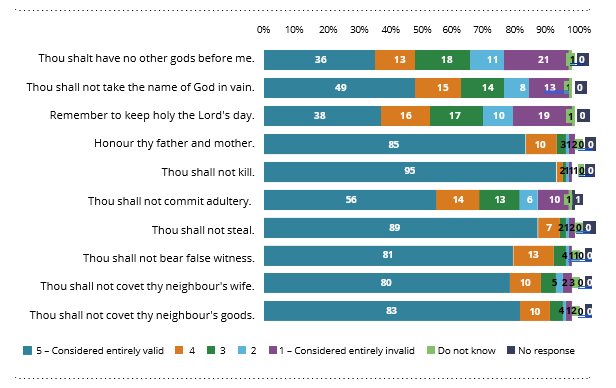
The Ten Commandments form the most important and fundamental element of the religious and moral code shared by Judaism and Christianity. We asked respondents to evaluate each of the Commandments. The results reveal clear differences between the various commandments in terms of how their validity is perceived. The findings fall into three main groups. The first group comprises the first three commandments—those on Moses’s first tablet—which emphasize the recognition of God’s sovereignty. The second group includes those commandments that concern human relationships. It is particularly noteworthy that, with the exception of ‘Thou shalt not commit adultery’, the commandments found on Moses’s second tablet—those regulating proper behaviour—are regarded as valid by 90–95 per cent of respondents. This proportion is far higher than the share of people who identify as religious. We are not claiming that 90–95 per cent actually live according to these commandments, but that the overwhelming majority consider it right that people should do so. This holds true even for the great majority of those who consider themselves non-religious (Fig. 1).
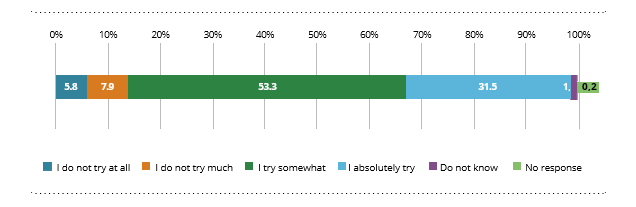
A substantial portion of society thus continues to regard the Ten Commandments as relevant moral and ethical guidelines, regardless of religious belief. In this light, it is particularly interesting to consider to what degree respondents actually strive to live according to the principles contained in the Ten Commandments (Fig. 2). Here, more than four fifths indicated that they live their lives more or less in accordance with them.
In our analysis, we also evaluated the question along the axis of religiosity and irreligion. The results showed statistically significant differences. Among respondents who identified themselves as explicitly religious—as might be expected—more than 99 per cent expressed a desire to live in accordance with the Ten Commandments. At the same time, the general norm-shaping influence of Christian culture is clearly reflected in the fact that even among those who described themselves as explicitly non-religious, an absolute majority—over 50 per cent—still regard the Ten Commandments as a source of guidance, either partly or entirely.
Perceptions of Christianity
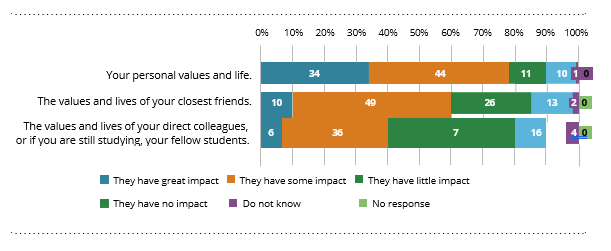
In our research, we also sought to understand to what extent people feel that Christian teachings influence their daily lives and their immediate surroundings (Fig. 3). According to respondents, Christian teachings tend to have a stronger impact on their personal lives: 44 per cent said they influence them to a moderate degree, while 34 per cent felt they have a strong influence on their thinking and actions. Altogether, 78 per cent of respondents stated that Christian teachings have at least some effect on their personal lives. By contrast, respondents perceive the influence of Christian teachings in their immediate environment—for example, among colleagues or fellow students—to be much weaker. They tend to believe that other people’s actions are less guided by these principles than their own. The results suggest that individuals primarily perceive the influence of Christian teachings in their own lives, while being more critical of those around them. One conclusion is clear: Christian teachings still possess enough moral authority that most people—even those who are either not at all or only nominally religious—prefer to see themselves as guided by these principles, while judging those around them more harshly. Whether motivated by a self-image of being a ‘good person’ or by a desire for respect and acceptance, nearly 80 per cent of respondents expressed hopes of achieving this by following Christian teachings. These findings can also be interpreted as an indicator of the continuing social prestige of Christian moral principles.
It is noteworthy that even among those who consider themselves explicitly non-religious, acceptance of Christian teachings can still be observed. Within this group—the firmly non- religious—11 per cent believe that Christianity has a very strong influence on their way of life, while a total of 32 per cent said that Christian teachings have affected them to some degree.
Christian Holidays
The celebration of Christian holidays by a wider segment of the population than those who actively practise their faith or identify as religious Christians may indicate the existence of a culture with Christian roots. To examine this, we focused on the eight most familiar Christian holidays in Hungary, asking respondents whether they celebrate or otherwise take part in associated Christian ceremonies, consider the Christian origin of these holidays important, and believe it is important to pass on their Christian traditions to future generations. These holidays represent the most visible elements of cultural Christianity. Their celebration constitutes the public expression of this culture.
We find that the celebration of Christian holidays enjoys considerable popularity in Hungarian society, regardless of religiosity.4 In our questionnaire, participants were asked about Christmas, Easter, Epiphany, All Saints’ Day, All Souls’ Day, the Day of the Foundation of the State, Pentecost, and St Nicholas Day. Among these, Christmas and Easter—the two most prominent traditional Christian feasts—are regarded as the most important. At the same time, the celebration of these Christian holidays extends well beyond the proportion of the population that identifies as religious. Christmas and Easter are therefore the most widely observed holidays, with only about one in six or one in five respondents saying they do not celebrate them at all. Most of the other listed holidays are also marked, in some form, by at least half of society, and in some cases by a majority. Furthermore, for every holiday examined, respondents expressed slightly stronger agreement with the idea that it is important to pass on the Christian traditions associated with that holiday to future generations.
An overwhelming majority—83 per cent—consider it right that holidays belonging to the Christian tradition should be officially celebrated in schools and workplaces. Remarkably, even among those who identify as explicitly non-religious, more than 70 per cent approve of the celebration of Christian holidays in such public settings.5
The Implicit Aspects of Christian Culture
Christian Anthropology
At the core of the Christian understanding of the human being lies the notion of ‘task’:6 humanity was given duties and commandments—first, at creation, the mandate to have dominion over the world,7 and later the Ten Commandments. The purpose of human life is the fulfilment of these tasks, that is, the keeping of the Commandments. Consequently, Christians are continually aware that there exists an external measure of good and evil, independent of themselves, and that they fall short of the goodness they ought to attain. They do not meet the standard expected of them. Christianity thus instils in us a habit of reflection upon ourselves and our own failings.8 It teaches the awareness of imperfection and the expectation that individuals must struggle with their own flaws.
For the Christian—excluding heretical movements—it is clear that the Kingdom of God cannot be realized on Earth, and that this is not what is meant by the divine command to have dominion over the Earth. It is also evident that meeting the moral standards demanded by the faith is exceedingly difficult in earthly life. The Christian therefore lives in a constant state of tension: how can one fulfil otherworldly moral obligations in a world where such fulfilment so often seems impossible?9 Man is a prisoner of his world yet carries within him unattainable ideals—and thus can never feel entirely at home within it.
For Christians, the solution is not to silence consciousness through mental techniques, mantras, or mind-altering substances; they do not seek to become like pebbles that think nothing. Nor is the proper attitude, when confronted with the tensions of the external world, one of complete submission, accommodation, or passive acceptance, but rather an active striving to master the world. The Christian’s task is to bear the cross: to accept living within deontic tension—the tension between moral obligation and human frailty—while seeking to ease it through reform and self-reform. The aim is not liberation from struggle, but continual engagement in it, the unending labour of reflection. Accepting the cross means assuming responsibility and engaging in the continual self-examination of conscience. It has become a constant, internalized demand upon Christians to shape both themselves and their environment—a demand inevitably accompanied by failure, by the acceptance of failure, and by the tension that arises from it. Western Christian culture has cultivated this inner tension and the capacity to endure it; it has not permitted escape through the easy means of self-oblivion, the idealization of loss of consciousness, or the shifting of responsibility onto others.
Deontic Tension and Reflection
Normativity is not merely one element of Christian culture—it is one of its key foundations. In everyday life, it is entirely natural for us to hold both others and ourselves to standards. Equally natural is the impulse felt by many to become something: a good father, a good teacher, etc.
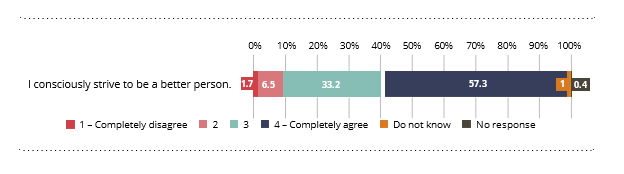
It is evident from our research that for the vast majority of people, the moral improvement of the self is an unquestioned aspiration (Fig. 4). For more than 90 per cent, it represents a valid personal goal and expectation. This also implies that—perhaps not always consciously—the great majority are not morally satisfied with themselves. According to our data published by Századvég this year in Kulturális kereszténység Magyarországon (Cultural Christianity in Hungary), only among those who identify as non-religious is there a noticeable proportion, 5.6 per cent, who make no effort toward self- improvement. They may be described as content with themselves and largely unreflective about their own actions. Living in large cities appears to have a similar effect. By contrast, 98 per cent of those who define themselves as distinctly religious strive to become better people.10
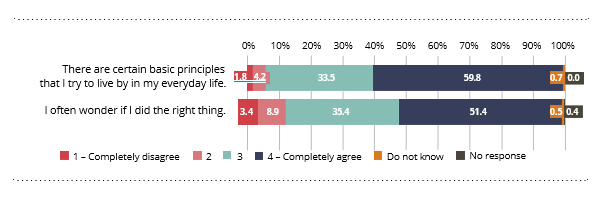
One of the fundamental premises of Christian ethics is that human beings must align themselves with the will and commandments of God; within this framework, adherence to principles and self-examination play a central role. At this point, what matters is not which principles these are, nor even whether people actually succeed in living by them, but rather that they see it as expected to strive—that it is right for a person to have guiding principles and to try to act in accordance with them. As our research illustrates (Fig. 5), more than 90 per cent of respondents believe there are certain principles they strive to follow in everyday life, and a similar proportion say they regularly reflect on whether they have acted rightly. The great majority accept this deontic expectation: whether or not they keep to their principles in practice, they see such moral effort as the proper and expected form of human conduct.
Normativity places a strong psychological pressure on the individual: one must measure up to certain principles, role models, or the expectations of one’s environment. This means engaging in continual—or at least regular—reflection on oneself, one’s actions, and their consequences, and repeatedly confronting one’s own weakness, failure, and imperfection. We call this experience of imperfection deontic tension, a characteristic feature of both Christianity and Judaism.
Roughly 86 per cent of respondents said that they regularly reflect on whether their actions are right. The findings suggest that—contrary to the hopes of the Enlightenment—it is not education that makes a person reflective, but rather their closeness to Christianity.
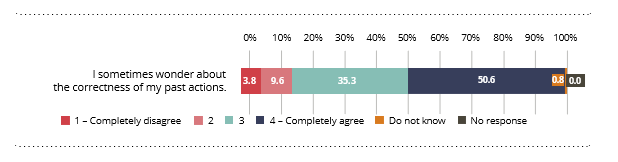
In the case of self-examination as well, religious self-identification proves to be the only significant influencing factor; otherwise, levels of self-reflection are remarkably homogeneous across society (Fig. 6.). Among those who describe themselves as religious, 98 per cent reflect at least occasionally on the rightness of their actions, but even among the self-declared non-religious, 78 per cent do so.
A separate question concerned what people believe causes human beings to wish or to do harm to one another. Responses to this open-ended question can be grouped into three main categories. A relative majority (38.5 per cent) believe it lies in human nature itself: ‘the devil lives within us’. A slightly smaller share (29.1 per cent) attributed it to weakness of will (‘I lose my temper’). A similar proportion (30 per cent) think it stems from the evil of others or of the world, which provokes bad intentions in the respondent, though they believe the victims ‘deserve it’. This last group shifts responsibility onto others, yet all three explanations—taken together, nearly 90 per cent of respondents—locate the source of wrongdoing within human beings themselves.11
Bearing the Cross and Renunciation
The recognition of one’s own faults through self-examination can have a corrective effect on behaviour—particularly when one is willing to admit to being wrong. We find that an overwhelming majority—nearly 95 per cent—state that they are prepared to back down in a competitive world.12
The answers to our question concerning the ideal of peace essentially confirm this tendency. Although one might assume that many people are reluctant to admit they are wrong in an argument, more than three-quarters of respondents describe themselves as the kind of person who would acknowledge a mistake in such a situation. This inclination aligns closely with Christian teaching on the virtue of humility and the importance of self-reflection and the admission of one’s own errors. Only 3.1 per cent said they would refuse to admit being wrong, indicating that pride, arrogance, or the pretence of infallibility are not socially accepted norms.13
We also tested the behavioural impact of reflection through a sharper, more divisive question: whether people would be willing to give up certain ‘sinful pleasures’ for the sake of moral purity.14 More than 60 per cent said they would indeed renounce such pleasures in pursuit of moral purity. (The metaphor of ‘purity’ as freedom from sin originates in Judaism and appears in Christianity chiefly through St Paul’s ‘Epistle to the Hebrews’.)15 The expression ‘sinful’ in the question clearly evokes a religious worldview, and indeed, the data show that those identifying as religious are more likely to give up such pleasures. Yet even among the non-religious, more than half acknowledge the existence of ‘sinful pleasures’ and express a willingness to renounce them for the sake of a moral ideal. If anything characterizes the Christian (and Jewish) moral habitus, it is precisely this: a conception of the self as grounded in an ongoing, inward relationship of moral accountability.
The world around us is always to some extent unfavourable, and indeed ‘heartless’. We do not for a moment claim that the life implied by the Christian view of humanity is an easy or pleasurable one. What distinguishes the life proposed by Christian culture from today’s consumerist mentality is not a condemnation of material comfort or the enjoyment of prosperity, but its idealization of mental cross-bearing—the acceptance of hardship and struggle. Different cultures have developed different ways of escaping from the ‘heartless’ world: through intoxication, the emptying of consciousness, and so forth. Modernity, for its part, has offered its own forms of escape—from psychological therapies to political and social emancipation movements aimed at creating conditions and societies in which humanity might finally be freed from frustration. In contrast, Christian culture proposes not escape, but the acceptance of cross bearing and, as its solution, the arduous task of self-improvement. Most respondents more or less agreed that a person should solve his or her own problems rather than rely on others— an attitude that reflects a focus on personal responsibility and perseverance.16
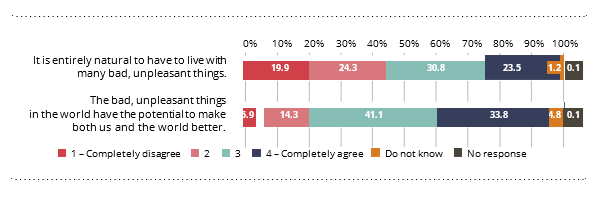
The majority of respondents take a generally positive stance toward a world full of difficulties (Fig.7). Most are not characterized by outright rejection of the world, nor by a desire to escape from it. Rather, they see in this problematic, ‘heartless’ world an opportunity for self-improvement. This outlook reflects a distinct habitus rooted in Jewish and Christian teaching. Some 75 per cent of respondents agreed, at least to some extent, that the presence of evil in the world offers a chance for the reform of both self and society. Perhaps because of this reflex derived from Christianity, withdrawal from the world is not encouraged within Christian culture. Far more characteristic is the struggle—with oneself and with the world.
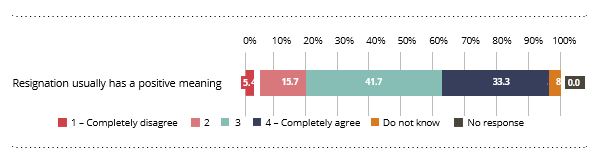
One of the most important questions linked to the idea of bearing the cross concerns the acceptance of renunciation as something positive. According to the data (Fig. 8), precisely three-quarters of respondents agree that renunciation has a positive meaning. Here again, religiosity shows a strong correlation with the responses. Only 1.8 per cent of those identifying as religious completely disagreed with the positive meaning of renunciation, compared with 11.2 per cent among the non-religious. Meanwhile, 87 per cent of the religious and 65 per cent of the non-religious associate renunciation with a positive sense or value. In other words, Christianity teaches the meaningfulness of giving things up, and generally, that such renunciation has meaning. We did not examine what respondents understood by this ‘meaning’: whether it referred to some tangible benefit, inner peace, the preservation of friendship or civility, the wellbeing of future generations, or a striving toward an ideal such as the building of a cathedral. But it is clear that, for the majority of even the non-religious, renunciation is seen as something meaningful.
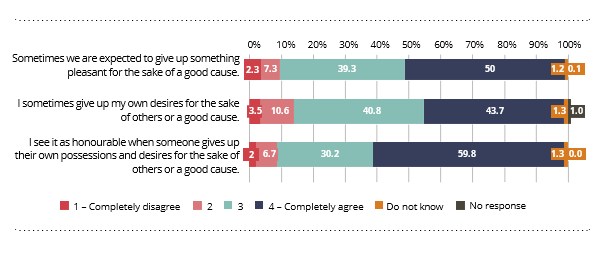
In our research, we asked respondents to what extent they agreed with the following statement: ‘Sometimes we are expected to give up something pleasant for the sake of a good cause.’ The results reveal a broadly shared social expectation regarding sacrifice and renunciation (Fig. 9). Only 2.3 per cent of respondents rejected outright the idea that renunciation for a good cause is a normative expectation. Conversely, 50 per cent expressed complete agreement, and a further 39.3 per cent tended toward agreement. Altogether, 89 per cent accepted, to a greater or lesser degree, the idea of giving something up for a good cause. Thus, the value of self-restraint—transmitted through Christian teaching—appears to remain present in society, even if it no longer necessarily manifests in explicitly religious form.
Here too, we see the same pattern as before: for one reason or another, human nature, desires, and impulses must at least occasionally be restrained. Christianity provides an answer as to why this is so—whereas modern conceptions of humanity generally do not. Yet the great majority, including those who describe themselves as non-religious, tacitly accept the need for such self-restraint.
Among respondents who described themselves as the most religious, 74.8 per cent fully agreed that sacrifice for a good cause is an appropriate expectation. Among those identifying as the most non-religious, this figure stood at 42.7 per cent. Only within the least religious group was there any notable opposition to the idea of sacrifice for the sake of a good cause. Yet the high proportion among the non- religious—85 per cent agreeing at least to some extent—suggests that the Christian habitus of self-denial for the sake of something beyond personal benefit remains widely accepted within Hungarian society.
Regarding the statement ‘Sometimes we are expected to give up something pleasant for the sake of a good cause’, while 50 per cent of respondents expressed full agreement, 43.7 per cent said they were convinced that they actually behave accordingly: ‘I sometimes give up my own desires for the sake of others or for a good cause.’ A further 40.8 per cent leaned toward agreement, while only 3.5 per cent stated firmly that they never forgo their desires for such reasons. Here too, religiosity emerged as the main factor influencing responses.
The social esteem attached to self-sacrifice is reflected in the fact that 59.8 per cent of respondents fully agreed with the statement, ‘I see it as honourable when someone gives up their own possessions and desires for the sake of others or a good cause.’ Altogether, almost 90 per cent agreed at least to some degree, while only 2 per cent expressed outright disagreement. Religiosity is the only variable that produced significant differences on this question. Among those identifying as the most non-religious, 56.8 per cent fully agreed that it is admirable to make sacrifices for others or for a good cause, while among the most religious respondents, this view was shared by 78.5 per cent.
The existence and influence of cultural Christianity can be inferred from how strongly Christian teachings are accepted even among those who do not consider themselves religious. A significant proportion of people who reject Christianity’s metaphysical claims nonetheless embrace the ethical ideals, habits, and models of human relations—partly rooted in Judaism—transmitted by Christian culture.
Offense, Forgiveness, and Love
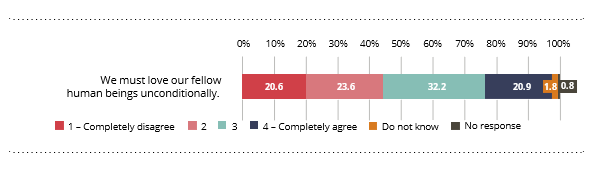
One of the defining features of the Christian moral ideal is undoubtedly the commandment of love. The ideal expressed in the Sermon on the Mount was far removed from the social realities of its time, and we cannot be certain that it aligns much more closely with our own. Yet it is clear that the overwhelming majority of Hungarians believe that the world is not as it ought to be—since they accept the exceptionally high moral standard set forth in the teachings of Jesus. Yet this ideal—the ideal of universal love, clearly rooted in Jesus’s teaching and the Christian tradition—divides society (Fig. 10). Unsurprisingly, it is more readily accepted among those who identify as religious. Among the religious, 20 per cent reject the commandment of universal love. They might be called ‘bad Christians’, the targets of both their priests and Christianity’s critics. But what are we to make of the roughly 30 per cent of non-religious people who accept the commandment of universal love? Are they suffering from false consciousness? Are they hypocritical, not ‘real’ atheists? Or have they simply been influenced—or ‘infected’, if you will—by Christian culture?
However, when we look at ideals that are less demanding in practice, the picture shifts. As mentioned earlier, nearly 95 per cent of respondents said that if, in the course of an argument, they realized the other person was right, they would admit their mistake.17 Pride is treated by Christianity as one of the greatest moral failings, so Christian culture abounds in condemnations of pride and exhortations to the opposite virtues, humility and peace.
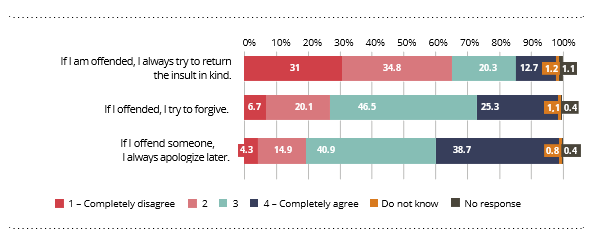
A similar pattern emerges in cases involving offence or injury (Fig. 11). Eighty per cent of respondents said that they apologize when they have hurt someone. Among those identifying as religious, this rises to 90 per cent, but even among the firmly non-religious, around 70 per cent accept the ideal of contrition—the recognition of wrongdoing and the seeking of reconciliation. The proportion of those who accept the ideal of forgiveness is strikingly high—above 70 per cent. Among those who describe themselves as firmly non-religious, 60 per cent accept the ideal of forgiveness, while among the religious this rises to 85 per cent.
It is easy to understand why such a demanding and difficult expectation as forgiveness—loving one’s enemies, refusing to take offence—can be hard even for believers to fulfil. Indeed, some are unable to do so at all: they fall short of the moral expectations of their own faith. But why do a significant number of the firmly non-religious nonetheless seek, at least verbally, to accept and live up to these ideals, when no secular moral framework explicitly demands forgiveness?
Conclusions: Christianitas Implicita
Our research suggests that Christian culture and Christian religion have become distinct. The circle of cultural Christians—those shaped by the Christian mindset, though not necessarily religious—appears much broader, comprising an estimated 80–85 per cent of Hungarian society.
The results of our two separate surveys conducted in 2023 and 2024 were remarkably consistent. Christian culture—the product of Christian religion—is not merely tacitly present, but in fact characterizes Hungarian society. By analogy with St Thomas Aquinas’s concept of fides implicita (implicit faith),18 we may speak of a Christianitas implicita, an implicit Christianity that defines the moral outlook of contemporary Hungary.
Although there exists a distinctly non-religious minority—roughly 15–20 per cent—living outside the sphere of Christian culture, such people likely existed in earlier ages as well. The difference is that in past centuries they tended to occupy the margins of society, whereas today they are found more often among the elite or upper social strata. Yet the anti-Christian attitude of elites, and the persistence of Christianity among the underprivileged, are not new phenomena; they are not peculiar to the modern age.
Hungarian society is relatively homogeneous in terms of cultural Christianity; differences in outlook and cultural attitude are not sharply defined. The two poles might be represented by the young, university-educated urbanite and the elderly, poorly educated villager—but even between them, the differences are a matter of degree rather than of kind. It is not possible to determine how Christian the respondents truly are. What we can measure is how they wish to appear—the image they want to project of themselves. Yet for the purposes of our research, this is sufficient. A society can be described as culturally Christian if the majority, in their responses, align themselves with Christian ideals and expectations.
From our findings, we can infer whether people wish to present themselves as Christian and whether they expect others to do the same. It appears that individuals perceive a broad, tacit social expectation of Christian-like behaviour—regardless of metaphysical belief. In other words, the overwhelming majority of those who at least verbally accept Christian ideals indicate that they believe most people expect this of them. Thus, the majority view Hungarian society’s lifeworld as Christian: they encounter social expectations shaped by Christian moral ideals and patterns of conduct. This is what we mean by cultural Christianity. Even though many perceive much of their personal environment as not overtly Christian, they nevertheless believe that society at large expects the profession and practice of Christian moral ideals. They may not necessarily see Christians around them—but they certainly perceive Christian expectations.
According to our research, Hungarian society can be divided into four plus one groups in terms of its relationship to Christian culture. The first group, around 35 per cent, consists of those who consider themselves more or less religious, attend church services, and accept Christian teachings. They represent the ecclesiastical Christians. The second group, roughly 15 per cent, may be described as loosely religious: they are not affiliated with any church, yet they largely accept Christian teachings, observe Christian holidays, and try to live in accordance with Christian moral expectations. The third group, the ‘culturally Christian only’, makes up about 30 per cent. These individuals are not, or are only nominally, religious, and they reject much of Christianity’s metaphysical doctrine. However, they accept Christian culture—its festivals, moral expectations, its view of humanity and of history—and perceive the world through a Christian lens. For them, Christianity remains an important point of moral reference: they strive to be, and to regard themselves as, good people according to Christian ideals.
Alongside these groups, there is another segment of around 20 per cent that stands outside the explicit elements of Christian culture—its teachings and holidays—but whose members still retain, in their thinking, many of its tacit elements. A significant share of this group also seeks to conform, at least outwardly, to Christian moral expectations or to present themselves as doing so. Finally, there exists a very small fraction, 1–2 per cent, that is explicitly hostile to Christian culture.
It is clear that the proportion rejecting Christianity’s explicit content is greater than that rejecting its implicit content. The Christian mentality extends far beyond the circle of those who identify as religious. Even among the consciously non-religious and those who reject Christianity’s explicit doctrines, the majority still share this underlying Christian habit of mind. All this suggests that even within this group, many people tacitly accept Christian presuppositions and mental frameworks. They do so not as the result of deep reasoning or deliberate conviction, but largely because such assumptions are socially expected within their environment.
We have seen that, in numerous cases, as many as 90–95 per cent of respondents expressed agreement with certain statements. One might interpret such high levels of consensus as evidence of ‘universal human values’. Yet it must be noted that even in these cases—where agreement was strongest—the proportion of self-declared non-religious individuals among the dissenters was significantly higher than average. In other words, even if there exist so-called ‘universal human values,’ they are, in practice, rooted in the (Christian) religious tradition.
This means that despite denominational, political, or ideological divisions, and despite the hyper-pluralism evident in the public sphere, at the level of mental habitus, patterns of thought, and underlying assumptions, there exists in Hungarian society a fundamental unity derived from cultural Christianity. Only about 1–2 per cent of the population stands entirely outside this shared framework. It is also likely that a similar unity exists across most Western societies—linking Hungary to them through this common cultural Christian foundation.
Translated by Thomas Sneddon
NOTES
1 Gilbert Keith Chesterton, Heretics (London – New York: John Lane, 1905), 156–157.
2 ‘Keresztény kultúra Magyarországon’ (Christian Culture in Hungary), Századvég (2023); ‘A keresztény kultúra megnyilvánulásai a magyar társadalom gondolkodásmódjában’ (Manifestations of Christian Culture in the Mindset of Hungarian Society), Századvég (2024). Hereinafter, we refer to the surveys as Századvég 2023 and Századvég 2024 in this study. For all the data referenced in this study see Attila Károly Molnár et al., Kulturális kereszténység Magyarországon (Cultural Christianity in Hungary) (Századvég, 2025).
3 Századvég 2023 and Századvég 2024.
4 Századvég 2023.
5 Századvég 2023.
6 Rémi Brague, Eccentric Culture: A Theory of Western Civilization. Trans. Samuel Lester (University of Notre Dame Press, 2009).
7 Genesis 1:9.
8 Romans 12:2.
9 John 18:36, 17:14.
10 Attila Károly Molnár et al., Kulturális kereszténység Magyarországon (Cultural Christianity in Hungary) (Századvég, 2025).
11 Századvég 2024.
12 Századvég 2024.
13 Századvég 2024.
14 Századvég 2024.
15 Paul Ricoeur, The Symbolism of Evil (Beacon Press, 1967).
16 Századvég 2024.
17 Századvég 2024.
18 Thomas Aquinas, Summa Theologiae, II–II, q. 2, a. 5.
Related articles:
At a time when public debate is increasingly polarized and superficial, Hungarian Conservative remains committed to depth, intellectual honesty, and independent conservative thought.
Producing high-quality journalism requires resources. Your contribution helps us expand our coverage, reach new audiences, and keep our content accessible.

Please consider supporting our mission.