The nation is ‘pure ideality’—professed Tibor Joó (1901–1945), one of the most outstanding, yet today less known, almost forgotten figures of the interwar generation of Hungarian philosophers.
According to Joó—whom we can still consider one of the most significant theoreticians of the Hungarian national idea and intellectual history (Geistesgeschichte)—the nation is constituted not by blood, tribe, or race, but by the spirit, and this spirit can only be addressed through the method of intellectual history. However, the very concept of ‘intellectual history’ (szellemtörténet) provoked very serious debates even in its own time.
In one of his main works, Introduction to Intellectual History (Bevezetés a szellemtörténetbe), Tibor Joó undertook to clear up the ‘conceptual confusion’ surrounding the discipline. To this end, he divided the concept of the spirit into three distinct levels that nevertheless form a dialectical unity:
Normative Spirit: According to Joó, this is the highest, abstract level, designating the spirit that ‘formulates the pure system of values.’ This is the realm of Ideas, eternally valid values, and ideals that provide direction for human action, but have not yet been realized in themselves.
Subjective Spirit: This is the mediating level, which appears in the individual, the acting subject. Its task and essence is to ‘forge the inspirations of the normative spirit into will.’ This is where the abstract value becomes a concrete human endeavour and commitment.
Objective Spirit: This is the level of realization. The objective spirit comes into being when, ‘in the wake of the act of the subjective spirit’, the spiritual content is ‘objectified in cultural institutions.’ This includes the state, the legal system, the arts, religious institutions, and every human creation in which the spirit has taken body.
According to the philosopher’s analysis, the term ‘intellectual history’ itself is not a fortunate choice; indeed, in a certain sense, it is explicitly misleading. The concept—Joó argues—was born as a battle cry in the heat of the struggle against positivism, adhered to the movement randomly, and its content was still immature when it took root.[1] The term can create the false impression that history has a corporeal (political, economic) branch and a separate spiritual branch, whereas the school of intellectual history proclaimed precisely the organic unity of life and history.
According to Joó, we are not actually dealing with a new, separate branch of science here, but with the correct perspective on history itself, aligned with the nature of its subject. The subject of history is man, who is distinguished from mere natural beings by the spirit—that is, value functions, self-conscious objectives, and openness to the transcendent. Consequently, human history is by its very essence always intellectual history, since behind every human act, institution, or creation lie spiritual intentions and value choices.
The essence of the turn toward intellectual history can be grasped in its break with and critique of the positivist view of history. According to Tibor Joó’s critique, the ‘naturalistic monism’ of positivism viewed culture as a subcategory of the natural, thereby stripping history of its specific, human dimension.[2] The positivist historian hunted for data, criticized sources, authenticated charters, and arranged events in chronological order. Although this work was an indispensable foundation, intellectual historians—including Joó and Prohászka—saw that positivists often missed the most important thing: understanding the underlying spirituality and restoring the unity of life in the historical picture. Ultimately, positivism fragmented reality: it examined law, the economy, religion, and art separately, but was unable to present that common root, that Zeitgeist (spirit of the age), from which all these objectifications sprang.
‘Human history is by its very essence always intellectual history’
At the same time, it is important to emphasize that neither Joó nor the more serious intellectual historians denied the real merits of positivism. Tibor Joó also acknowledges that positivism created the auxiliary sciences of modern historiography and accustomed researchers to conscientious source criticism and respect for data.[3] Thus, according to Joó, intellectual history is not at all the negation of scientifically rigorous philology or some boundless, subjective mythologizing, but the transcending of both (Aufhebung in the Hegelian sense): intellectual history is not the denial of data, but the uncovering of the ideal structures underlying the material world.
As he writes:
‘…True history can only view its material as the history of the spirit, from whatever field of human life it may come. Being familiar with the historicity of the matter, we now also know that this is not actually a new perspective, but the revival of an older one. The so-called intellectual historical trend restored the continuity of development along a certain line, from which positivism had derailed it.’[4]
Tibor Joó calls attention to an extremely important philosophy-of-language distinction that stems from a specific feature of the Hungarian language, and which can also help in better understanding the nature of intellectual history. The German word Geschichte means both the events that occurred and the science about them (Historie). In the Hungarian language, however, we can make a sharp distinction between the concepts of történet (story/events) and történelem (history/historiography):
Történet (Events/Story): The sequence of actual events, the ‘things that happened’ (res gestae)—the process of reality. This is the ontological reality we examine.
Történelem (Historiography): The knowledge formed about the events, the scientific narrative (historia rerum gestarum). This is the result of cognition, the science itself.
‘Under the technical term intellectual history, we must therefore understand that view of history, or the movement shaping it, which came into being as a reaction against positivism and revived and further developed the theoretical foundations of the theory and practice of so-called German idealism. However, since it appears that this perspective corresponds to the true nature and totality of history (történet), this so-called intellectual history simultaneously proves to be the correct and complete historical perspective (történetszemlélet) as well.’[5]
Joó dealt more extensively with the nation and nationality in five of his works. In his essay ‘The Hungarian National Spirit’ (‘A magyar nemzeti szellem’, 1937); in his ‘national-political study’ titled Matthias and His Empire (Mátyás és birodalma, 1940); in his studies The Hungarian National Idea (A magyar nemzeteszme) and Hungarian Nationalism (A magyar nacionalizmus, 1941); and in the collection Confessions on Hungarianness – A Breviary of National Self-Knowledge (Vallomások a magyarságról – A nemzeti önismeret breviáriuma), published in book format shortly before the author’s death (1943), which contains the reflections on the nation by the greats of Hungarian history that Joó considered most important.
According to Joó, one of the most fashionable concepts of the era, ‘race’ (faj), is ‘mere biology’, belonging to the realm of natural sciences, while the nation is ‘pure spirit’.[6] And the greatest difference between a people (nép) and a nation (nemzet), in his view, is that the nation is a self-reflective, conscious reality, whereas the people is rather an unorganized, ‘pre-political’ substance. But in accordance with his intellectual historical premise, neither can be viewed as a form in a purely material sense. Joó also views the people and the nation as certain degrees of consciousness of the Hegelian ‘objective spirit’, successive stages of ‘awakening to self-consciousness’.
‘The nation recognizes that it occupies a place in the whole of humanity, and this place designates a certain role for it. It undertakes a mission. The people also lives within the circle of humanity, but it does not yet take note of this, and does not draw the consequences from it; it does not rise to the self-consciousness of this. This occurs with the birth of the nation. Or rather, the nation is born with this awakening to self-consciousness. It, as it were, emerges from the narrow circle of its own community, views from above the great system of peoples, the whole of humanity, and itself within it.’[7]
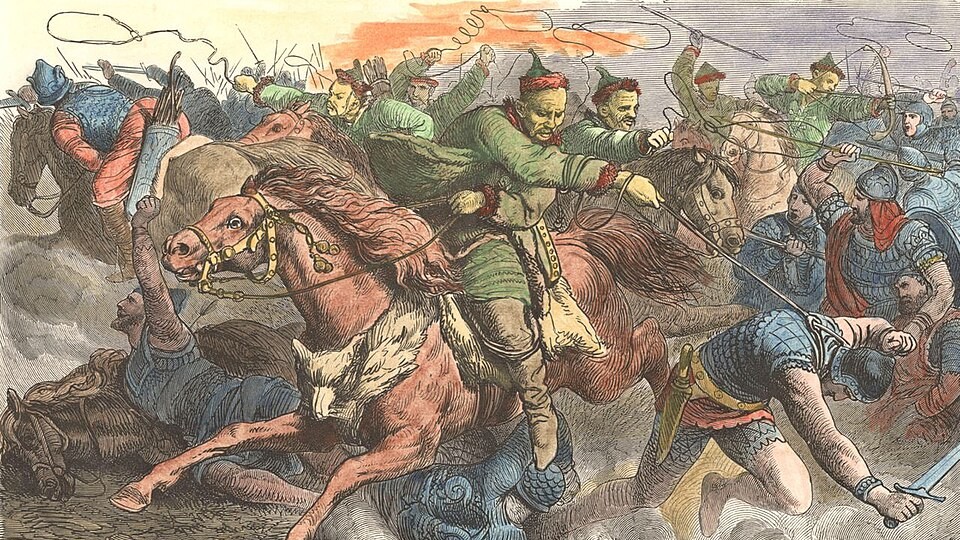
In the philosopher’s interpretation, the idea of the Hungarian nation in the intellectual historical sense—that is, the cardinal point upon which both the medieval and later Hungarian national ideas rest—is concretized in the spiritual act called the Blood Oath (vérszerződés): prior to this, we can rather speak of ‘proto-Hungarians’ or the ‘Megyer tribe and its allies’. Thus, neither language nor a ‘loose historical community of fate’ had much to do with the founding of the Hungarian nation, but rather the spiritual charisma of Prince Álmos (kündü)—those who joined him and swore eternal loyalty to him became members of the Hungarian nation from then on. From this perspective, Álmos ‘created’ the Hungarian nation, and in the case of his lineage (which likely existed in reality as well), it cannot be excluded that it truly leads back to Attila, the Great King of the European Huns. Thus, the Hunnic Attila is the symbolic origin of the idea of the Hungarian nation, and the European Hunnic Empire is the archetypal community to which the idea of the Hungarian state can also be traced back. This act is the primary, spiritual justification for the much-debated Hun–Hungarian connection.
As Tibor Joó writes:
‘There is perhaps no nation in the world whose nation and fate are bound by such unbreakable threads, in such organic unity to the spirit and fate of its ancient ruling house, and whose fate was so decisively influenced by this house, as the Hungarian is by Árpád’s family…This family traced its descent from the most powerful ruler of the Migration Period, King Attila, and ruled without interruption from ancient times. Since Attila’s gigantic empire, the scope of its rule had shrunk back, and finally, like that of the great king’s ancestors in the beginning, was restricted to but one tribe, yet the memory of their descent and power did not fade either among themselves or among the equestrian nomadic tribes undulating around them, before whom the lord of the Hunnic armies galloping to the West floated as an ideal…Therefore, when Árpád united the tribes into a new, eternal unity at the gates of Europe, making them his own people, he gave the new communal framework a unifying spiritual content with the traditions of his family…For what does this consciousness contain? The inherited right of eternal rule, ancient power, conquest, and the self-respect of unparalleled martial excellence and fearsomeness.’[8]
The way Tibor Joó grasps the ‘Attila-consciousness’ and the birth of the Hungarian national idea illuminates, with plastic force, why there is no real crossover between the positivist and the intellectual-historical views of history. Both start from facts, such as the Hunnic tradition described in medieval chronicles. A strict positivist historian, however, will view the Attila-tradition found in the chronicles merely as a retrospective ‘constructed myth’, an ‘imagined reality’, or the court propaganda of medieval chroniclers, whose sole purpose was the power legitimation of the Árpád dynasty’s rule. Since the descent cannot be proven with empirical charters, it is an ahistorical fiction to them, and the unprovable nature of concrete biological continuity would be sufficient reason to invalidate this tradition.
Tibor Joó’s analysis, however, highlights that the essence and history of the Hungarian nation simply cannot be understood without the spiritual factor. Even if biological or institutional continuity were debatable in the absence of data,[9] the Attila-consciousness—the self-respect of eternal rule and excellence—became a massive, objective history-shaping force as a spiritual reality. The essence lies not in whether the historical tradition is ‘provable’ or ‘fiction’, but in this shaping force. According to Joó, it was exactly this spiritual content, this idea, that enabled the Árpáds to forge the heterogeneous, multilingual nomadic tribes into a single integrated nation.
Joó primarily distinguished between the ‘Western’ and ‘Hungarian’ concepts of the nation. He saw this above all in the fact that, in his view, the Hungarian concept of the nation was formulated in a different cultural sphere, and since its origin is thus historical, its unfolding is also different. The Hungarian concept of the nation was born in that steppe cultural sphere or civilization (László Csáji Koppány) which once—on par with the great Spenglerian cultural spheres, though often not even mentioned by Western historians—ruled the vast Eurasian steppe from Manchuria all the way to Eastern Europe.[10] Tibor Joó also found the true origin of the Hungarians in this cultural sphere, emphasizing that the Christian foundation of the state in the Carpathian Basin does not signify the birth of the actual nation, but the entry of an already-formed political community into that Western-Germanic-Christian cultural sphere which determined its subsequent fate.
Undoubtedly, the definition of the concept of the Hungarian nation was actually one of the sharpest ideological battlefields in interwar Hungary. The traditional legal-political concept of the nation (every subject of the Holy Crown is Hungarian) clashed not only with the increasingly strong ethnic-racial (völkisch) thinking, but also with those progressivist, leftist, and bourgeois-radical interpretations of the nation that took shape in the preceding decades and during the era. Joó’s debate partners in the intellectual force field—besides István Bibó’s later theses blaming the historical elite—were trends such as Oszkár Jászi’s bourgeois radicalism, which viewed historic Hungary merely as an oppressive ‘feudal’ formation and the nation as a Western-style, rational-administrative category; or Ervin Szabó’s Marxist class-struggle perspective, which reduced the national idea to a mere ideological mask of the capitalist and noble classes.
Like Szekfű and Hóman, Joó also saw the essence of the Hungarian national idea in the St Stephen imperial concept, which is capable of integrating various ethnicities into a higher-order state and spiritual unity. In contrast, he viewed modern, 19th-century linguistic nationalism as a step backwards, a demotion of the nation, degrading the higher-order spiritual community into a lower-order biological-linguistic community.
To understand what this higher-order, integrating state idea referred to by Joó actually was, we must reach back to the most ancient layers of Hungarian ethnogenesis. The lifestyle of the steppe equestrian nomads—traversing boundless landscapes, constant movement, and the necessity of conquest—developed a political behaviour that was inherently suited to uniting different peoples. The nomadic ruler did not want to assimilate his subjects, but ‘placed his rule over the various peoples, leaving them in the free enjoyment of their ethnicity.’ This perspective led to the fact that nomadic empires—like those of Attila or Genghis Khan—were religiously and ethnically tolerant. Joó emphasizes that in St Stephen’s Admonitions, it was actually this ancient Hungarian political behaviour that donned a Christian cloak:
‘Today we already know that St Stephen’s reform by no means obliterated the political tradition brought from the East without a trace, but built the foundations of the new development upon it…This tradition speaks to us in this admonition as well. And this is the germ from which the uniquely Hungarian concept of the nation developed, a concept that differs significantly from the Western one…’[11]
Joó saw the source of power in two complementary principles, the tension and unity of which provide the dynamism of the Hungarian state: The first of these is the charisma of the House of Árpád (the Turul dynasty): the consciousness of celestial descent (the Turul legend). According to the faith of the people, the depository of power can only be the ‘blood of holy kings’. The second is the voluntary submission of the free warriors to the leader. This is not servitude, but a social contract based on agreement, where the relationship between leaders and led rests on mutual trust and a shared community of fate.
This kind of charismatic loyalty enabled the survival of the Hungarians even when other nomadic peoples disappeared with the extinction of their dynasty, for the Hungarian nation identified with its rulers, adopting their myths and sense of vocation.
Joó essentially penetrated into the deep layers of Hungarian self-identity to uncover that genetic origin which came into being from the meeting of Christian universalism and the steppe tribal heritage. According to his analysis, St Stephen’s former empire seems almost incomprehensible, even absurd, to modern, homogeneous nation-state thinking. According to his famous political testament recorded in the Admonitions, ‘A country of one language and one custom is weak and fragile.’ Joó pointed out that while modern political reality sees multi-ethnic countries as burdened with crises, for the state founder, diversity meant the strength and ornament of the state. Joó’s premise is fundamental: ‘What then drove this man, who belonged among the greatest political geniuses of all time, to this conception?’
‘A country of one language and one custom is weak and fragile’
The first level of resolving the paradox, according to Joó, lies in pure practical expediency. St Stephen recognized that the condition for the European survival of the Eastern nomadic people was a civilizational shift: the transition from a wandering lifestyle to a settled, agricultural one. This required Western ‘schoolmasters’—knights, missionaries, artisans—who arrived in the country as carriers of Christian culture and advanced military technology. Joó explains the king’s intention thus:
‘…For he did not want to mould his people to this or that nation; he did not want to make them Italian, nor German, nor Slavic, but only European Christian. He wished to inoculate his country and people with the virtues and strengths of all nations.’[12]
This point clearly shows that Stephen’s concept of the nation was not ethnic, but civilizational and religious in nature. The goal was not the erasure of national characteristics, but the grafting of Hungarianness onto Christian universalism.
Joó also emphasizes that St Stephen did not create his laws in a vacuum; the ideal of renewing the Roman Empire, the so-called Carolingian and Ottonian tradition, determined his thinking. In this world order, the concept of the nation did not exist in the modern, particularistic sense; the emphasis was on universal Christian humanity.
‘In this medieval universalism, the emphasis is therefore not on national individuality, but on what is common: Christian humanity. The empire comprehends even the national kingdoms, thus the sons of the individual nations belong together to a certain extent in a political sense as well; nowhere in Europe are they completely strangers. This is the so-called Rome-idea...’[13]
Tibor Joó, whose work was an attempt at the philosophical clarification of concepts, nonetheless entered into a sharp debate with Prohászka, another very important philosopher of the era, who also approached the nation based on intellectual history and characterology.
The contradiction stretching between Prohászka’s and Joó’s conceptions touched the deepest ontological layers of Hungarian self-knowledge. Joó placed the history-shaping will and the spiritual vocation at the centre, while Prohászka focused on fateful determination. For Prohászka, the national character is a timeless, permanent essence (substance). The hiding (bujdosó) makeup is not a product of history, but the internal, psychological structure of the Hungarians, which manifests itself over and over again throughout history.
According to Joó, what Prohászka calls the hiding character is not an eternal trait, but a historical deformation. He argues that the cause of ‘Hungary’s ruin’ must not be sought in the metaphysical character traits of the Hungarians, but in a fatal intellectual error: the adoption of Western-style nationalism. In his view, the Hungarian national idea was originally (that is, with St Stephen) an idea of the state, an inclusive, universal, and ethnically tolerant Hungarus-consciousness. In the 18th–19th centuries, Hungarians uncritically adopted the Western (Herderian, French) concept of the nation, which was built on the unity of language and race. This concept was alien to the Hungarian tradition, and this is what blew apart the organic unity of the Carpathian Basin. The Hungarians became hiders when they lost their state-building, imperial function (after Mohács). Passivity is not a character trait, but the consequence of the loss of function. If the nation regains its vocation, its character will also change.
The Hungarian tragedy leading up to Trianon, according to Joó, followed directly from this narrow-minded, modern-rationalist, materialistic ethnic nationalism. The Hungarian intelligentsia adopted this in the Reform Era, and this perspective led to the alienation of the nationalities. The reason for the disintegration of historic Hungary was not (only) hatred of Hungarians or Beneš’s anti-monarchism, but that the Hungarian nobility ‘forgot’ its steppe heritage. The linguistic nationalism resurrecting in the Reform Era, according to Joó, is merely a surrogate that has barely anything to do with the original Hungarus-consciousness; indeed, it is its opposite:
‘The nation, however, is created by what develops during the process of understanding: the common spirit. And this is not mediated by language alone…It can only be stated with great superficiality, therefore, that language is an essential constituent element of nationality.’[14]
While István Bibó saw the ‘dead end’ of Hungarian social development in the fact that it did not follow the model of Western, monolingual, homogeneous bourgeois nation-states quickly and organically enough, Joó points out that the cause of the tragedy was exactly the opposite. The Hungarians did not fail because they ‘lagged behind’ the West, but because in the 19th century they uncritically adopted the ethnic-linguistic nationalism of the West, giving up their own, thousand-year-old, higher-order steppe-Christian integrating vocation. What in Bibó’s eyes would have been progress, in Joó’s reading, was the fatal demotion and betrayal of the Hungarian mission in the Carpathian Basin.
Although the intellectual historical trend between the two world wars—and within it, especially the work of Tibor Joó and Lajos Prohászka—was the crowning achievement of Hungarian fate analysis, post-idealist, ontic cultural-historical approaches often subject the fundamental premises of these authors to sharp criticism. In his retrospective analysis, Ádám Fejér, for example, reproaches the intellectual historians for remaining prisoners of ‘personal idealism’ because they wanted to interpret everything as a European model idea.[15]
According to Fejér, Tibor Joó is mistaken when he calls the ability of the Hungarians to integrate heterogeneous ethnicities and their Eastern empire-building power a ‘national idea’. In view of this critique, the early medieval Hungarians possessed merely a pure ‘nomadic political routine’, and a kind of religious-natured ‘national experience’ transcending the individual intellect, but an individually representable national idea in the Indo-European sense was absent from their culture. This approach, however, is a typically Western-centric fallacy that absolutizes modern rationalism and Christian universalism. Forging hundreds of thousands of people and various heterogeneous tribes into a single coherent political body cannot be done purely out of technical routine. This required a tremendous integrating force, myths of common origin, and archaic, but highly conscious, sacred acts like the Blood Oath. Its significance lies precisely in recognizing: this ancient, steppe metaphysics—which later lived on in the Doctrine of the Holy Crown and the unique Hungarus-consciousness—was an equal and massive spiritual construct, that is, a true idea. This idea perfectly corresponds to the historical reality of Anthony D Smith’s aristocratic (lateral) ethnie.
Fejér also reproaches intellectual history for severing the concepts of culture (tradition) and civilization (progress) from each other, and by favouring the former, covering up the historical fact of Hungarian society’s ‘chronic civilizational lag’. Yet intellectual history did not want to cover up this duality; rather, it touched upon the primary secret of Hungarian survival. Throughout Hungarian history, the frameworks of material civilization, the state apparatus, and the economy collapsed multiple times under external pressure (the Mongol invasion, the Ottoman occupation, and later Trianon). Fejér, however, fails to see that if the sustaining power of the nation had depended purely on civilizational-material development, the Hungarians would have disappeared from the stage of history long ago. What sustained the country through centuries was precisely that ‘elevated Hungarian national experience tending to assume a religious character’, capable of becoming independent from ‘civilization’ in the Spenglerian sense, which even Fejér acknowledges. Intellectual history, thus, is very rationally focused on culture as the primary, fate-shaping constant of Hungarian survival.
Fejér views it as a kind of methodological bankruptcy, the irresolvable contradiction between Romanticism and Classicism, that the two thinkers see the national character so differently. This apparent contradiction, however, is not a flaw in the method of intellectual history at all, but the reality of a split Hungarian history. Intellectual history proved to be a colossal scientific achievement because it was capable of grasping both poles of the Hungarian soul standing in historical tension with each other: the empire-building, generous, and assimilating steppe attitude, as well as the suspicious, disillusioned ‘hiding’ character left to itself after tragedies, which Prohászka was able to capture at the highest philosophical level. It is precisely the inseparable tension and synthesis of these two poles—the universal, state-building sense of mission and the inward-turning, self-protecting finitism—that yields that complete Hungarian metaphysical character, independent of time and biological determinism, which ensured the spiritual continuity of the nation even amidst the storms of history.
Fejér’s basic thesis is that Joó’s conception is one-sided because it severs the question of culture and the nation from civilization and ‘progress’. Furthermore, Fejér outright disputes that the nomadic empire-building practice and political tradition emphasized by Tibor Joó qualify as an ‘idea’ (national idea); in his view, this is mere ‘political routine’ or ‘technique’. The specific feature of Hungarian culture, accordingly, is exactly the lack of an ‘individually representable national idea’. Against this civilization-centric, enlightened narrative, however, intellectual history—following Spengler—rightly introduces the fundamental cultural-philosophical distinction: Culture (internal, organic, spiritual self-identity) and Civilization (mechanical, external technique) differ fundamentally from each other. Fejér also errs when he can only conceive of an idea as an exclusively abstract, intellectual concept. Joó’s threefold typology of the spirit proves precisely that the objective spirit is objectified in concrete political acts, institution- and state-building. The creation of form is therefore not a mechanical routine, but the enormously powerful manifestation of the nation-building subjective spirit, which carries the metaphysical core of the nation independently of measures of bourgeoisification.
[1] Tibor Joó, Bevezetés a szellemtörténetbe (Introduction to Intellectual History), Franklin-Társulat, Budapest, 1935, p. 5.
[2] Ibid, p. 8–9.
[3] ‘…We would commit a grave error, however, if we denied positivism all merit. The matter stands exactly to the contrary, despite what many an overzealous adherent of the new history proclaims. Naturally, the historical perspective and methodology of positivism is completely false because it is fatally one-sided, but its role in the history of historiography is of immeasurable merit. It accustomed our science to conscientious criticism, the appreciation of data, meticulous material preparation, and created its auxiliary sciences.’ Ibid, p. 9.
[4] Ibid, p. 110.
[5] Ibid, p. 15.
[6] Quoting Tibor Joó’s essay ‘Faj és nemzet’ (‘Race and Nation’), Protestáns szemle, Filep, 2019, p. 142.
[7] Tibor Joó, A magyar nacionalizmus (Hungarian Nationalism), Athenaeum, Budapest, 1941, p. 264.
[8] Tibor Joó, ‘A magyar nemzeti szellem’ (‘The Hungarian National Spirit’) in: Tamás Gusztáv Filep (ed), Joó Tibor: Történelemfilozófia és metafizika. Válogatott írások, Ister Kiadó, Budapest, 2001, pp. 179–181.
[9] Although we naturally cannot know with absolute certainty, it is a known fact based on historical and ethnographic research that in steppe nomadic cultures, the cult and veneration of ancestors belonged to the sphere of the most important ideological subjects. The ‘listing of the seven ancestors’ was almost mandatory even for commoners, and forgetting ancestors was a disgrace; thus, it is highly unlikely that a princely-tribal leading family, of all people, would not have kept a record of its ancestors. In contrast to the theory of ‘pragmatic legitimation’ and retrospective myth-making, it must be noted that in the nomadic political space, one could not claim just anything at any time. Bloodlines were tracked just as closely by rival clans, so contemporaries knew exactly who truly descended from the charismatic ruler (Attila). Later, exactly this same strict logic of descent can be observed in the case of the Genghisid legitimation laws prevailing in the successor states of the Mongol Empire.
[10] Regarding the concept of ‘steppe civilization’, see László Koppány Csáji, A sztyeppei civilizáció és a magyarság. Adalékok az eurázsiai sztyeppei civilizáció kutatásához, a magyar őstörténet-kutatás változásához, valamint a sztyeppei vagy sztyeppei eredetű népek etnogenezis-kutatásához (Steppe Civilization and the Hungarians. Contributions to the research of Eurasian steppe civilization, changes in Hungarian prehistory research, and the ethnogenesis research of steppe or steppe-origin peoples).
[11] Tibor Joó, A magyar nemzeteszme (The Hungarian National Idea), Franklin Társulat, Budapest, 1939, p. 30.
[12] Ibid, p. 27.
[13] Ibid, p. 28.
[14] Ibid, pp. 271–272.
[15] Ádám Fejér, ‘Nemzet és kultúra: Joó Tibor és Prohászka Lajos magyarságfelfogásának értelmezése’ (‘Nation and Culture: Interpreting the Concept of Hungarianness of Tibor Joó and Lajos Prohászka’), Bölcsészfüzetek IV. (Tanulmányok a két világháború közötti magyar gondolkodásról), Szeged, 1992, pp. 67–77.
Related articles:
At a time when public debate is increasingly polarized and superficial, Hungarian Conservative remains committed to depth, intellectual honesty, and independent conservative thought.
Producing high-quality journalism requires resources. Your contribution helps us expand our coverage, reach new audiences, and keep our content accessible.

Please consider supporting our mission.