I. Introduction: The Horizon of Fate Analysis
The demand for national self-knowledge was not merely a unique problem of the interwar period—which philosophers, writers, poets, and historians vividly addressed at the time—but an eternal endeavour. The nation has sought to know itself in every era, even if the strict concept of the nation may not have meant exactly the same thing in different historical epochs.
Although modernist interpretations of the nation and nationalism consider the nation a ‘creation’ of the French Revolution, simplistic answers to the question ‘what is a nation?’ are worth avoiding. As Ernest Gellner, one of the most authoritative authors representing the ‘modernist’ position, writes:
‘Nationalism is not the awakening of an old, latent, dormant force, though that is how it does indeed present itself. It is, in reality, the consequence of a new form of social organization, based on deeply internalized, education-dependent high cultures, each protected by its own state…Nationalism engenders nations, and not the other way round.’[1]
In currently dominant positivist approaches—a category into which Gellner perfectly fits—the nation itself does not exist as a real entity, as it is only an aggregate tailored to the conditions of time and space. The nation has no metaphysical character or core; it is merely a group of people swept together by economic or political rationality, who—mostly, though not exclusively—speak a common language. Ultimately, the national character, the national spirit, or the ‘fate-shaping force’ is a ‘constructed reality’: a retrospective fiction continuously shaped and rewritten by time and social changes. As János Gyurgyák, for instance, writes, the permanence of the national character can be countered by the power of historical time, since modern economic relations, urbanization, and the ‘age of capital and money’ fundamentally change man; therefore—as he puts it—‘there are no character traits independent of time and space.’[2]
As Gergely Egedy also points out from a conservative perspective, modernists undoubtedly have numerous historically grounded arguments: before mass education, a standardized literary language, capitalist industrialization, and political egalitarianism, the ‘nation’ truly did not exist in the modern, mass-democratic sense of the term.[3] Egedy rightly warns that it would be a severe anachronism to project the 19th-century concept of the bourgeois nation-state back onto the Middle Ages.
The modernist approach, however, conflates the institutional system of the egalitarian bourgeois nation-state with the nation itself as an organic community of fate. The fact that modern citizenship did not exist in the Middle Ages does not imply that ethno-national identity did not exist at all in the pre-modern era.
Anthony D Smith, the founder of the ethno-symbolist school, formulated his critique against this reductive approach. In his work The Ethnic Origins of Nations, Smith warns that modern nations cannot be viewed merely as ‘inventions’ of modern state administration and industrialization, as if modern capitalism had executed a tabula rasa that radically rewrote human history. The central thesis of the book is that nations did not emerge from nothing, but are based on so-called ethnies (ethnic cores). In Smith’s literal definition:
‘[An ethnie is] a named human population with a myth of common ancestry, shared historical memories, one or more elements of common culture, a link with a historic territory, and a measure of solidarity, at least among the elites.’[4]
According to Smith’s argument, without these pre-modern, spiritual, and cultural roots, modern nation-building would have been unsuccessful:
‘The central thesis of this book is that the modern nation in practice and in theory powerfully depends on older ethnic cores or ethnies…nations are not created ex nihilo.’[5]
Smith argues with good reason that a nation cannot be ‘invented’ from nothing. The pre-modern ethnie, the ancient ethnic core, already possessed myths of common origin, historical memory, unique cultural characteristics, and a spiritual attachment to a specific geographical space (homeland) even before modernity. Thus, the 19th century did not ‘create’ or ‘invent’ the nation; it merely reframed an age-old spiritual reality in a modern, bureaucratic political form and lent a kind of egalitarian content to earlier, hierarchical feelings of identity.
The modernist logic that views the nation as a mere construction is contradicted by numerous other historical-anthropological and philosophical facts. The very fact that there is no single world language, but rather a multiplicity of them, proves that different human communities respond to reality in distinct ways. Language is clearly not a material, but a spiritual reality, a tremendous shaping force that primarily carries the culture and self-identity of the nation. Yet, language cannot be exclusively and entirely equated with the spirit of a nation. The best example of this is the Irish (as well as the Scottish and partially the Welsh) nation, which, despite its members largely adopting the English language, has preserved its historical identity, and its culture and way of thinking remain fundamentally different from those of the English today.
‘The very fact that there is no single world language…proves that different human communities respond to reality in distinct ways’
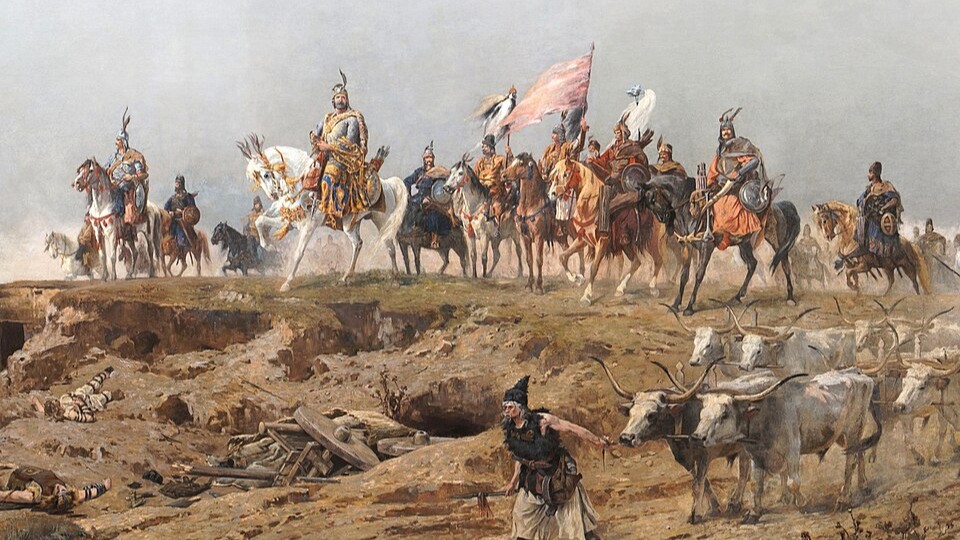
This same spiritual tenacity can be observed in Hungarian history. Throughout its thousand-year history, the Hungarian people migrated from East Asia, through the Urals and the Pontic steppe, all the way to the Carpathian Basin. Although the physical body of the people was genetically continuously refreshed and partially replaced over this vast time interval and spatial movement, Hungarian consciousness remains a constant. Moreover, the Hungarians lived through numerous social formations (tribal society, feudalism, capitalism, and socialism), yet these did not change them beyond recognition. Medieval Hungarian historical memory was aware that Árpád’s people took possession of the Carpathian Basin ‘following Attila’s heritage’, and Hungarian envoys already spoke of the political-national cohesion of the Hungarians before the Byzantine Emperor Constantine Porphyrogenitus.[6]
If the positivists were right, and environment and social change truly overwrite everything, then in the ‘age of capital and money’, the internal logic of our language and thinking should have fundamentally changed as well. But this is not what happened. What could be the reason for this?
Behind historical changes, there simply must exist an ‘invisible constant’ that ensures continuity despite biological-physical changes—and sometimes even despite a change in language. This can be called a metaphysical character: a deep spiritual structure independent of time, space, and biology, which ensures the continuity of the national fate amidst the changing sceneries of history.
The functioning of this spiritual reality can be closely observed in the lifeworlds of pre-modern society. If we examine a typical Hungarian peasant in the era of King Matthias, from the perspective of modernist logic, he would not be a member of the ‘nation’ at all, since in public law, he did not belong to the Natio Hungarica—the noble nation possessing the right to bear arms and political rights. He had no voting rights at the Diet of Rákos, and the source of power in his world was not the ‘people’, but the divinely authorized monarch.
According to Marxist historiography—and from this viewpoint, the so-called ‘modernists’ do not fall far from the Marxists—in pre-modern societies, ‘class position’ (serfdom) or universal religion (Christianity) overrode ethnic-linguistic cohesion, and the peasantry was too tied to the land to possess an identity pointing beyond their own village. However, projecting the concept of modern, horizontal ‘class solidarity’—which in reality never existed outside of modern ideological parties—back onto the Middle Ages harbours severe anachronism. There was no cultural cohesion between a Hungarian serf on the Great Plain and a Slovak serf in Upper Hungary; they never felt themselves to be in the same ‘category’, if only because they could not communicate with each other, had different folk music, and distinct local customs. Solidarity in the Middle Ages was not horizontal, but vertical and cultural: the serf was attached not to another serf, but to his own village, his own linguistic community, and his own landlord or king.
At the same time, this modernist-Marxist argument severely underestimates the mobility of pre-modern society. The economy, warfare, and religion generated massive population movements: through weekly markets, the telekkatonaság (militia based on land tenure),[7] and pilgrimages (which often meant travelling hundreds of kilometers to various shrines, where people from the most diverse parts of the country, yet speaking the same language, met), the peasantry continually experienced ethnic ‘otherness’ within the empire, thereby reinforcing their own linguistic-cultural identity.
Finally, this critique also ignores the fact that in the Kingdom of Hungary, religious and ethnic identity organically merged. The medieval Hungarian peasant—despite the meta-level spiritual universalism of medieval Catholicism—did not attend an abstract ‘Catholic’ church, but rather a church whose walls were painted with the legend of King St Ladislaus.[8] For the peasant, St Ladislaus was the knight-king who saved the Hungarian maiden from the pagan Cuman. To the peasant, the ‘Christian defender’ was primarily a Hungarian king with Hungarian historical roots, and the Virgin Mary was above all Patrona Hungariae—the Patroness of Hungary. On the level of everyday experience, ‘the defence of Christianity’ was synonymous with the sacred defence of the homeland, protecting the Hungarian linguistic-cultural sphere.
In light of all this, in an ethnic and cultural sense—on the plane of spiritual reality—this peasant from the era of King Matthias possessed a deep, instinctive Hungarian consciousness. He belonged to an invisible linguistic-cultural community whose cohesion was ensured by cultural memory built upon a successive chain of generations. Although we do not have direct written sources left by the medieval peasantry themselves regarding their beliefs, the archetypes brought from the steppe past formed an organic part of folk identity.[9] For instance, the motif of the Miraculous Stag (Csodaszarvas), originating from the pre-Christian past, survived in winter solstice folk customs and minstrel songs (regösénekek) among the village peasantry right up to the 20th century, which is irrefutable proof of a millennium of cultural continuity. And while the cycle of legends concerning Hunnic kinship and Attila (the Sword of God) was elevated to the rank of official noble ideology by 13th-century chronicle literature, these narratives inherently drew from ancient Eastern-steppe oral tradition.[10]
These myths were known to both the nobility and the peasantry, since in medieval Hungary, elite culture and folk oral tradition were not as hermetically separated as modernists assume. The farming lesser nobility living geographically together with the peasantry in the villages, as well as the minstrels (igricek, regösök, lantosok) singing at markets and in manor houses, ensured a continuous cultural ‘osmosis’. For the serf, the ‘good King Matthias’ did not mean an abstract head of state, but rather the sacred protector who, maintaining the divine order, defended the Hungarian world against intruding foreigners.
To apply Anthony D Smith’s ethno-symbolist conceptual framework to Hungarian reality: the medieval Hungarians were a typical ‘lateral’ (aristocratic) ethnie. This means that the myths of common descent, historical memory, and political self-administration were carried at the highest, most conscious level by the leading stratum, the nobility (Natio Hungarica). At the same time, at the level of culture, language, and folklore, the peasantry formed the indispensable ‘demographic and spiritual reservoir’ of the Hungarian ethnie.
Nothing proves the attraction and integration capacity of this pre-modern Hungarian spiritual force field better than the historical assimilation of incoming peoples. This integration was incomparably flexible. The Szeklers, for example, were not a separate ethnic group, but a subgroup (sub-ethnie) of the Hungarian ethnic core, consisting of free warriors with a specific public law status, who, stemming from their border-guarding lifestyle, most purely preserved the common steppe origin myths—for example, the Hunnic tradition, which was indispensable for early Hungarian self-knowledge.
The integration of nomadic auxiliary peoples was similarly organic. Just as the Kabars who arrived with the Hungarians, or the Slavic–Avar populations found here, underwent the process of language shift, their identity also gradually became Hungarian. The same happened with the Pechenegs, Cumans, and Jassic people, who later lost their languages. Although they originally arrived as independent ethnic groups, their lifestyle and warrior ethos perfectly fit into the Hungarian steppe-military concept of the state, so they blended into the genetic and spiritual body of the Hungarians while preserving their privileges. Over time, their specific identity transformed into regional pride within the broader Hungarian nation.
‘The nation…was a functioning, assimilating, and identity-forming force centuries before the birth of the modern state’
And this integrating force field worked even in cases where language shift did not occur—such as with the German-speaking Transylvanian Saxons or the Zipser Saxons (cipszerek) of the Szepesség. Among them developed the famous Hungarus-consciousness. This dual identity allowed someone to remain Saxon in a cultural-linguistic sense, while declaring themselves an unwavering loyalist of the Kingdom of Hungary and the Holy Crown in terms of political loyalty and shared fate. Thus, the nation—as a spiritual reality—was a functioning, assimilating, and identity-forming force centuries before the birth of the modern state.
The Collapse of Spiritual Borders
In the history of Hungarian ideas, the years following the Trianon peace treaty particularly grounded the demand for modern national self-knowledge. The previous conservative-liberal era, which coincided with the golden age of the Austro–Hungarian Monarchy, was the optimistic epoch of ‘Progress’. After the visions of the death of the nation, it seemed that the nation had finally reconciled with the dynasty after a long time, and the period of cautious ‘prosperity’ could begin, one of the main fruits of which was the Széchenyi-esque ‘cultivated human mind’. In Hungary, however, few thinking minds perceived the already general (and today even deepening) crisis of modernity, that is, the Nietzschean ‘transvaluation of all values’.[11]
Philosophical-historical thinking was still unable to detach itself from the fundamentally optimistic Zeitgeist, barely or not at all perceiving the catastrophic preliminary winds of the First World War. The era—like the Hungarian political literature of the preceding centuries—was spent in the spirit of ‘legal formalism’, debates and interpretations concerning public law, and, regarding more concrete national knowledge, the ‘Ugric–Turkic war’ hallmarked by the names of Ármin Vámbéry and Pál Hunfalvy.[12]
The ‘Ugric-Turkic war’ was the most significant linguistic and prehistorical debate of the second half of the 19th century. The struggle took place between the supporters of Finno-Ugric (József Budenz, Pál Hunfalvy) and Turkic (Ármin Vámbéry, József Thúry) descent. This highly extreme debate, which still stirs bitter antagonisms among parts of the Hungarian public today, well illustrates how much the self-interpretation of the Hungarians can be led astray if approached purely on the plane of biological, material origin.
Although scientifically the Budenz-type Finno-Ugric theory triumphed with the support of the Hungarian Academy of Sciences (MTA), public opinion and national romance emotionally leaned all along toward the ‘warrior, glorious’ Turkic (Hun) kinship as opposed to the ‘fish-smelling kinship’. In light of today’s archaeogenetic research, we already know precisely that neither origin is exclusive, as Hungarian identity is above all an idea, not biology.
As for the biological (material) aspects of the question: the two types of origins—the ‘Finno-Ugric’ and the ‘Turkic’ (complemented by the Eastern Iranian: Scythian, Sarmatian element, which was extremely important in the ethnogenesis of the early Hungarians)—are not at all opposites of each other, but complementary factors that can be grasped in organic unity with each other. The so-called ‘Finno-Ugric’—today more correctly termed Uralic-speaking—peoples, from whom a part of the Hungarians originated, were tragically misinterpreted in that era.[13] In Hunfalvy’s time, projecting contemporary conditions backwards, they were unjustifiably considered ‘forest-dwellers’ or mere ‘hunter-gatherer’ peoples who possessed no martial culture or political-state-organizing ability. The Uralic-speaking peoples—and particularly the genetic ancestors of the Hungarians—had already possessed a high-level equestrian nomadic culture for millennia before they mixed with the (almost certainly) Oghur-Turkic speaking Huns and Onogurs.[14] Their earlier settlement area might not even have been the Ural Mountains, but the territory of Northeast China, the valley of the West Liao River, in close proximity to the proto-Turkic population.[15]
The latest breakthroughs in linguistics and archaeogenetics perfectly support this common steppe root. The highly publicized study by Martine Robbeets (Max Planck Institute) and her research group proved that the homeland of the Turkic, Mongolic, and Tungusic (ie, Transeurasian) languages traces back to Northeast Asia, to the Liao River valley. Although the Proto-Uralic language is not strictly part of this language family, archaeogenetic data confirm that our Uralic-speaking ancestors set out toward the northwest, ie, Siberia, from exactly this Manchurian macro-region, living in close proximity to proto-Turkic groups for millennia.[16]
Thus, even the Proto-Uralic peoples did not represent an isolated, Europid hunter-gatherer community. Their original, ancient genetics (which related them to the neighbouring Altaic peoples) very early on mixed with the steppe, martial Western-Eurasian (Yamnaya, Andronovo) population during their westward migration. Thus, the ancestors of the Uralic groups—after absorbing the Scytho-Siberian culture—can fully be considered an equestrian nomadic, warrior people long before their later admixture with the (probably Oghur-Turkic) Huns.
However, the loss of the First World War and the partition of historic Hungary meant an elemental shock for Hungarian national self-esteem. This was perhaps comparable only to the crisis caused by the defeat at Mohács. Almost overnight, in 1918–1920, a political, psychological-mental, and even spiritual-ontological catastrophe arose that not only induced a sudden rupture and crisis in the entire Hungarian nation but also, pointing beyond mere revisionist political demands, questioned the very meaning of the nation’s existence.
With the loss of the First World War and the dissolution of the Austro–Hungarian Monarchy, not only did the era of positivism and the parallel millennial optimism come to an end, but also the era of positivism and the parallel millennial optimism too. The country collapsed, not only on a political, but also on a metaphysical plane. The loss of the territorial integrity of historic Hungary—which in its trauma can be compared to the country being torn into three parts during the Ottoman era—induced such a radical crisis of national identity, understanding of history, and vision of the future that has remained defining in the social and especially psychological self-image of the Hungarians ever since.
In this atmosphere, tense to the breaking point, the questions of ‘What is a Hungarian?’, ‘What is the mission of the Hungarian nation?’, and ‘How can we survive?’ resurfaced. These propositions crossed over from the philosophical plane into the world of practical problems almost on their own, and in the Horthy era, national self-reflection became the cornerstone of the Hungarian identity seeking to reform itself. The stakes of the search for answers at this time were no longer merely the desire for scientific knowledge, but a kind of ‘nation therapy’: establishing the diagnosis became a prerequisite for preserving the shattered national unity and the survival of a cohesive Hungarian identity. The Hungarian nation had to understand itself again, forced by the compelling factors of the era, this time in a deeper, more essential way than the public law-political or mere ethnic-cultural level.
Paradoxically, it was as if the collapse of the external borders that had stood for a millennium caused an unusually intensive, yet not passive, but now creative inward turning of the Hungarian spirit. It was as if the process triggered an immediate internal emergency reaction in the deepest and most sensitive minds of the era: the Monarchy and with it the thousand-year-old Kingdom of Hungary was gone; Transylvania, one of the foundation stones of Hungarian identity, which preserved the political frameworks of independent Hungarians even during the Ottoman and Habsburg wars, unexpectedly fell into hostile and foreign hands. More than three million Hungarians—that is, approximately one-third of the nation—found themselves overnight on the territory of the former nationalities of the Austro–Hungarian Monarchy,[17] now organized into new states. Furthermore, they found themselves in a critical existential and psychological situation, as anti-Hungarian sentiments, fueled by wartime politics, dominated.
The former common army was paralysed under the weight of the war defeat and the pressure of the Little Entente. Naturally, Hungarians wanting to act for their nation assessed that the external borders, which had suddenly become malleable and uncertain, could not be restored ‘here and now’. Waking up from the Trianon shock, the demand to redraw and strengthen the internal, spiritual borders emerged almost immediately. This showed that the mechanism of action between spiritual and material reality works the other way around as well: the historical-pragmatic question of ‘Where did we go wrong?’ soon turned into the philosophical reflection of ‘Who are we really?’.
One of Oswald Spengler’s most fundamental thoughts—that nations/cultures are not merely material aggregates but living organisms that are born, flourish, and die —was highly relevant here. It is the antithesis of the one-sided, naive optimism of the Enlightenment and the Kantian ‘perpetual peace’. This represented the reappearance of the archaic/pre-modern idea of historical and social cyclicality, which also broke with the idea of the spiritualist-progressive wing of Romanticism, the ‘sublate and preserve’ unfolding of the Hegelian World Spirit. This turn—independent of the catastrophic results of the world war—fundamentally shook faith in linear progression, and this biological-mystical perspective paved the way for Hungarian fate analysis.
[1] Ernest Gellner, Nations and Nationalism, Cornell University Press, New York, 1983, pp. 59–66. The ‘modernist’ camp (which, besides Gellner, included such significant authors as Eric Hobsbawm or Benedict Anderson) views the nation as the artificial product of modern state administration, industrialization, and mass education. In contrast, the primordial (essentialist) approach conceives the nation as a timeless, organic, spiritual community that precedes the state. Historically, there is also a sharp contrast between the French Revolution’s concept of the ‘state-nation’ (where citizenship creates the nation) and the Central European concept of the ‘culture-nation’ (where language, blood, and shared fate are decisive).
[2] János Gyurgyák, A magyar jellem (The Hungarian Character). Lajos Prohászka, one of the most significant Hungarian cultural philosophers of the interwar period, notes in an essay that ‘bourgeoisification’ goes hand in hand with the devaluation of earlier forms of knowledge. Prohászka did not accept so-called ‘general knowledge’ as a real measure of value: ‘What we commonly call it…is rather an average. The concept of general knowledge is therefore essentially a statistical designation…The standard of judgment here is only the external conditions and tools of culture: that is, what someone could experience from culture, but not how they experienced it.’ Lajos Prohászka, ‘Kultúra és műveltség’ (‘Culture and Education’), In: Történet és kultúra, Ed Gábor Orosz, Hamvas Béla Kultúrakutató Intézet, Budapest, 2015, pp. 284–295. p. 290.
[3] Gergely Egedy, ‘Gondolatok a nemzetről. A politikai és a kulturális megközelítés’ (‘Thoughts on the Nation. The Political and Cultural Approach’), In: Nemzetfogalmak és etnopolitikai modellek Kelet és Közép-Európában, pp. 70–80. p. 74.
[4] Anthony D Smith, The Ethnic Origins of Nations, Oxford, Blackwell Publishers, 1986, p. 32. Opposite Gellner’s modernism, besides ethno-symbolism, the pre-modern conception of the nation has spawned other scientific schools as well. Such is the perennialist school (Adrian Hastings), which emphasizes the continuity of national consciousness back to the Middle Ages, while the research of cultural memory (Jan Assmann, Pierre Nora) describes the nation as a deep-layered community of fate maintained by shared traumas and rituals.
[5] Ibid, pp. 211–212.
[6] The Byzantine Emperor’s work De Administrando Imperio (On the Governance of the Empire), written in the mid-tenth century (especially chapters 38–40), gives a detailed account of the alliance of the Hungarian (Turk) tribes, the Blood Oath (the elevation of Álmos and Árpád), and that strong political-military cohesion which characterized the Hungarians as a unified political entity in the eyes of the contemporary Byzantine court.
[7] The Hungarian serf (especially in the borderlands and on the Great Plain) was not an unarmed, earth-bound slave. The institution of the telekkatonaság (militia based on land tenure), and later the border fort struggles and the military campaigns of King Matthias’s era, mobilized a huge number of peasant lads who travelled the country and even reached foreign lands.
[8] Dozens of such frescoes have survived throughout the Carpathian Basin, even in the smallest villages.
[9] The organic, folk-embeddedness of the pre-modern peasantry and the myths of steppe origin (especially the shamanistic/táltos belief system and the Miraculous Stag) is also proven by Hungarian ethnography and cultural anthropology (among others, the works of Arnold Ipolyi, Géza Róheim, Vilmos Diószegi, and Mihály Hoppál).
[10] The main proof is the first Hungarian chronicler himself, Anonymus (around 1200). In the preface and text of the Gesta Hungarorum, he repeatedly complains that the history of the Hungarians could only be known thus far from the ‘false fables of peasants and the babbling songs of minstrels’ (ex falsis fabulis rusticorum vel a garrulo cantu ioculatorum). Anonymus’s exact goal was to cast these orally transmitted (in his view, sometimes inaccurate) songs into a ‘scientific’, Latin form. The Miraculous Stag myth, which grounds the story of Hunor and Magor, or the Turul legend, are such purely Eurasian (Scytho-Siberian and Uralic) totemic motifs that could not be drawn from Western Latin sources; the chroniclers could only have elevated them into official noble ideology from the living national oral tradition, from folk memory. This is also proven by the fact that the Hunnic tradition (Prince Csaba) survived in its purest form among the border-guarding Szeklers living on the periphery.
[11] As a counterexample, one could mention Endre Ady, who saw the metaphysical plunge in the ‘mendacious’ peace and legal wrangling of dualism even before Trianon. The motifs of ‘We Need Mohács’, ‘Hun, New Legend’, or ‘Hiding Kuruc’ all anticipated Lajos Prohászka’s metaphor of the ‘hiding’ [bujdosó]. Ady already experienced an internal, spiritual Trianon when the country’s borders were still intact. He introduced the concepts of the ‘Hungarian curse’ (or ‘Turanian curse’) and the ‘Hungarian messiahs’ into public discourse—all as spiritual, not public law, categories.
[12] The so-called ‘Ugric–Turkic war’ was the most significant linguistic and prehistorical debate of the second half of the 19th century. The struggle took place between the supporters of Finno-Ugric (József Budenz, Pál Hunfalvy) and Turkic (Ármin Vámbéry, József Thúry) descent.
[13] In modern linguistics, the earlier term ‘Finno-Ugric’ is increasingly replaced by the expression ‘Uralic language family’, since Finno-Ugric is only one (albeit the most extensive) branch of this larger language family, to which the Samoyedic languages are also attached. It is important to emphasize that the greatest methodological error committed in the 19th century was the automatic equation of linguistic kinship with genetic-ethnic kinship. Through language shift and cultural assimilation, an equestrian nomadic warrior elite could also adopt the language of a population speaking a Uralic base language (or vice versa), without this entailing the abandonment of their original steppe lifestyle.
[14] Based on the archaeogenetic investigations of Endre Neparáczky and the Institute of Hungarian Research (Magyarságkutató Intézet) (as well as the research led by Tibor Török), the genetic profile of the conquering Hungarians consists of extremely complex but well-identifiable layers. The first significant admixture—which could have meant the formation of the proto-Hungarian core—is placed in the 3rd century AD, in the region of the Asian steppes. At this time, a fundamentally Iron Age Asian (a kind of Mansi-like, Uralic) population mixed with a Eurasian steppe, equestrian nomadic (Sarmatian, and later Asian Hun) component. This genetic evidence refutes the 19th-century topos that the ancestors of the Hungarians were mere forest-dwelling hunter-gatherers; ethnogenesis took place right from the start under the strong genetic and cultural influence of steppe warrior cultures (Huns, Onogurs).
[15] This geographical and genetic fact perfectly explains the millennia-old close linguistic and cultural interactions between early Uralic and Altaic populations, proving that the Uralic ancestral population already lived in Asia as active participants in steppe nomadic cultures. (See: Yinqiu Cui et al, ‘Y Chromosome analysis of prehistoric human populations in the West Liao River Valley, Northeast China’, BMC Evolutionary Biology, 13, art 216, 2013; Anne-Mai Ilumäe et al, Human Y Chromosome Haplogroup N: A Non-trivial Time-Resolved…)
[16] See Martine Robbeets et al, ‘Triangulation supports agricultural dispersion of the Transeurasian languages’, Nature, 599, pp. 616–621, 2021. The latest population genetic investigations (the analysis of the N1a Y-chromosome haplogroup) have shown that the genetic roots of the population speaking Uralic languages lead back precisely to this same Northeast Asian region. The westward-migrating Proto-Uralians later assimilated the Indo-Iranian (Sintashta-Andronovo) cultural groups, utilizing Bronze Age war chariots and equestrian combat tactics. See in detail: Zoltán Maróti et al, ‘The genetic origin of Huns, Avars, and conquering Hungarians’, Current Biology, 32 (13), 2022.
[17] As a consequence of the peace dictate of Trianon (4 June 1920), exactly about 3.2–3.3 million Hungarians ended up outside the new national borders. The total population of Hungarians on the territory of historic Hungary at the time of the 1910 census was approximately ten million people (excluding Croatia, exactly 9,944,627 people declared Hungarian as their mother tongue). If we add to this the Hungarians living in Croatia and the emigrants, the total population hovered slightly above ten million. This means that at the signing of the treaty, every third Hungarian ended up outside the country’s borders.
Related articles:
At a time when public debate is increasingly polarized and superficial, Hungarian Conservative remains committed to depth, intellectual honesty, and independent conservative thought.
Producing high-quality journalism requires resources. Your contribution helps us expand our coverage, reach new audiences, and keep our content accessible.
Please consider supporting our mission.