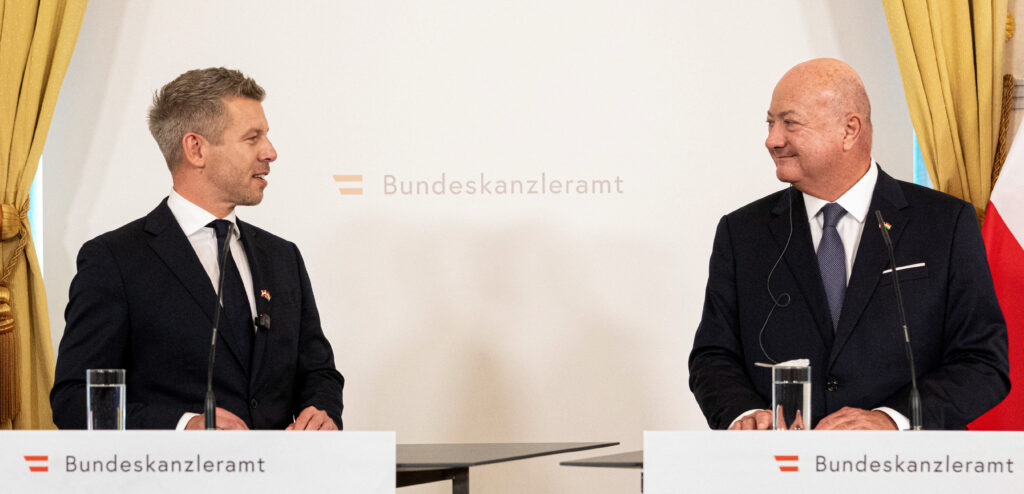
Outgoing Hungarian prime minister Viktor Orbán announced on Saturday that he will not take his seat in the next parliament, scheduled to be inaugurated on 9 May. This means that, after 36 years, there will be no representative in the National Assembly bearing the name Viktor Orbán, marking the end of a political era that has defined Hungary’s modern history in many ways.
Orbán explained his decision by stating that, at this time, he is ‘not needed in parliament’, but rather in the ‘reorganization efforts’ of Fidesz, following the party’s historic defeat in the 12 April election. In the following analysis, we examine the rationale behind Orbán’s decision, what it signals about the political future of Fidesz, and the speculations that have emerged in recent days.
Holding Together Orbán’s Political Myth
Having served four consecutive terms with a constitutional supermajority, Orbán is well aware of the limited role the parliamentary opposition now plays in Hungary’s political system. The Tisza Party will control 141 of the 199 seats in parliament, allowing it to pass legislation—including constitutional amendments—without difficulty. In such a context, the opposition’s role is largely reduced to marginal influence and parliamentary debate with little practical impact.
Over the past two decades, Orbán’s political image has been built precisely on avoiding such situations, presenting himself as a national leader who transcends everyday political debates and operates on the international stage rather than the domestic one. ‘Viktor Orbán is not right—he will be right,’ as the well-known saying goes, a perception that has, in the eyes of his supporters, been confirmed on several occasions, for example during the 2015 migration crisis. This has contributed to the image of an infallible, invincible, and—for the opposition—largely untouchable leader.
A key element of this image has been his approach to the parliamentary opposition: avoiding direct engagement, dismissing criticism, and, when addressing opponents, often doing so in a manner that underscored political dominance.
‘This has contributed to the image of an infallible, invincible, and—for the opposition—largely untouchable leader’
The recent electoral defeat, however, has significantly weakened this political aura. Were Orbán to assume the role of parliamentary opposition leader, he would be drawn into constant debates with Tisza representatives—debates that, given the government’s commanding majority, would be largely useless. Moreover, any criticism he or Fidesz might raise could easily be countered by references to the ‘past 16 years’, diminishing its effectiveness.
This dynamic closely mirrors the post-2010 period, when former Socialist prime minister Ferenc Gyurcsány remained a central figure in the opposition. For 15 years, he served as a convenient and frequently used scapegoat for Fidesz, which consistently framed opposition forces as being tied to him, thereby undermining their credibility.
Unsurprisingly, both Fidesz and Orbán appear intent on avoiding a similar scenario in the next parliamentary cycle. That objective would be considerably more difficult to achieve with Orbán sitting within the Fidesz parliamentary group.
The Lessons of 2002
Over his 36 years as an MP, the current term would not be his first spent in opposition. From 1990 to 1998 and from 2002 to 2010, Orbán and Fidesz spent a total of 16 years in opposition, with the latter period offering a potential parallel to what lies ahead in terms of reorganizing the party.
After being defeated by the Hungarian Socialist Party (MSZP) in 2002, Orbán announced a similarly urgent need to rebuild his political community. During the subsequent parliamentary cycle—although he retained his mandate—he did not focus primarily on traditional parliamentary work. Instead, he deliberately shifted the centre of gravity of his politics outside the legislature, launching the so-called ‘civic circles’ (polgári körök), a nationwide grassroots network aimed at mobilizing supporters and rebuilding the party’s social base. This marked a strategic departure from conventional opposition behaviour, as Orbán increasingly positioned himself not as a parliamentary actor, but as the leader of a broader political movement.
‘The party’s primary problem is no longer the absence of a nationwide network or organizational capacity, but rather a loss of credibility’
This approach proved effective in transforming Fidesz into a mass political force and bears similarities to what the Tisza Party and Péter Magyar achieved over the past two years, becoming the largest political force both in terms of votes and parliamentary mandates without prior legislative presence.
While that earlier cycle did not immediately deliver electoral victory, it laid the groundwork for Fidesz’s sweeping win in 2010, which—alongside widespread dissatisfaction with the incumbent Socialist government—was largely driven by the party’s extensive mobilization of its electoral base.
For Orbán, however, the current defeat is not directly comparable to those of 2002 or 2006, nor are the challenges facing Fidesz today. The party’s primary problem is no longer the absence of a nationwide network or organizational capacity, but rather a loss of credibility in the eyes of voters. This is equally true for the highest and the lowest levels of the hierarchy in the party.
The ‘Orbán Paradox’
A significant portion of Tisza’s voters cast their ballots against Viktor Orbán. It was not necessarily Péter Magyar or the Tisza platform that attracted them; rather, they sought to vote against Orbán, against Fidesz, and against the past 16 years.
This dynamic gives rise to what many describe as the ‘Orbán paradox’: the outgoing prime minister has increasingly become a burden for his own party, yet he remains its central unifying force. Removing him from Fidesz—where he retains considerable authority within the party and among a large segment of right-wing voters—could risk destabilizing the entire structure.
By not taking up his parliamentary mandate while remaining president of Fidesz, Orbán appears to be attempting to resolve this paradox: remaining present within the party while stepping back from the institutional front line.
‘The outgoing prime minister has increasingly become a burden for his own party, yet he remains its central unifying force’
Looking at European politics, there are precedents for long-time, symbolic party leaders stepping back from formal roles while continuing to exercise influence from behind the scenes. Notably, two prominent examples are allies of Viktor Orbán.
One is Jarosław Kaczyński, who has long led Poland’s Law and Justice (PiS) party while staying outside the day-to-day front line of parliamentary politics, operating instead as a figure above the party structure. The other is the late Silvio Berlusconi, who maintained dominant influence over his political camp without consistently holding a central parliamentary role.
The Great Escape?
At the same time as Orbán announced his exit from parliament, media reports surfaced suggesting a potential ‘great escape’ to the United States. Hungarian journalist Szabolcs Panyi suggested that the US could serve as a possible refuge for the outgoing prime minister, particularly in light of the incoming government’s repeated promises to investigate alleged corruption over the past 16 years.
Péter Magyar and the Tisza Party built much of their campaign on accountability, with Magyar pledging to uncover misuse of public funds and restore the rule of law. In this context, speculation emerged that Orbán—now without a parliamentary mandate—could be more exposed to potential legal scrutiny, giving rise to theories about a prolonged stay abroad or even a request for political asylum, given his close relationship with US President Donald Trump and the current Republican administration.
BREAKING: Viktor Orbán quits Hungary's parliament after 36 years – confirming my earlier scoop that he's planning a longer US trip this summer, where heads of the Orbán business empire – his daughter and son-in-law – already live, and where he could seek refuge from prosecution. pic.twitter.com/SiPzXRDtCm
— Szabolcs Panyi (@panyiszabolcs) April 25, 2026
These claims were further amplified by a report published by British outlet The Guardian, which suggested that individuals close to Orbán had already begun exploring opportunities abroad, including in the United States, while transferring assets out of Hungary following the election defeat. The presence of Orbán’s wider family and Fidesz-linked business circle in the US added to this narrative.
Fidesz and the outgoing government strongly rejected these reports. In an official statement, the Government Communications Centre dismissed the claims as ‘fake news’, stating that Orbán ‘is not traveling to the United States for an extended stay’ and that, in line with his previous habits, he would merely attend the football World Cup final, adding that ‘any rumours to the contrary are false and unfounded’.
Related articles:
At a time when public debate is increasingly polarized and superficial, Hungarian Conservative remains committed to depth, intellectual honesty, and independent conservative thought.
Producing high-quality journalism requires resources. Your contribution helps us expand our coverage, reach new audiences, and keep our content accessible.

Please consider supporting our mission.