On the eve of the Second World War, rising high above the dimension of current politics and war, Béla Hamvas’s great essay ‘The Five Geniuses’ was born.[1] Hamvas’s view of the Hungarian nation in this era was so unique and simultaneously so deeply metaphysical that it is worth exploring at length from the perspective of the philosophy of fate. He completely withdrew national self-knowledge from the dimension of a linear view of history and positivist historical inquiry, shifting it entirely to the realm of ‘spiritual geography’. According to Hamvas, the destiny and culture of Hungary evolved at the intersection of five different ‘geniuses’ or currents of spiritual character. Consequently, the Hungarian nation does not possess a single, homogeneous national character, as Prohászka or Szekfű attempted to describe it, but is in fact the meeting ground of five distinct spiritual forces, Geniuses, that are in tension with one another.
Hamvas—who was undoubtedly not a trained historian and ideologically stood even further away from general historical approaches than Ferdinandy—can nevertheless be called a thinker akin to the spiritual-historical approach.[2] In his exceptionally diverse body of work, the question of Hungarianness—although it faded into the background in the second half of his creative period—always carried profound significance.[3] Without his historical-philosophical insights regarding the Hungarian nation, it would be impossible to form a complete picture of the understanding of Hungarians between the two world wars.[4]
The starting point of ‘The Five Geniuses’ is a fundamental distinction in spatial philosophy: the differentiation between ‘space’ in a geometric sense and ‘place’ possessing spiritual quality. Physical extension in itself is a dead abstraction, but the true arena of human existence is the place which has a character, an aura, and a formative power. ‘Space has a formula; place has a genius.’[5]
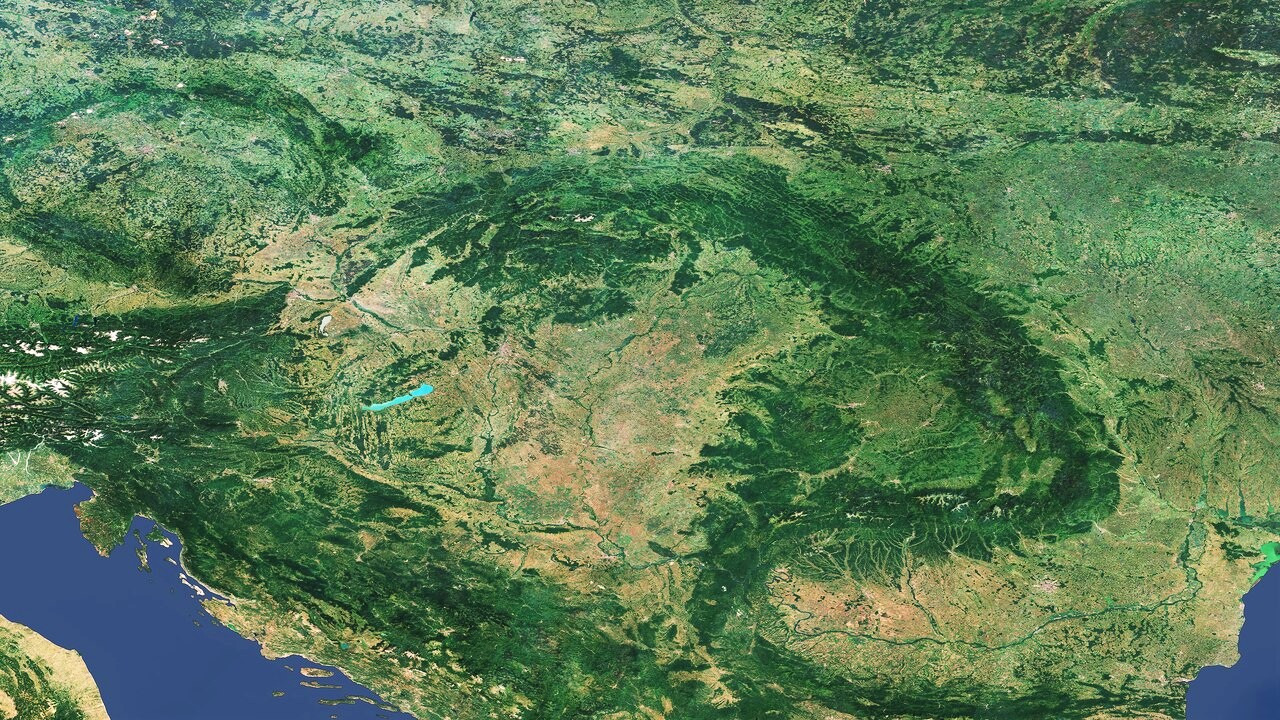
In Hamvas’s system, the concept of genius does not merely signify the former tutelary deity of ancient Roman religion, but rather the indissoluble, organic unity of the landscape, the climate, the flora, the historical tradition, and the people living there. The genius of the place determines the life order of the community, the structure of the family, the artistic forms, the mode of farming, and the ultimate spiritual orientation. The unique characteristic of Hungary and the Carpathian Basin is that this geographical area is not dominated by a single homogeneous spiritual force field; instead, five radically different geniuses meet, intersect, and clash with one another here. These are the geniuses of the South, the West, the North, the East (the Great Plain), and Transylvania. The presence of these five powers simultaneously represents the unparalleled potential richness of the Hungarian spirit and the primary cause of its historical failures and internal divisions. The central message of the work is the exploration of how these five geniuses are integrated into the ‘objective psyche’ of the Hungarian people, and how the lack of synthesis and balance led to the nation’s historical and moral crisis.
The genius of the South is geographically manifested in the southwestern corner of Transdanubia, around Lake Balaton, on the gentle slopes of Somogy, Zala, and Baranya, as well as in the regions of Veszprém and Pécs. This region breaks away from the enclosed Carpathian Basin character in both climatic and spiritual senses; its air, light conditions, and atmosphere evoke the Mediterranean region. The orientation here points not toward the eastern steppes or the northern mountains: ‘South of Somló, the landscape stands with its back to the North, facing the sea and Rome.’[6] The closest spiritual relative of this landscape, according to Hamvas, is not even the neighbouring Hungarian countryside, but rather Istria, Dalmatia, Provence, and Attica.
The fundamental determinant of the Southern ideal of existence is ‘relaxedness’. This state signifies the complete absence of spasmodic willing, sweat-inducing exertion, and tragic heroism. Human relationships, movement, speech, and social structure are equally permeated by this harmonious absence of tension. The cohesive force of the community here is not coercion, nor a rational social contract, nor Aristotelian friendship, but Empedoclean Philia, a natural, cosmic attraction. This is the ancient power capable of dissolving social antagonisms —between rich and poor, master and servant— into a higher, intimate unity, in ‘social charm’. The basic cell of society is the family, not in the sense of a closed biological unit, but as a community of people with the same temperament, which can encompass an entire farm or manor house.
The embodiment of the Southern genius in Hungarian art is Dániel Berzsenyi, who—unlike the ‘diffuse and overripe’ Sándor Kisfaludy—represents Horatian fire and cosmic harmony. The symbol of the Southern spirit is the ‘apiary’ (méhes), to which a person withdraws to synthesize the world within themselves in a state of ‘wakeful sleep’ amidst the buzzing of the summer heat. ‘The apiary is the place of wakeful sleep.’[7]
The genius of the West is the arena of humanized nature and intense bourgeois civilization. Its geographical extent stretches from Pozsony (Bratislava) and Sopron across the Little Hungarian Plain (Kisalföld) along the Danube to Győr and Esztergom. While the South proclaims harmonious fusion with nature, the essence of the West is the elevation above nature. Western man does not merely endure nature, but ennobles it, confines it within frameworks, and institutionalizes it. ‘Civilization is what is stronger than nature. Cultivation does not create; it merely cultivates, because the spirit in whose name it cultivates is not its own.’[8]
The Western order of life is ‘individualistic, democratic, and liberal’. The ultimate goal of the Western genius is the creation of personality. According to Hamvas, this ‘Wilhelm Meister-esque’ life order was most purely represented in Hungarian history by István Széchenyi, who ‘wanted nothing else than to extend the West over the entire country, to create intense cultivation, so as to assimilate all Hungarians into Western bourgeois civilization. This is why so many were enthusiastic about his thoughts, and this is why so many opposed him.’[9]
‘Civilization is what is stronger than nature. Cultivation does not create…because the spirit in whose name it cultivates is not its own’
The genius of the North—about which the Prešov-born Hamvas writes surprisingly dismissively, even though he himself hailed from an Upper Hungarian, Zipser German (cipszer) background—is the spirituality of the mountains, enclosed valleys, and damp, melancholic pine forests of Upper Hungary, which geographically stretches downward from the Carpathians and radiates into Transdanubia in certain patches (Bakony, Vértes). The fundamental ontological characteristic of Northern existence is centerlessness and provincialism. ‘North here means as much as centerlessness.’[10] Province here does not simply mean distance from the capital, but rather a cultural passivity that does not create an independent civilization, and merely adopts external (Western) forms superficially without essentially being changed by them.
The Northern man has a direct, primary relationship with nature, but this relationship is not characterized by Southern serenity, but rather by transience and melancholy. Since the protective shell of civilization and solid religious dogma are absent, the spirit is replaced by daydreaming, imagination, and superstition.[11]
The genius of the East—which, according to the Hungarian studies of the time, was considered the ‘most Hungarian’ among the regions, the cradle of the Turanid Hungarian type—is also predominantly characterized by negativity in Hamvas’s view. The basis of the existential experience on the Great Plain, according to Hamvas, is a severe psychological and ontological paradox: the horizontal infinity, the sheer openness of the Puszta, actually generates the deepest experience of confinement. There is no seashore here where one could anchor; man is crushed by the dual pressure of the sky and the flatland. The constant drought and lack of water breed an elemental, scorching inner fire, an unquenchable thirst for freedom, and restlessness. ‘Therefore, the man of the Great Plain is suspicious and distrustful, deceitful and envious, and he isolates himself, saving only himself while letting everything else perish.’[12]
The basic cell of Eastern society is the martial tribe. ‘In the East, the family branches out into a tribe, and the tribe is the social cell whose character is martial, but always political and public, and the family is deliberately hidden here.’[13] Hamvas calls this concealment ‘Eastern modesty’. The settlement structure of the Great Plain (the enormously swollen village-towns and the isolated farmsteads) is proof of nomadic transience. The cities have no true sacral or urbanistic centre; the people living here secretly always feel that settling down and institutionalization is a betrayal of ancient freedom.
From this transience and desire for freedom unfold the two archetypal figures of the East: the outlaw (betyár) outside society, and the fat peasant (labanc). The outlaw is the ascetic of absolute fidelity to fate and statelessness, who makes no compromises with the jailers of civilization. In contrast, the labanc who strikes a deal with power is the object of the deepest contempt. The greatest error of the Eastern genius is that it reduces this metaphysical thirst for freedom exclusively to the level of politics.
The genius of Transylvania, according to Hamvas, is the most closed, most complex, and most individual spiritual force field in the Carpathian Basin. Its spiritual roots lead neither to ancient Rome, nor to enlightened Paris, nor to the Asian steppes, but to Byzantium. This Byzantine heritage is a peculiar face-behind-a-face, an irresolvable tension between the rigid, geometric external form and the fierce, wild passion raging behind it.[14] In Transylvania, things are never unambiguous; everything has at least two meanings. ‘The Transylvanian man is more ready than either the Western, the Southern, or the Eastern.’[15]
Social interaction is permeated by magical caution inherited from Byzantine courts, by intrigue, shrewdness, and ceremony. The Transylvanian man is tactful, clever, and often a jack-of-all-trades (polymath), who—unlike the dogmatism of the Great Plain—views political compromise as a high art of survival. In Transylvania, the family rises to the highest social rank: ‘In Transylvania, the family is a dynasty.’ Private life is permeated by stifled whispering behind curtains, a lust for dominance, and caution. The perfect literary expression of the Transylvanian genius is the ballad (such as the novels of Zsigmond Kemény), which is dark, dramatic, full of silences, and accurately reflects this complex, tragic, yet highly stylized form of existence. Transylvania is the meeting point of high civilization and the elemental savage, a state of perpetual, tense readiness.
‘Transylvania is the meeting point of high civilization and the elemental savage, a state of perpetual, tense readiness’
According to Hamvas, the tragedy of Hungarian history is that these geniuses could not merge into a harmonious unity, to unite beneath a ‘hieratic mask’. Hungarian history is the constant, unresolvable struggle between the East—the Great Plain, the Kuruc, Protestantism, defiance—and the West—Transdanubia, the Labanc, Catholicism, order. The Hungarian nation could not achieve unity; the geniuses diverge. The wild freedom of the East destroys the built forms of the West, and the West suffocates the vitality of the East.
According to Hamvas, the structure of the human soul consists of the so-called objective psyche, which condenses millennial human experiences in the form of primordial shapes and archetypes. These forces are independent of individual will; man can only identify with them. The unique tragedy and potential greatness of the objective psyche of the Hungarian man lies in the fact that while most European peoples only need to synthesize two or three archetypes, all five geniuses are present in the Hungarian soul. The task of destiny is unavoidable: ‘To be Hungarian means nothing less than to create balance in the world of the five geniuses.’[16]
Throughout history, however, this synthesis has been realized only sporadically, in exceptional personalities—such as, according to Hamvas, in the life’s work of Mór Jókai. The fundamental state of national existence is disintegration. When the archetypes do not form an organic, interacting unity, but one of them strives for exclusive dominance while the others are repressed, autonomous complexes are formed in psychology. Hamvas describes the metaphysical consequence of this with masterful precision: ‘If the archetype lives in the light of daytime consciousness, it is a genius that serves man’s healthy and true life; if it falls into obscurity, it is a demon…’[17]
Hungarian history is tragic, according to Hamvas, because the abstract desire for freedom of the East hates the form of the West; the West looks down upon the provincialism of the North; the closed arrogance of Transylvania despises the straightforwardness of the Great Plain. This internal division led to the pathological, irrational fraternal hatred that permeates Hungarian public life and society. The external historical disasters (Mohács, Trianon) were in every case preceded and prepared by this internal discord, the psychological projection in which the individual shifts their own unresolved tensions onto the other.[18] The dissolution of community solidarity, the continuous denouncements, envy, and the inclination to destroy one another are symptoms not of a political, but of a deeply psychological and ontological crisis.
The sociological reflection of psychological division is the abnormal functioning of social castes. Hamvas applies the traditional Eastern system (Brahmin, Kshatriya, Vaishya, Shudra) to analyse the body of the Hungarian nation. The four fundamental activities of society are the festival (spiritual), the assembly (knightly-governing), the market (economic), and the labour (serving). A society is only viable if this hierarchical order is guided by the highest spiritual (Brahmin) caste.
The Hungarians, however, stepped onto the stage of history as a warrior, nomadic (Kshatriya) people, having previously broken away from a higher civilization—likely the East Asian Shang civilization, according to Hamvas[19]—and thereby lost their original spiritual caste. The nomad has only a shaman, a mere magical vestige rather than a true tradition-preserving spiritual power. Upon arriving in the Carpathian Basin, the Hungarians were forced to artificially import a spiritual caste from the West (the Christian clergy) to survive. This step, however, never became organic. The knightly caste viewed the clergy and religion merely as tools for political power.
The consequence, according to Hamvas, was a ‘beheaded society’. ‘A beheaded society without a spiritual caste is like a person who has not awakened to self-awareness, a plaything of the forces of history.’[20] The Kshatriya (noble) caste excels in battle and administration but is incapable of providing a deep, spiritual foundation for a civilization. The nobility made politics the sole form of self-realization, thereby degrading even the most important questions of existence into matters of power. ‘The Kshatriya knightly-governing caste, which lives in the world of the momentary tensions of power, has no sense for spiritually deeply founded rule.’[21] In the absence of this spiritual rule, the fate of the nation became not a consciously directed construction, but a blind game of chance and vulnerability to demonic forces.
Here, Hamvas’s fate analysis astonishingly, almost paradoxically, resembles Bibó’s diagnosis, but it also highlights its material one-sidedness. Both Bibó and Hamvas agree that the Hungarian historical elite—the nobility—led the nation into a dead end. Yet, while Bibó condemns the nobility in the name of bourgeois progression because it was unwilling to renounce its privileges and stood in the way of Western-style, egalitarian mass democracy, Hamvas’s traditionalist critique asserts exactly the opposite. According to Hamvas, the sin of the Kshatriya nobility was not elitism, but precisely the fact that it was not elite enough: it lacked the transcendent, ‘Brahmin’ spiritual foundation behind it. Bibó demanded the profane ‘humanization’ and mere institutional rationalization of power from the Hungarian past; Hamvas, however, points out that politicizing without spiritual guidance, sinking into mere rationality, is in itself just the unleashing of demons. The Hungarian tragedy, for Hamvas, is not the lack of embourgeoisement, but the loss of sacredness.
According to the cultural-morphological analysis of ‘The Five Geniuses’, the Hungarian nobility (the Kshatriya caste), having lost the spiritual (Brahmin) guidance provided by the Christian-sacral ideal of the state, was decapitated by the 18th and 19th centuries.
‘The Hungarian tragedy, for Hamvas, is not the lack of embourgeoisement, but the loss of sacredness’
Although Hamvas acknowledges the historical truth of the knightly-noble stratum preceding this era, he points out that the Hungarian elite entering modernity tried to replace the lost spiritual posture with mere emotional substitutes, the false, romantic pathos of gypsy music, and empty parliamentary rhetoric. The diagnosis, however, does not refute but rather confirms the theses of fate analysis (especially those of Tibor Joó): the Hungarian nobility did not fail when it represented the archaic and early medieval Hungarian character, but when, abandoning all this, it sank into a spiritless modernization bureaucracy and a ‘pale copy’ of 19th-century Western linguistic nationalism. At this point, the true metaphysical character of the nation no longer lived on in the assimilating political elite, but—as we saw earlier—in the lower nobility living in organic unity with the peasantry and in the deep layers of the people.
Hamvas also observes that in the modern world, collective salvation—whether tied to race, class, or nation is an untenable delusion. Humanity has entered the aeon of individuation, where salvation and redemption are exclusively personal. ‘For man today, regardless of differences in religion, race, nation, or class, the most important task to be realized across the whole earth is personality.’[22] Collective categories—like the five geniuses of the Hungarians—are merely building blocks that the individual must become aware of and integrate within themselves.
According to Hamvas, the crisis of the Hungarians—the ‘Turanian illusions’, the provincial ‘hatred of the West’, the particularist sense of mission—can only be eliminated if, instead of the political illusions of the ruling Kshatriya caste, a new spiritual base is established. The task is not defiant isolation or the mere copying of foreign forces, but the recognition of the idea of the universal state. The universal state is not a political world empire, but a civilizational framework in which different nations, races, and geniuses live in peace under the leadership of spiritual authority (Brahmin).[23]
In its current, ‘beheaded’ state, a state of bestiality and vulnerability, the Hungarian nation can only survive if it performs the most difficult task: transforming internal demons back into creative geniuses. For Hamvas, therefore, the nation is neither a racial nor a political issue, but above all, a matter of salvation. The task would be to keep the opposing forces in a new balance, something that Transylvania achieved most perfectly throughout history. One must not choose between backwardness and progress, or East and West, but integrate them at the level of a higher, sacral, spiritual unity, at the spiritual level that Hamvas calls the ‘realization of Tradition’.[24]
In Hamvas’s work, the idea of Tradition is not a political, literary, or dynastic tradition, but that of the spiritual-metaphysical tradition, which—even with personal shifts in emphasis—is practically identical to the philosophia perennis of traditionalist thinkers. Hamvas interpreted Tradition as an original and primordial order, out of which modernity—being in permanent crisis and at the same time a permanent apocalypse—has, as it were, fallen. Tradition is therefore originally not a religious or philosophical tradition, but primordial knowledge concerning the spiritual order of the universe.
‘Tradition is an order—existing before the creation of the world (pre-existent)—that was, is, and will be identical and valid for all worlds and all existence,’ writes Hamvas in one passage.[25]
From Hamvas’s concept of tradition, however, the conquering Hungarians seem to have been omitted. In his interpretation, nomads have no spiritual caste, only their degenerated shamans left over from high civilizations, and their sheer military power. Since Hamvas viewed the conquering Hungarians merely as a plundering knightly caste torn away from a higher civilization, without spiritual guidance, he considered the founding of the independent Hungarian state to be ‘Kshatriya’ pride and false independence in opposition to imperial—Byzantine or Western—integration. This, however, is a historically erroneous projection, which, unfortunately, in Hamvas’s case is largely the echoing of the hostile propaganda of Western European chroniclers. Archaeological and historical facts, however, prove that the Árpád-era conquest was a logistical and military masterpiece planned with immense consciousness and lasting several years. Moving hundreds of thousands of people and vast herds of livestock across the Carpathians, and then immediately sealing off the basin with a system of borderlands (defence lines), is not the work of a ‘band of robbers’. The Hungarian raids were not blind plundering campaigns, but mercenary actions paid for by Western powers (like Emperor Arnulf), and preventive strikes serving the security of the Carpathian Basin ring, whose goal was to prevent an attack by a strong, united Western empire against the new homeland. In contrast to Hamvas, Tibor Joó recognizes the reality of this archaic order of existence much more accurately. The conquest was not a forced flight, but a logistical and state-building act, and the Hungarians did not lack a ‘spiritual dimension’.
[1] Hamvas wrote the work precisely in 1940. He had already formulated the core ideas in 1936—exactly the same year Prohászka wrote The Wanderer and the Hider (A vándor és a bujdosó)—in a shorter essay titled ‘Five Geniuses’ (subtitled: Sketch for the Psychology of Hungary). This early draft was published in the journal Társadalomtudomány (Social Science).
[2] Béla Hamvas’s view of history can also be interpreted as the radicalized, metaphysical extreme of spiritual history. Although he firmly rejected ‘academic’ historiography, his fundamental stance expressed in his essay collection The Invisible History (A láthatatlan történet, 1943) aligns him with the zeitgeist: he believed the true driving forces of history were to be discovered not in material facts or documents, but in the invisible regions of the spirit, in myth and sacredness. With this approach, he was also closely connected to the mythic-humanist historical conception of the Sziget circle, hallmarked by Károly Kerényi and Antal Szerb, which similarly—from a different angle—aimed at transcending positivism.
[3] Hamvas’s creative career took a forced turn in 1948, following the political attack by György Lukács and his dismissal from his library job (being placed on the B-list). During his years of silence, working as a storekeeper and gardener, his attention shifted from specific questions of national characterology towards universal metaphysics and archaic tradition (Scientia Sacra). During this period, the question of Hungarianness did not disappear but was integrated into a broader, salvation-historical framework: the national self-examination of the Hungarian Hyperion (Magyar Hyperion, 1936) culminated in his late great novel, Carnival (Karnevál), where typical Hungarian character types and problems of Hungarian destiny appear as symbols of the drama of universal human existence.
[4] Hamvas’s life work remained partially unassimilable for today’s academic scholarship not only because of the post-Marxism that survived the regime change. According to Dezső Csejtei, Hamvas’s philosophical portrait remained a ‘torso’ (unlike the statue-like Kant or Gadamer) because he had to create himself ‘out of nothing, without any antecedents or continuity’. He lacked the ‘background, the foundation, the cultural continuity’; the genius lacked the high average standard, the hundreds of anonymous professors whose shoulders he could have stood upon. Dezső Csejtei, ‘Introductory Words’ to Katalin Thiel’s Masquerade (Maszkjáték).
[5] Béla Hamvas, ‘The Five Geniuses’ (‘Az öt géniusz’). In The Hungarian Hyperion – and other essays with Hungarian relevance (A magyar Hüperión – és más magyar vonatkozású esszék), Medio Kiadó, Budapest, 2001, p. 83.
[6] Ibid, p. 9.
[7] Ibid, p. 3.
[8] Ibid, p. 15.
[9] Ibid, p. 25.
[10] Ibid, p. 21.
[11] At the level of historical manifestations, the purest example of Northern formlessness and melancholy is the Kuruc war. According to Hamvas’s analysis, this movement was not a classical revolution or war of independence, but a guerrilla war of the ‘barefoot’, fueled by aimless, unrealistic desires, which was doomed to fail from the start. According to his rather sweeping judgment: ‘The Kuruc is a primitive individualist and a melancholic fantasist and anarchic provincial.’
[12] Béla Hamvas, ‘The Five Geniuses’ (‘Az öt géniusz’). In The Hungarian Hyperion – and other essays with Hungarian relevance (A magyar Hüperión – és más magyar vonatkozású esszék), Medio Kiadó, Budapest, 2001, p. 47.
[13] Ibid, pp. 10–11.
[14] Ibid, p. 35.
[15] Ibid, p. 50.
[16] Ibid, p. 94.
[17] Ibid, p. 122.
[18] Ibid, pp. 120–121.
[19] ‘The striking kinship of the shamanism of the nomadic peoples and tribes living on the Eurasian continent seems to prove that most tribes broke off from the same high-order civilization, and it is not impossible that it was the one recently called the East Asian Shang civilization, preceding the Chinese.’ Hamvas, ‘The Five Geniuses’, p. 104. Although Hamvas’s claim regarding the origin of shamanism is unverifiable, he likely conceived of the truly existing early Chinese Shang (or Yin) dynasty (c 1766–1122 BC)—based on his studies of Taoism—as one of the last pure embodiments of an archaic, traditional order of existence. In this era, according to Hamvas, the sacral kingship still genuinely formed a bridge between Heaven (spirit) and Earth (matter); the foundation of power was not profane violence or administration, but the maintenance of the cosmic order (the Tao).
[20] Béla Hamvas, ‘The Five Geniuses’ (‘Az öt géniusz’). In The Hungarian Hyperion – and other essays with Hungarian relevance (A magyar Hüperión – és más magyar vonatkozású esszék), Medio Kiadó, Budapest, 2001, p. 69.
[21] Ibid, p. 68.
[22] Ibid, p. 104.
[23] Ibid, p. 102.
[24] Hamvas—following his own universal orientation—interpreted Tradition as the common spiritual foundation of humanity, the original and primordial order of existence, from which modernity, being in a permanent crisis and simultaneously a permanent apocalypse, has, as it were, fallen out.
[25] Béla Hamvas, Patmos II, Életünk Kiadó, Szombathely, 1992, p. 170.
Related articles:
At a time when public debate is increasingly polarized and superficial, Hungarian Conservative remains committed to depth, intellectual honesty, and independent conservative thought.
Producing high-quality journalism requires resources. Your contribution helps us expand our coverage, reach new audiences, and keep our content accessible.

Please consider supporting our mission.