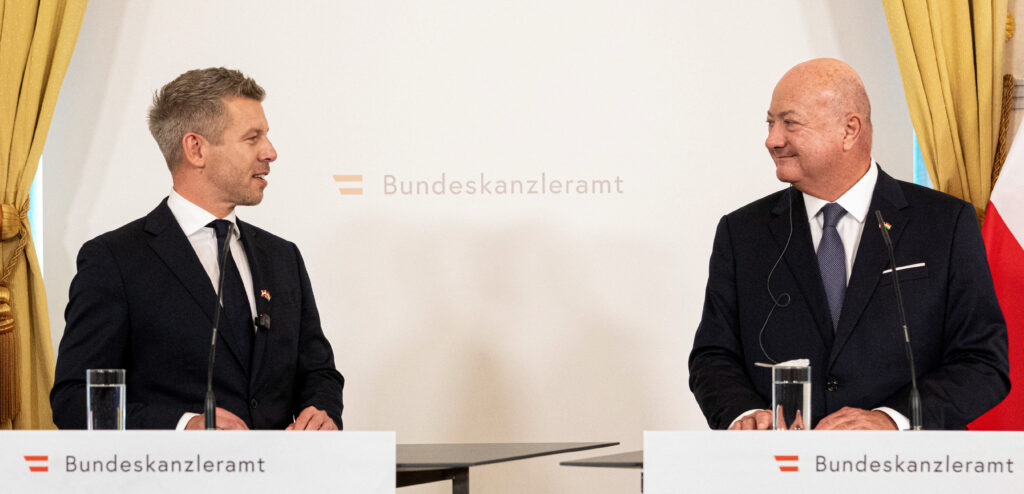

Prime Minister Péter Magyar has become caught up in a controversy over his use of a military helicopter to inspect the crisis around the Paks nuclear power plant, just as a new poll showed his governing Tisza Party losing support for a second consecutive month and falling below 50 per cent among all adults for the first time since its landslide victory in April.
Magyar announced the flight himself on Facebook on Wednesday morning, posting a photograph beside a military helicopter with Defence Minister Romulusz Ruszin-Szendi. He said water-management specialists and power-plant executives in Paks would show them the situation ‘from above’ ahead of important government decisions, adding that it was the first time he had travelled by helicopter.
Former independent MP Ákos Hadházy reacted immediately, placing Magyar’s photograph alongside an earlier image of Viktor Orbán travelling by helicopter under the caption ‘Spot the difference’. He estimated that even one helicopter would have cost HUF 1.5–2 million and questioned what information Magyar needed to obtain personally from the air. If the inspection did not influence any decision, Hadházy argued, the expense amounted to propaganda or political PR, accusing the prime minister of doing the same thing he had criticized Orbán for before.
The argument is valid and equally sensitive for Magyar, who had made similar criticism of the former prime minister only four months earlier, in the campaign’s final phase. After Orbán and then-foreign minister Péter Szijjártó travelled by military helicopter to inspect gas infrastructure near Kiskundorozsma in April, Magyar said a ‘real leader’ did not stage a ‘B-category action film’ or ‘fly around in helicopters looking at gas pipes’. Fidesz politicians, including Péter Takács and Csaba Dömötör, immediately revived the quote on Wednesday, accusing Magyar of hypocrisy.
The use of military aircraft by government officials under consecutive Orbán administrations had faced sustained scrutiny from opposition politicians and the media long before Tisza was even a thing. Both Szijjártó and Orbán were frequently accused of using them for unnecessary trips, costing massive amounts of taxpayers’ money.
Magyar rejected Hadházy’s comparison, saying there was a ‘significant difference’ between politicians flying at public expense for ‘pleasure’ and a prime minister receiving on-site expert information before a decision affecting the whole country. He also argued that military pilots and helicopters must complete minimum annual flying hours anyway, meaning the expense would have arisen independently of his presence. Paks being offline, he said, could cost taxpayers at least HUF 50 billion per month.
‘Both Szijjártó and Orbán were frequently accused of using them for unnecessary trips’
The flight came during an acute crisis at Paks. Prolonged drought and record-low Danube levels had recently forced Hungary’s only nuclear plant, which normally provides close to half the country’s electricity, to operate at around 10 per cent of capacity. Following Wednesday’s meeting, the government ordered the construction of a riverbed sill and prepared two 80-metre barges for possible controlled sinking to raise water levels around the cooling-water intake.
At almost the same time, on 12 August, Europion published polling conducted on 11 August—before the helicopter trip—showing Tisza at 49 per cent among all adults, down from 50 per cent in July and 52 per cent in June. It is the first time the party has fallen below 50 per cent in any poll since the April election. Among decided voters, Tisza fell three points to 58 per cent, while among decided voters certain to participate, it dropped three points to 61 per cent.
The figures suggest that the honeymoon after the election is definitely over; support is not dipping dramatically, but gradually receding. Europion had already recorded a two-point fall among the full population between June and July, from 52 to 50 per cent, before the further one-point decline in August. It is important to note that these movements remain within the margin of error; nevertheless, the direction has now been the same for two consecutive months.
Medián’s late-July poll also shows the same trajectory. The survey, conducted between 22 and 24 July, put Tisza at 57 per cent of the total electorate, three points down from June, while its support among certain voters with a party preference declined by between three and five points from the previous month. Medián itself described the movement as bordering on the margin of error, but noted that Tisza appeared to have come off the peak reached in June.
‘It is the first time the party has fallen below 50 per cent in any poll since the April election’
There is an interesting connection between the two polls, namely that both followed a communication failure by Magyar. The Medián survey came after Judit Polgár rejected his rushed offer of a presidential nomination, while Europion published its own findings on the day he posted the controversial helicopter photo. Magyar also lost his first place in Europion’s politician popularity ranking to Transport and Investment Minister Dávid Vitézy, who rose four points to 52 per cent, one point ahead of Magyar.
There is little evidence, however, that voters leaving Tisza are producing a corresponding revival for Fidesz. According to Europion, the former governing party stands at 21 per cent among all adults, one point above July, while its support among certain voters with a party preference remained unchanged at 25 per cent.
On the contrary, the third parliamentary party, the hard-right Our Homeland (Mi Hazánk), climbed from 8 to 10 per cent among all adults, from 10 to 12 per cent among voters with a party preference, and from 8 to 10 per cent among certain voters with a party preference. 14 per cent of those who backed Fidesz in April now say they would vote for Our Homeland.
Related articles:
At a time when public debate is increasingly polarized and superficial, Hungarian Conservative remains committed to depth, intellectual honesty, and independent conservative thought.
Producing high-quality journalism requires resources. Your contribution helps us expand our coverage, reach new audiences, and keep our content accessible.

Please consider supporting our mission.