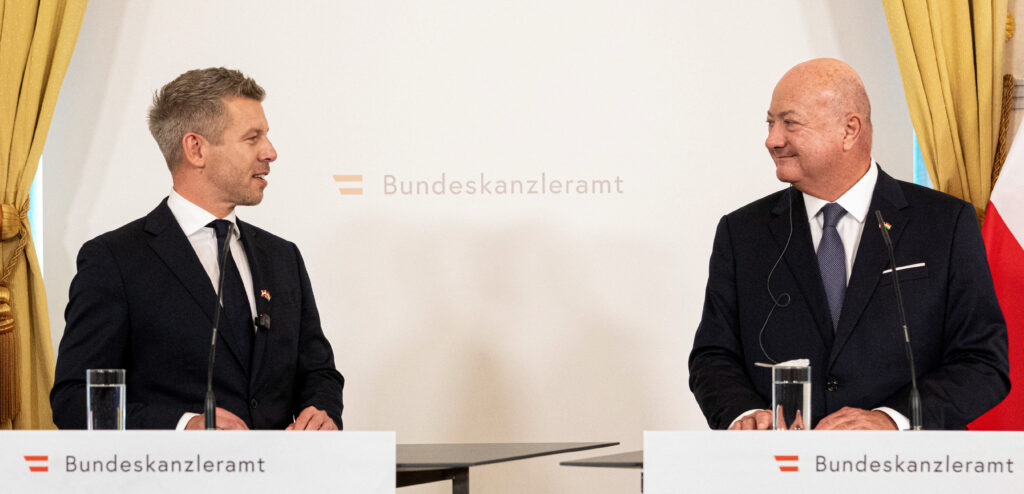

What was meant to be a triumphant start to the week for Prime Minister Péter Magyar and his Tisza Party instead produced one of the new government’s most serious backlashes so far, after Hungarian chess grandmaster Judit Polgár rejected Magyar’s public endorsement of her to replace President Tamás Sulyok.
Polgár, considered to be the best female chess player in history, announced her decision in a carefully worded Facebook post on Monday evening, calling the endorsement ‘one of the greatest honours of my life’ and saying she was profoundly grateful to those who had put forward her name. Her refusal, however, was unequivocal. ‘I do not feel enough strength within me to assume the historic responsibility of uniting a divided nation,’ she wrote, adding that she was therefore unable to accept the request.
The episode followed an unprecedented constitutional confrontation that ended with President Tamás Sulyok promulgating the 17th amendment to Hungary’s Fundamental Law—and thereby terminating his own mandate. Passed by the Tisza parliamentary supermajority on 13 July, the amendment used a tailor-made transitional clause to remove Sulyok and several Orbán-era officeholders, while granting constitutional status to a powerful new asset-recovery and anti-corruption authority. Sulyok denounced the measure as an attack on democracy, the rule of law, and the separation of powers, but signed it on Saturday anyway.
Magyar defended Sulyok’s removal as part of Tisza’s mandate to dismantle what it describes as the ‘political and economic patronage network’ built during Viktor Orbán’s 16 years in power.
‘By Monday afternoon, Tisza’s parliamentary group had declared her unanimously the most suitable candidate’
Minutes after Sulyok announced that he would sign, Magyar promised that the successor would not be chosen in ‘smoke-filled rooms’, inviting parties, civic organizations, and citizens to submit names and announcing a consultation process.
That promise unravelled in less than 24 hours. After 16 well-known figures from Hungarian cultural, scientific, and sporting life proposed Polgár on Sunday, Magyar endorsed the idea that evening and announced that he would nominate her on Monday. By Monday afternoon, Tisza’s parliamentary group had declared her unanimously the most suitable candidate—before she had accepted and scarcely 24 hours after the public consultation process began.
What Magyar later described as his own fault and a series of communication errors turned into a massive public backlash. The main criticism was not about Polgár, but rather about reproducing the very method Tisza had condemned and won a landslide by promising to change: namely, a governing party with a constitutional supermajority picking public officeholders and heads of constitutional institutions internally, without involving the wider public.
Amnesty International Hungary said ‘the problem is not Judit Polgár, but Péter Magyar’s procedure’, accusing the prime minister of behaving as though there were no time for meaningful public debate. The former leader of the progressive Momentum party and vocal Tisza supporter, András Fekete-Győr, said the exercise already had the ‘smell of an announcement of results’ before the consultation had properly begun. Even among the party’s supporters, online criticism focused on why recommendations had been invited if the party intended to rally behind the first prominent name.
Magyar initially pushed back, insisting that he had requested recommendations rather than promised a formal public consultation. Reacting to Polgár’s decision, however, he revealed that she had told him during their meeting that she would not accept the nomination ‘in view of the circumstances that had developed’.
The prime minister then conceded that criticism of the nomination process had included legitimate questions and acknowledged that it had not unfolded as many Hungarians would have considered proper or ideal. He apologized for communications mistakes caused by his enthusiasm and confidence in Polgár, adding that ‘the responsibility lies exclusively with me’.
Reacting to the rejection, Fidesz deputy group leader János Bóka said Polgár had made ‘the only right decision’, blamed Magyar for creating an ‘undignified situation’, and declared that his party would not participate in ‘further acts of the charade’. KDNP group leader Bence Rétvári called the outcome Magyar’s ‘first visible failure’, arguing that Sulyok’s forced removal, the prime minister’s confrontational style, and the collapse of the promised consultation had stripped the process of credibility.
‘Political analyst Gábor Török likewise called the nomination controversy the new government’s first clear failure’
Political analyst Gábor Török likewise called the nomination controversy the new government’s first clear failure. ‘There was a plan, the prime minister embraced it, the parliamentary group unanimously supported it, but it went up in smoke,’ he wrote, contrasting the power-political success of removing Sulyok with the failure to manage his succession.
Parliament must elect a new president within 30 days. Magyar says at least ten serious recommendations have arrived and Tisza will reconsider them this week, while excluding anyone who held a major party-political role before 2026. Publicly suggested alternatives have included former justice minister Péter Bárándy, Methodist pastor Gábor Iványi, and former ombudsman László Majtényi.
Related articles:
At a time when public debate is increasingly polarized and superficial, Hungarian Conservative remains committed to depth, intellectual honesty, and independent conservative thought.
Producing high-quality journalism requires resources. Your contribution helps us expand our coverage, reach new audiences, and keep our content accessible.

Please consider supporting our mission.