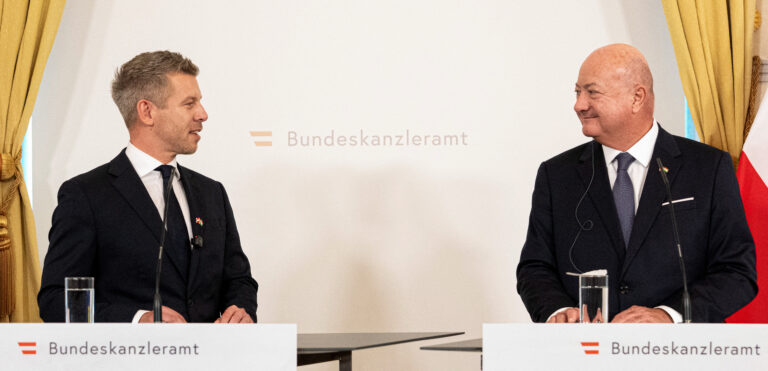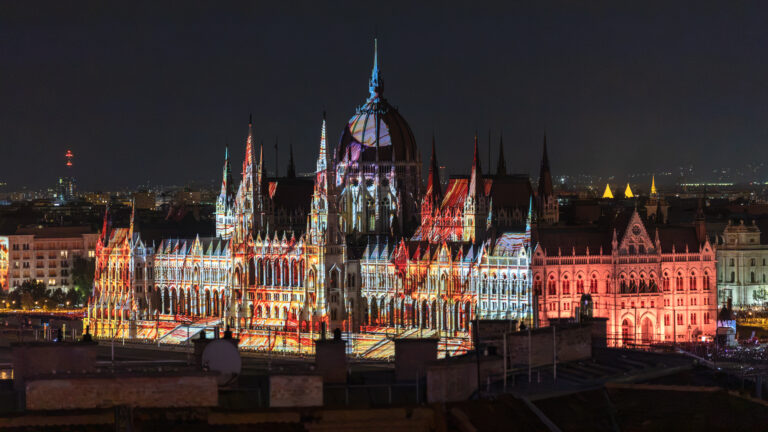
Day 2 of the tenth annual Balkans Budapest Forum, hosted by the Hungarian Institute of International Affairs (HIIA), continued at the Kempinski Hotel Corvinus in Budapest, Hungary on Tuesday, 10 March. Director of External Relations at HIIA Ákos Mernyei was first on stage for the day.
Mr Mernyei started by sharing that he was there for the inception of this very event series ten years ago, and the concept behind it was to create something ‘more enduring’ than a conference dedicated to a timely topic. Now, he stated, the Budapest Balkans Forum is one of the most important meetings of public figures to discuss all matters related to the Western Balkan region.
He then went on to describe the current geopolitical landscape as ‘increasingly multipolar,’ where ‘security and connectivity matter more than ever’. On the issue of the Western Balkan nations’ accession to the EU, Mr Mernyei warned the EU that in this day and age, ‘hesitation has its geopolitical risks’.
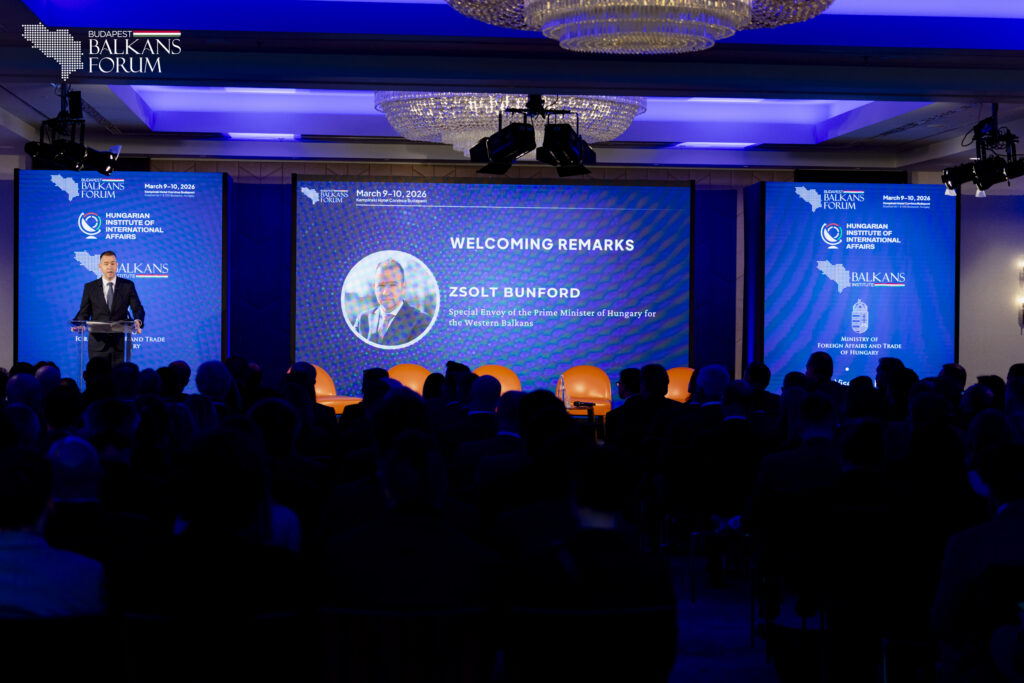
Zsolt Bunford, Special Envoy of the Prime Minister of Hungary for the Western Balkans, followed. He too lauded the Forum’s importance, and shared that the idea originated from the Ministry of Foreign Affairs and Trade of Hungary in 2017. He also stated that the event has a clear message: the Western Balkans belong in the European Union.
Staying on the topic of EU enlargement, Mr Bunford said that the pendulum has been swinging throughout the Union’s history, with periods of slow and fast enlargement. In 2004, for instance, 10 countries joined the EU, including Hungary. Today, however, we are in a slow enlargement period, with the last nation to join the Union being Croatia in 2013. Mr Bunford told the audience that today, Montenegro and Albania are closer than ever to EU accession.
Minister for European Union Affairs János Bóka of Hungary spoke next, declaring that ‘EU enlargement is at a crossroads’. As he explained, in December 2025, the European Council wrote in its conclusion that it views the EU enlargement as a ‘geostrategic investment in peace, security, stability, and prosperity’. He compared that official viewpoint with that of the Thessaloniki Agenda in 2003, which prioratized the Western Balkans in its enlargement strategy.
Meanwhile, as the speaker pointed out, the EU’s enlargement ambitions today focus on Ukraine. He criticized this approach to accession as one ‘tailor-made for Ukraine’, and warned that the Eastern European country will live under the threat of war and will require substantial financial assistance from Brussels for the foreseeable future.
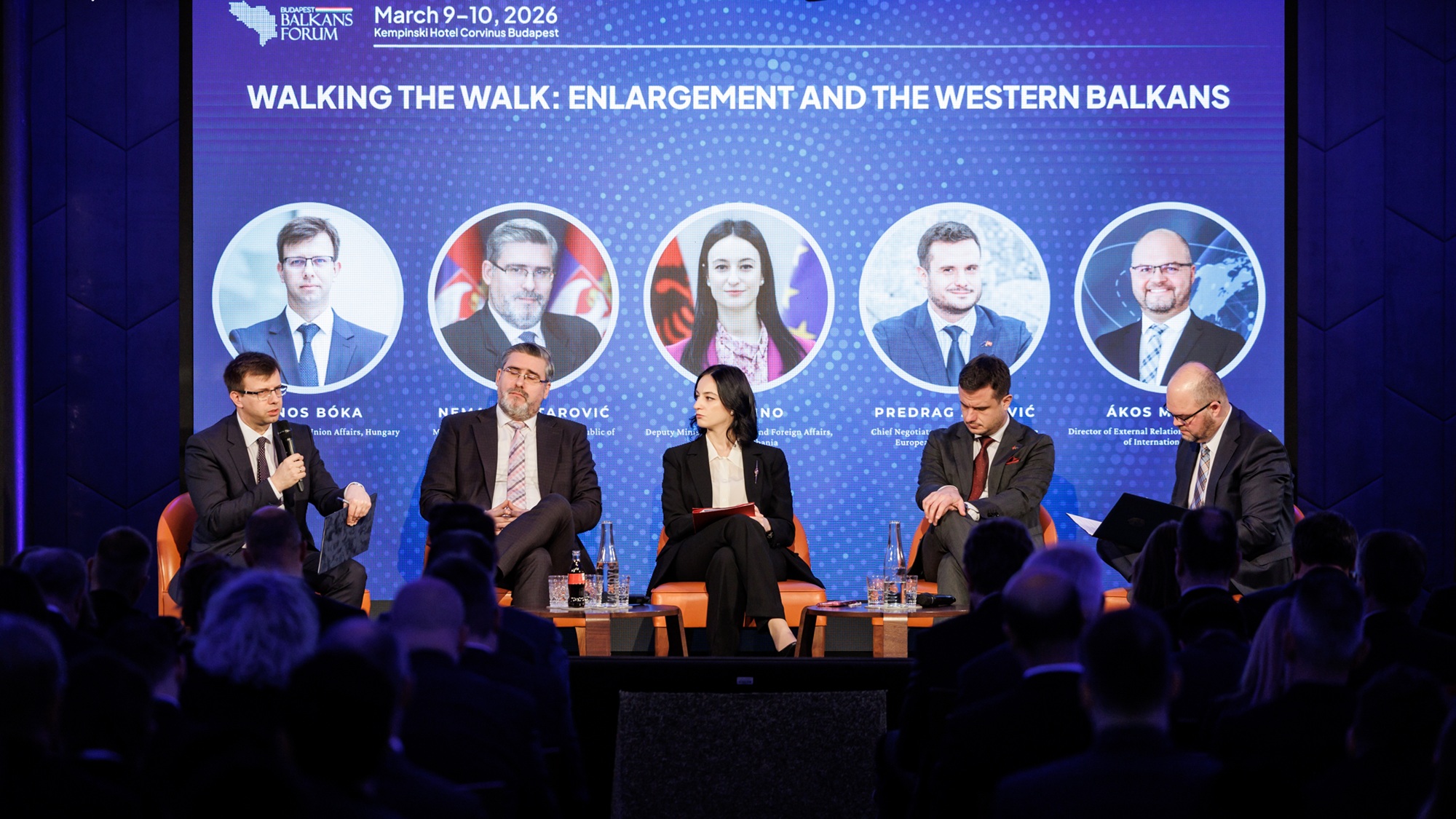
Minister Bóka was joined on stage by Minister of European Integration Nemanja Starović of Serbia, Deputy Minister of Europe and Foreign Affairs Megi Fino of Albania, and Chief Negotiator for Montenegro with the European Union Predrag Zenović for an insightful panel discussion. Mr Mernyei of HIIA took on the role of the moderator.
Mr Zenović kicked off the discussion by sharing that his home country of Montenegro started negotiations about accession with Brussels back in 2012; however, the public will to join the EU and integrate into Europe has been present in the country even before. He described the European Union as ‘a unity of political values without comparison in the world’. He also proudly told the audience that Montenegro has met the accession criteria in the EU’s strictest category, the rule of law. As things stand now, the Balkan nation is hoping ot become a full-fledged Member State by the end of 2028. This intention is denoted by the slogan ’28 by ’28’, meaning that Montenegro wants to become the 28th Member State of the Union by the year 2028.
Ms Fino said that joining the EU has been a ‘national mission’ for her home country of Albania for over three decades; and pointed out the fitting nature of the title of the panel, ‘Walking the Walk’, as the EU accession process is indeed a walk, not a sprint, she quipped. As for the obstacles of that process, the speaker shared that they tend to be technical on Albania’s part and political for the EU’s part.
Mr Starović stated that, in his observation, the political accession process has trumped the merit-based accession process in Brussels lately. However, he also noted that it is a very unequal relationship between the EU and Serbia, and his country has no leverage to change the stance of Brussels on that matter. He went on to state that by far the most prominent reason Serbia wants to join the Union is ‘the four freedoms’: freedom of movement of people, goods, services, and capital within the Member States.
Taking back the word, Minister Bóka stated that issues of EU enlargement have always been political, even in the case of the accession of Hungary back in 2004. If the EU has the political will to have a new Member State join, he explained, the process becomes purely technical.
Related articles:
At a time when public debate is increasingly polarized and superficial, Hungarian Conservative remains committed to depth, intellectual honesty, and independent conservative thought.
Producing high-quality journalism requires resources. Your contribution helps us expand our coverage, reach new audiences, and keep our content accessible.
Please consider supporting our mission.