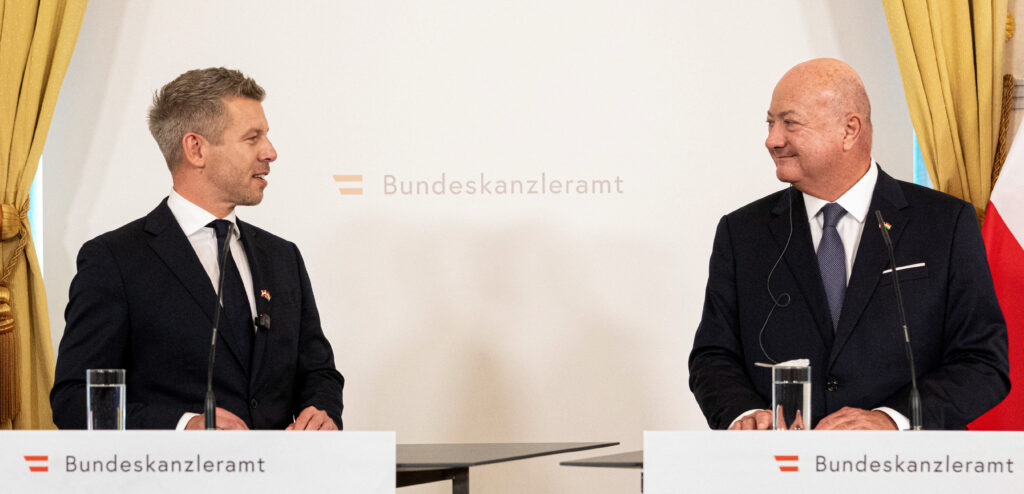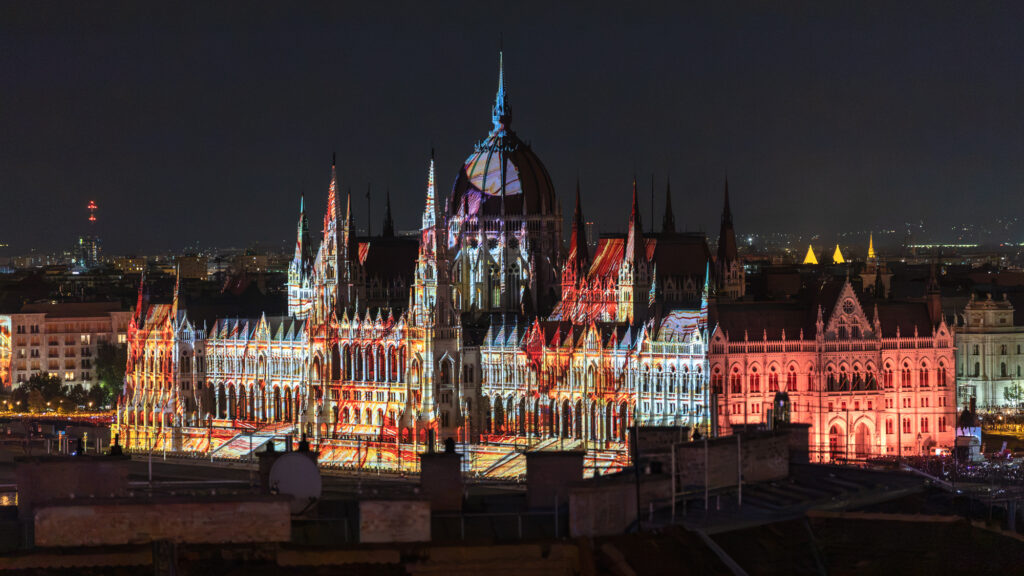
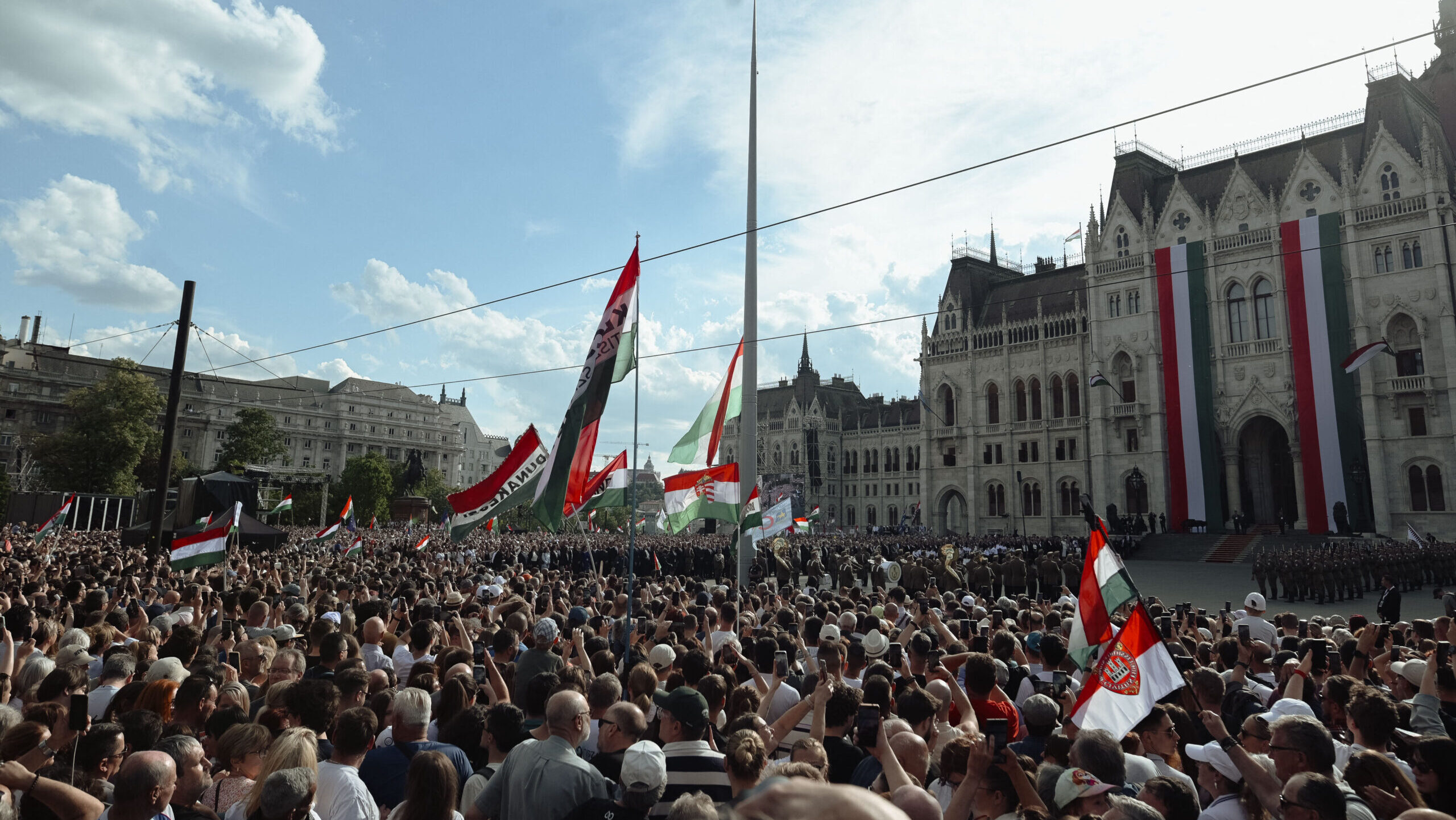
Hungary experienced one of the most memorable government transitions in its modern political history on Saturday, 9 May, as the newly elected National Assembly held its inaugural session, marking the end of Viktor Orbán and Fidesz–KDNP’s 16 years in power following the Tisza Party’s landslide victory in the 12 April election.
The inaugural session of the new parliament—in which Tisza holds a constitutional supermajority with 141 mandates, Fidesz–KDNP has been pushed into opposition with 52 seats, and the hard-right Our Homeland (Mi Hazánk) is the only other party to cross the parliamentary threshold with six mandates—was historic in several respects. In the following article, we gather the top five moments of 9 May.
Péter Magyar Gives Ultimatum to President Sulyok
After being sworn in as the ninth prime minister in Hungary’s post-communist history, Péter Magyar addressed the new parliament in an hour-long speech. Much of the address focused on restoring the rule of law in Hungary and was directed explicitly at what he described as the old elite, many of whom were sitting in the chamber.
The most tense moment came when Magyar turned towards President Tamás Sulyok and called on public officials linked to the Orbán era to ‘resign today’.
‘Here and now, in the house of Hungarian democracy, I call upon those public officials who served the previous regime to resign today, or by 31 May at the latest. Tamás Sulyok should be the first to do so,’ Magyar said, looking directly at the president. ‘It is time to leave, while you still can,’ he added.
Continuing his speech, Magyar declared that if Sulyok did not voluntarily resign, the new parliament would initiate formal impeachment proceedings against him as early as this week. In the Hungarian political system, impeachment is one of the most extreme constitutional tools available for removing a sitting head of state. The process can begin only if at least one-fifth of MPs propose it and two-thirds of parliament approve the motion by secret ballot, after which the Constitutional Court—not parliament itself—decides whether the president violated the Fundamental Law or committed an intentional criminal offence warranting removal from office.
Such a move would be unprecedented in modern Hungarian political history.
During Magyar’s remarks directed at him, President Sulyok was seen smiling and nodding. Although the president did not respond directly during the session, his own opening address—delivered before Magyar’s speech—was widely interpreted as a political message aimed at the Tisza Party. Sulyok emphasized that ‘all power can only be understood within the framework of rule of law’ and that ‘legal certainty is a value that we must preserve under all circumstances’. Many analysts interpreted the speech as a veiled warning to the incoming government to respect constitutional limits.
Orbán Skips His Final Parliamentary Address
What did not happen on Saturday, however, was the traditional farewell speech by the outgoing prime minister. In fact, Viktor Orbán did not attend the inaugural session at all, breaking with more than three decades of Hungarian political tradition.
Although neither the Fundamental Law nor any statute requires it, every outgoing head of government since 1990 has attended and delivered a speech during parliamentary transitions—from Miklós Németh and Péter Boross to Gyula Horn and Orbán himself in 2002, all the way to Gordon Bajnai.
Orbán announced after the electoral defeat that he would not take up his parliamentary mandate, ending a 36-year career in parliament spent both in opposition and government. He justified the decision by arguing that he was ‘not needed in parliament’, but rather in the ‘reorganization efforts’ of Fidesz, portraying himself more as a movement figure than a conventional opposition leader.
Analysts had already argued at the time that Orbán was also seeking to avoid being drawn into politically uncomfortable parliamentary confrontations, thereby protecting what remained of his political myth following the 12 April defeat. His decision to skip what would have been his final parliamentary address can also be interpreted through that lens, avoiding the symbolic image of personally handing over power to Péter Magyar in front of the country.
Orbán also skipped his final European Council meeting following the election defeat.
Hard-Right Walkout
The Tisza Party placed strong emphasis on symbolism during the inaugural session, as reflected in the number of hymns played during the ceremony. Besides the traditional Hungarian national anthem, the Szekler anthem, the Roma anthem, and the ‘Ode to Joy’—widely regarded as the anthem of the European Union—were also performed, sparking controversy before and after the event.
The parliamentary group of Our Homeland announced in advance that it would walk out after the Hungarian and Szekler anthems in protest against the inclusion of the EU and Roma anthems at a national ceremony. MPs from the party intended to proceed to the hall where the Holy Crown is displayed, where, according to a prior agreement among parliamentary parties, MPs were expected to take their oath.
However, Tisza reportedly altered the session agenda at the last moment without informing opposition parties, resulting in Our Homeland MPs leaving the chamber precisely as the Sükösd Roma Child Choir entered to perform the Roma anthem.
A Mi Hazánk Mozgalom a leghatározottabban visszautasítja a 100 Tagú Cigányzenekar közleményében szereplő hazug rágalmat! Természetesen nem a Sükösdi Danubia Tamburazenekar miatt, és főleg nem a gyermekek származása miatt vonultunk ki az Országgyűlés alakuló ülésének végén.
— Toroczkai László (@ToroczkaiLaszlo) May 10, 2026
Ahogy… pic.twitter.com/tdtwKpbu3z
Magyar immediately seized on the moment politically, declaring that ‘anyone who fears children, music, and the nation’s diversity is not showing strength, but cowardice.’ He added that the walkout ‘was not directed against the Roma anthem or the European anthem, but against the Hungarian people.’
Our Homeland leader László Toroczkai responded in a lengthy post on X, firmly rejecting accusations that the party had protested against children or Roma performers. He argued that the walkout had been announced beforehand and was specifically directed against the performance of the EU anthem, reflecting the party’s opposition to a federalized ‘United States of Europe’.
Toroczkai also accused Tisza of transforming the inaugural session into a partisan political event by incorporating campaign-style musical elements. He claimed the schedule had been deliberately changed so that children would enter the chamber precisely during the party’s walkout, calling the move ‘dishonest’ and contrary to parliamentary convention. He also published what he said was the original session agenda in support of his claim.
Public Celebration at Parliament
Following the inaugural session, Kossuth Square turned into a large-scale public celebration organized by the Tisza Party, with thousands gathering outside parliament for speeches, concerts, and live screenings.
Supporters described the atmosphere as historic and emotionally charged, with Péter Magyar later addressing the crowd and calling the day ‘the first day of a free democratic Hungary’. The performers included Oláh Ibolya, Ferenc Molnár Caramel, and Gábor Presser. According to reports, Kossuth Square was completely packed by the evening, making the event one of the largest political–cultural gatherings in recent Hungarian history.
Mr Hegedus, the new health minister in post-Orbán Hungary, and a former NHS surgeon, re-enacted the dance routine that had already turned him into an international internet hit
— The Telegraph (@Telegraph) May 11, 2026
Find out more about him ⤵️https://t.co/eyE5qCMpWM pic.twitter.com/zWGNKcYufG
One of the most viral moments of the celebration involved incoming Minister of Health Zsolt Hegedűs performing his now-iconic dance moves, which had already made him one of the most recognizable members of the incoming government following election night. Clips of Hegedűs dancing spread rapidly across social media after Saturday’s event as well, with British outlet The Telegraph reportedly describing him as an ‘international internet hit’.
Critics, however, argued that dancing on the steps of parliament made him appear ‘unserious’ and questioned whether a future minister should behave ‘like a party entertainer’ on the very day a new government was formed.
DJ Péter Magyar
Besides Zsolt Hegedűs, Prime Minister Péter Magyar also went viral after several videos showed him partying and briefly taking over a DJ booth later that evening.
One particular video attracted special attention, showing Magyar sitting in one of the windows of the parliament building with his feet resting on the windowsill, apparently smoking and drinking.
The footage triggered sharp criticism from Fidesz-linked commentators, who described the scenes as ‘disgraceful’, ‘undignified’, and even likened the atmosphere to a ‘brothel’.
Így gyalázta meg Magyar Péter a Parlamentet... 💩🤡 pic.twitter.com/aK7DCGwGNw
— Vadhajtások.hu (@VadhajtasokHu) May 10, 2026
Critics argued that Magyar had brought a ‘college party atmosphere’ into the Hungarian Parliament and claimed the behaviour was incompatible with the dignity expected of a prime minister and the symbolic importance of the National Assembly. Several commentators also highlighted what they viewed as a contradiction between Magyar paying tribute to the Holy Crown earlier in the day and later behaving disrespectfully inside one of the central symbols of Hungarian statehood.
Supporters of Magyar, however, dismissed the outrage as politically motivated and exaggerated, arguing that the footage merely captured an informal late-night celebration following one of the most emotional political transitions in modern Hungarian history. Several Tisza supporters defended the scenes on social media as a spontaneous human moment after a historic victory and contrasted the criticism with what they described as far more serious scandals during the Orbán governments.
Related articles:
At a time when public debate is increasingly polarized and superficial, Hungarian Conservative remains committed to depth, intellectual honesty, and independent conservative thought.
Producing high-quality journalism requires resources. Your contribution helps us expand our coverage, reach new audiences, and keep our content accessible.

Please consider supporting our mission.