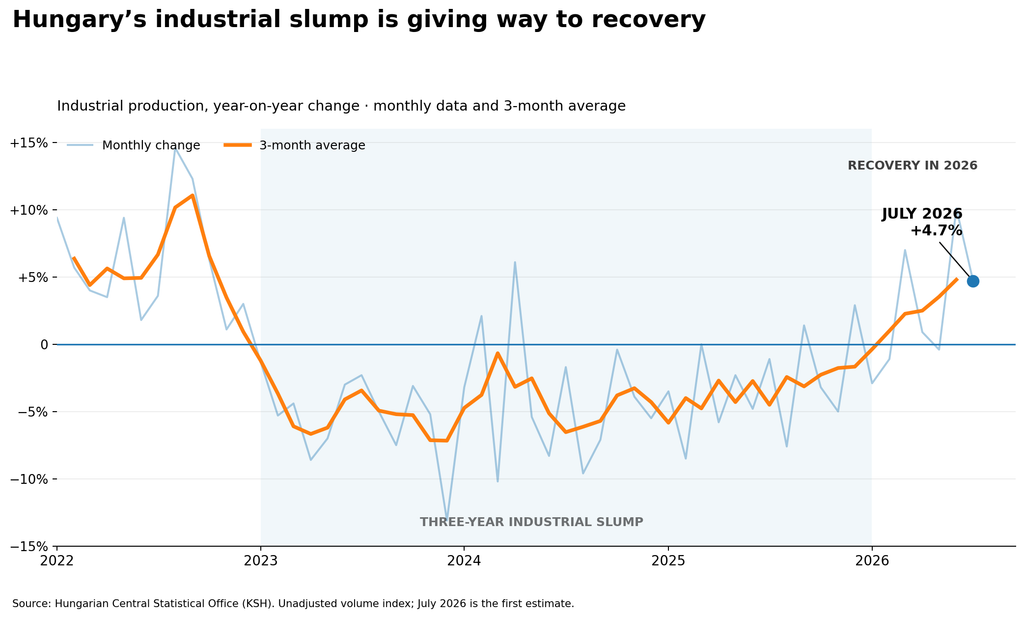
Hungary’s industrial recovery continued in July, strengthening expectations that manufacturing could again become a meaningful contributor to economic growth after three years of contraction, although analysts warned that August is likely to bring another setback.
Industrial production rose 4.7 per cent year on year in July, both on an unadjusted and working-day-adjusted basis, the Hungarian Central Statistical Office (KSH) said on Monday, 7 September. Output was also 1.7 per cent higher than in June on a seasonally and working-day-adjusted basis. Production in the first seven months of 2026 was 2.7 per cent above the same period last year.
The rebound remains highly concentrated. KSH said output fell year on year in most manufacturing subsectors, but increased in the two heavyweight areas of transport equipment and computer, electronic, and optical products. Electrical equipment—a category including battery manufacturing—and food, beverages, and tobacco contracted.
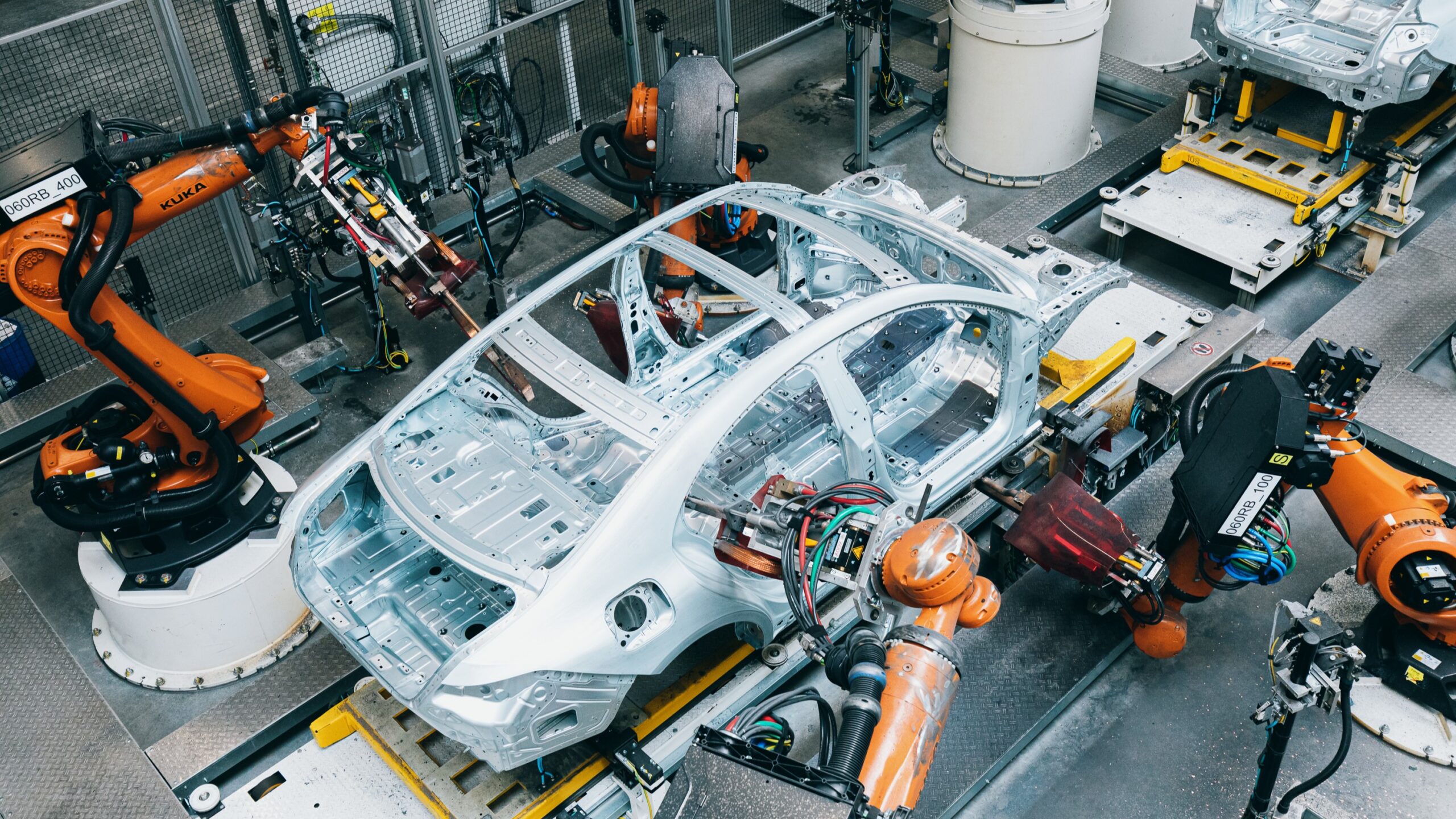
Analysts say the improvement is increasingly being driven by new export capacity rather than a broad-based recovery. BMW’s new Debrecen plant, which began series production of the Neue Klasse iX3 in late 2025, produced its 50,000th car by 28 July. Mercedes-Benz, meanwhile, inaugurated expanded facilities in Kecskemét on 13 July after a €1 billion investment that raised annual capacity to 350,000 vehicles.
At the same time, Hungary’s electronics sector has benefited from the global AI investment boom, including rapidly expanding server and data-centre equipment production at Foxconn-owned Cloud Network Technology in Komárom.
Péter Virovácz, chief economist at ING Bank, said the familiar ‘saw-tooth’ pattern in monthly production was continuing, but around an improving trend. He expects a ‘rather poor’ August, followed by another correction in September, while forecasting industrial growth of around 3–4 per cent for 2026 as a whole.
Gábor Regős, chief economist at Gránit Asset Management, likewise warned that August could be hit by the partial shutdown of the Paks nuclear power plant and associated voluntary production restraints, potentially shaving several percentage points off monthly output. Erste Bank senior macroeconomic analyst Orsolya Nyeste said the damage could be smaller if factories aligned energy-saving measures with their usual summer maintenance shutdowns.
Hungary is also outperforming the wider EU industrial cycle. The latest comparable Eurostat data are for June: EU industrial production rose just 0.6 per cent year on year, while Hungary’s working-day-adjusted output increased 4.1 per cent. The next date to watch in this context is 15 September, when KSH will publish its second, detailed estimate for July industrial production, including subsector, sales, export, regional, and order-book data.
Related articles:
At a time when public debate is increasingly polarized and superficial, Hungarian Conservative remains committed to depth, intellectual honesty, and independent conservative thought.
Producing high-quality journalism requires resources. Your contribution helps us expand our coverage, reach new audiences, and keep our content accessible.

Please consider supporting our mission.