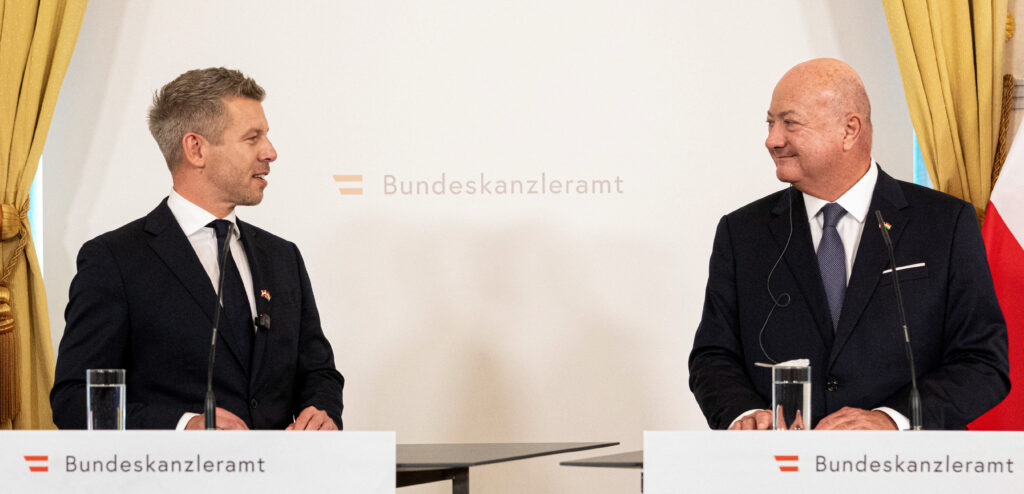

Prime Minister Péter Magyar said his government has extended the ‘state of crisis due to mass migration’ until the end of the year, rejecting calls from human-rights NGOs to let the measure expire and complicating one potential legal route towards ending the country’s €1 million-per-day migration-related EU fine, which is approaching a cumulative €1 billion.
Magyar announced on Friday evening that the migration-specific emergency regime, which was due to expire on 7 September, will instead remain in force until 31 December 2026. First introduced on 15 September 2015 by former prime minister Viktor Orbán’s government at the height of the migration crisis, the measure has remained in force in various forms for almost 11 years.
‘The Tisza government will not loosen the legal framework against illegal migration,’ Magyar said, arguing that recent events in Ceuta, Spain’s North African enclave, had demonstrated how even small legal changes could create dangerous gaps in the protection of Europe’s external borders. The extension was also published in the official Hungarian Gazette.
The decision came only a day after Magyar outlined his government’s efforts to stop the EU penalty while keeping Hungary’s restrictive border system intact. As Hungarian Conservative reported, one possible route being discussed between Budapest and Brussels involved allowing temporary migration measures—including the state of crisis—to expire, thereby removing part of the legal framework behind Hungary’s continuing non-compliance with earlier Court of Justice rulings.
Magyar has now ruled out that option, at least for the next four months. The prime minister pointed directly to this summer’s migration crisis in Ceuta to justify the move. He argued that the Spanish Supreme Court’s ruling prohibiting immediate pushbacks for sea arrivals was rapidly exploited by migrant-smuggling networks, demonstrating how quickly routes can shift once a legal weakness becomes known.
‘The prime minister pointed directly to this summer’s migration crisis in Ceuta to justify the move’
‘A single legal gap, a poorly prepared change can create an unmanageable situation in a very short time,’ Magyar said. ‘The Hungarian government cannot take such a risk.’ Foreign Minister Anita Orbán similarly stressed that Europe must not create the impression that illegal entry can eventually lead to legal residence.
The extension of the Orbán-era state of crisis put the government directly at odds with the same NGO network that Fidesz fought against over the past ten years on illegal migration and human rights. Hours before Magyar’s announcement, the Hungarian Helsinki Committee argued that the migration crisis regime should be allowed to expire, claiming that its legal basis ‘no longer exists’.
The organization rejected the government’s implication that ending the measure would weaken border security. ‘The termination of the state of crisis would not mean abandoning border protection,’ it said, stressing that neither dismantling the fence nor allowing uncontrolled entry would be required. Instead, Helsinki argued, Hungary could return to what it described as lawful individual asylum and immigration procedures.
Human-rights NGOs had already confronted the new government back in June, accusing Prime Minister Magyar of retaining what they described as ‘Orbán-era rhetoric’ towards migrants and asylum seekers.
Friday’s decision also triggered visible criticism among parts of Magyar’s more progressive online supporter base. Online commenters pointed to the government’s continuation of ‘Orbánism’ by extending the state of crisis, calling Tisza ‘Fidesz 2.0’. Anita Orbán’s post about the extension was also flooded with comments from outraged supporters, who accused the foreign minister of using rhetoric similar to that of Fidesz.
Hungary continues to lose €1 million every day for failing to fully comply with the CJEU’s December 2020 judgment. The ruling found that Hungary had unlawfully restricted access to asylum procedures, failed to guarantee applicants’ right to remain during certain appeals, and removed illegally staying third-country nationals without the safeguards required under EU return law. The accumulated loss is approaching €1 billion, on top of the €200 million lump-sum penalty imposed in June 2024.
Magyar maintains that Orbán presented Hungary with a false choice between obeying EU law and protecting the border. His government, he said on Friday, intends to use the period until December to negotiate a new system with European institutions that preserves the southern fence and strong enforcement powers while finally bringing Hungary into compliance and stopping the penalty.
Speaking on Thursday, before the extension of the state of crisis, Commission spokesperson Markus Lammert said Brussels was engaging ‘closely’ with Budapest over the fine, adding that ‘it’s for Hungary and the court to see what can be done.’
Related articles:
At a time when public debate is increasingly polarized and superficial, Hungarian Conservative remains committed to depth, intellectual honesty, and independent conservative thought.
Producing high-quality journalism requires resources. Your contribution helps us expand our coverage, reach new audiences, and keep our content accessible.

Please consider supporting our mission.